

A new study shows that intense radiation from quasars can make planets uninhabitable.
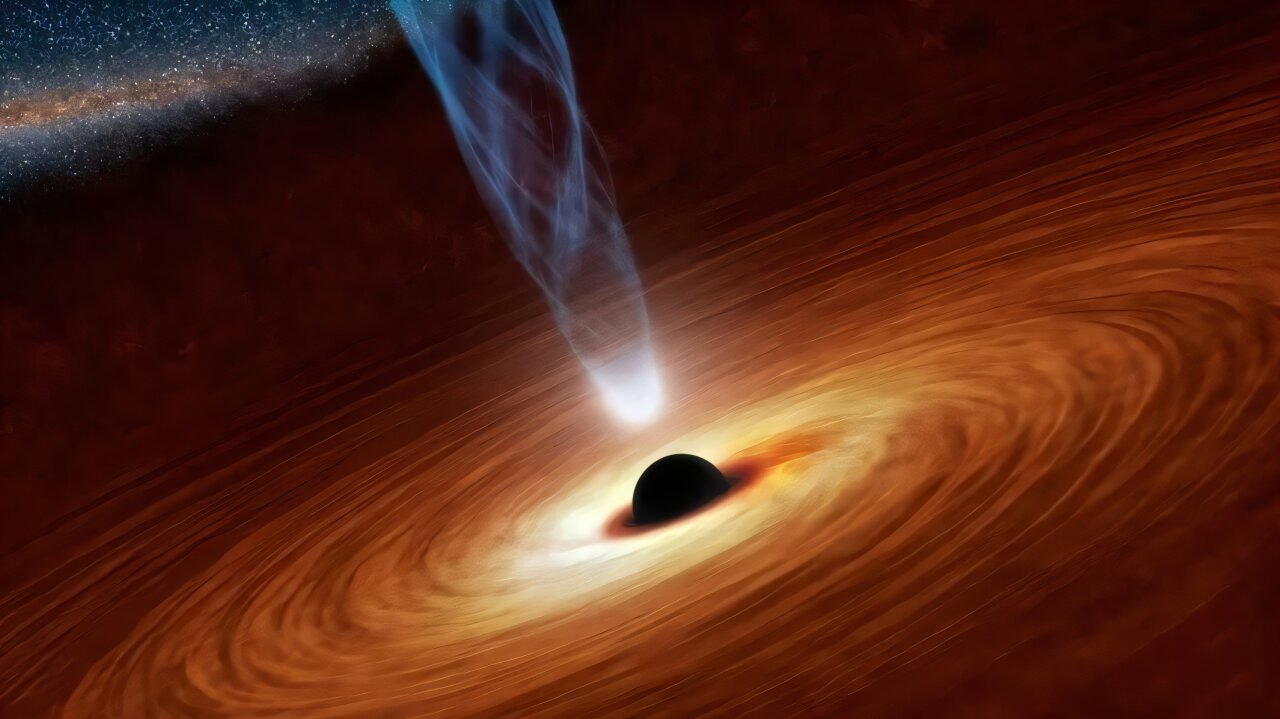
How do supermassive black holes affect the habitability of exoplanets?
Discussions about the habitability of exoplanets mainly focus on the planet’s distance from its star. If it is too close, any water on the surface evaporates into space. If it is too far, the water on the surface freezes. Both factors pose serious limitations on the possibility of life. Habitability depends on whether the exoplanet is located in the Goldilocks zone, the distance from the star where liquid water can exist.
But what about the broader context? Even if an exoplanet is located in its star’s habitable zone, other factors may rule out the possibility of life. If the Solar System is too close to a supermassive black hole (SMBH)—which likely resides at the center of all large galaxies—then it won’t matter how close the planet is to its star. The overwhelming force of the SMBH will make habitability virtually impossible.
A new study published in The Astrophysical Journal examines the role of supermassive black holes in the habitability of exoplanets. It is titled “The Impact of Supermassive Black Holes on Exoplanet Habitability. I. Spanning the Natural Mass Range.” The lead author is Jourdan Waas, who works in the Department of Aerospace, Physical, and Space Sciences at the Florida Institute of Technology.
Supernovae have long attracted the attention of researchers because of their significant implications for the habitability of planets. They emit powerful radiation capable of sterilizing a planet, as well as shock waves that can strip away atmospheres or even completely destroy exoplanets. This is precisely why researchers are wondering how habitable the densely populated bulge of the Milky Way might be, given the large number of supernova explosions in this star-rich environment.
Ultra-fast outbursts from active galactic nuclei
But supernovae are not the only high-energy astrophysical phenomena. An actively feeding supermassive black hole is called an active galactic nucleus (AGN), and while a supernova releases an enormous amount of energy in a short period of time, an AGN can be much more energetic on a continuous basis. “A clear understanding of the many roles that supermassive black holes play in galactic habitability would help pave the way for assessing the prospects for extraterrestrial habitability and life in the Universe, the authors write.”
Supermassive black holes are, of course, extremely massive. They can be billions of times more massive than the Sun. And, of course, they are not inert. They possess immense gravitational force and emit tremendous amounts of energy when active. How do these massive, dynamic objects affect the habitability of exoplanets? As we know, habitability requires an atmosphere, and the atmosphere of an exoplanet is barely a speck compared to an active galactic nucleus and its winds.
“While the influence of supermassive black hole (SMBH) activity on habitability has garnered attention, the specific effects of active galactic nucleus (AGN) winds, particularly ultrafast outflows (UFOs), on planetary atmospheres remain largely unexplored,” the authors write. This study examines the relationship between the mass of the host star, ultra-fast outbursts, and the habitability of exoplanets. “Through simplified models, we account for various results involving the relationships between the distance from the planet to the central SMBH and the mass of the SMBH,” they say.
The overall results will come as no surprise. The researchers show that the more massive the central supermassive black hole, the faster the exoplanets lose mass through their atmospheres, and the less habitable they become. Researchers claim that an increase in the mass of a supermassive black hole leads to greater heating of the atmosphere and higher temperatures, higher molecular thermal velocities, and increased mass loss. All of these effects diminish with distance from the center of the galaxy.
Two types of solar winds and how they work
Active galactic nuclei generate winds that act as a feedback mechanism on their host galaxies. Researchers have studied two types of winds originating from AGNs and their impact on the atmospheres of exoplanets. These two types are energy-driven and momentum-driven.
AGN outflows begin as fast, small-scale winds. They originate in the accretion disk and propagate outward, eventually colliding with the interstellar medium. At this stage, the system evolves into a two-shock system.
One shock front is a reverse shock, which acts to slow down the wind. The other is a forward shock, which compresses the surrounding interstellar medium (ISM). What happens at the reverse shock determines whether the wind will be energy-driven or momentum-driven.
If the wind cools sufficiently, it cannot expand. In this case, it does not transfer energy, only momentum, and acts as a wind driven by momentum. The flow does not propagate effectively and has a more limited impact on the galaxy.
If the wind isn’t cooled enough, the gas retains its energy and behaves like an expanding bubble. This is a wind driven by energy, and it is much more effective at expelling gas from the galaxy. It is also more effective at heating the atmospheres of exoplanets.
Ozone depletion in exoplanet atmospheres
The researchers also studied ozone depletion. Stellar flares produce energetic particles that can form nitrogen oxides capable of destroying ozone on Earth. “Given their extreme velocities, it is worth examining whether AGN winds, particularly UFOs with velocities ∼ 0.1c and postshock speeds of O(1000) km s−1, may contribute to ozone depletion in atmospheres similar to Earth’s,” the authors write.
They found that ozone destruction increases with the mass of the black hole and the proximity to the AGN. More massive black holes produce stronger AGN winds and more nitrogen oxides, resulting in greater ozone destruction. In their models, ozone destruction decreases with distance from the AGN. “Winds driven by energy cause slightly more destruction than those driven by momentum,” the researchers explain.
Crucially, ozone depletion is shown to rise with SMBH mass and decrease with distance from the galactic center, with nearly complete ozone loss (∼100%) occurring across galactic scales for SMBH masses ≥ 108 M⊙ in the energy-driven case. This indicates that significant ozone loss occurs in most of the galaxy’s inner regions. This suggests that near-total ozone depletion may be the most universal and widespread atmospheric consequence of AGN winds.
The depletion of the ozone layer does not necessarily render the planet uninhabitable. However, it could limit life in the oceans. Life on Earth only moved onto land after oxygen had accumulated in the atmosphere and ozone had formed to protect organisms from ultraviolet radiation.
Black holes affect habitability, particularly due to the destruction of atmospheres
Overall, the study shows that energy-driven ultrafast AGN outbursts (UFOs) heat exoplanet atmospheres more effectively than momentum-driven winds. This accelerates atmospheric molecules to escape velocity, stripping away the atmosphere. AGNs can also produce nitrogen oxides, which can destroy ozone. The more massive the black hole, the greater the effect.
Moreover, the effect may extend over vast distances from the center of the galaxy. “These simulations suggest that, for the most massive SMBHs, the effective region of influence extends well beyond the inner galaxy and potentially includes the galactic halo in the energy-driven scenario,” the authors write. This could be detrimental to habitability. However, the authors also explain that if the interstellar medium is dense, it could reduce the affected area—but only for winds, not for ozone loss caused by particles.
Previous studies have shown that certain regions of the Milky Way make exoplanet atmospheres vulnerable to destruction. Atmospheric photoevaporation caused by XUV radiation in the galactic bulge poses a serious obstacle to life. “However, these results suggest that ‘…winds from active galactic nuclei can influence planetary environments at much larger galactocentric radii than UV or XUV radiation alone,’” the authors say.
Future studies should investigate the combined effects of AGN winds and radiation. “Since our current model does not account for radiative effects, the combined impact of winds and high-energy radiation on the galactic habitable zone should be investigated in future studies,” the authors explain.
According to phys.org

