

Two new exciting photographs show in detail catastrophic star explosions known as novae. These images, captured by powerful telescopes, have allowed scientists to see the early stages of these powerful cosmic cataclysms in detail for the first time, revealing the incredible complexity of a phenomenon that was previously thought to be simply a bright flash. The study is published in Nature Astronomy.
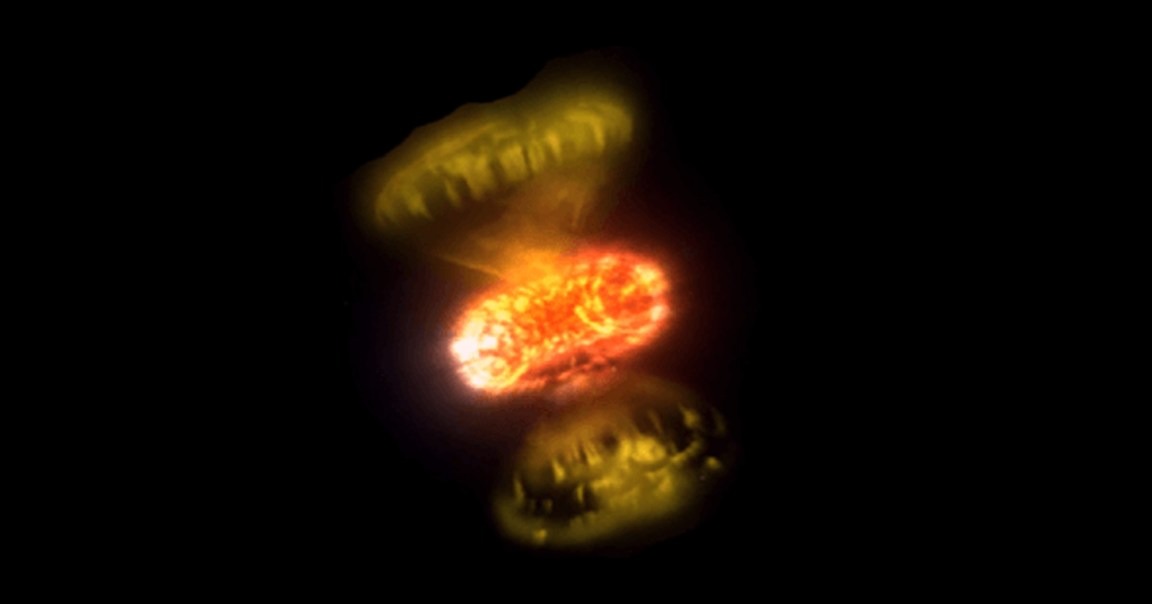
What is a nova?
A nova is a giant thermonuclear explosion on the surface of a white dwarf — the dense core of a star similar to our Sun. It occurs when the dwarf greedily absorbs matter (mainly hydrogen) from a neighboring companion star. When the absorbed hydrogen reaches a critical mass and temperature, a powerful thermonuclear fusion occurs. In terms of power, it resembles a super-powerful hydrogen bomb that emits energy equal to that produced by the Sun in 100,000 years, but it is released in a fraction of a second.
Unveiled secret
For a long time, astronomers saw novae as nothing more than bright points of light. The breakthrough was made possible by the CHARA Array interferometer and other observatories. By combining their data, scientists created a virtual giant telescope capable of seeing the details of the explosion.
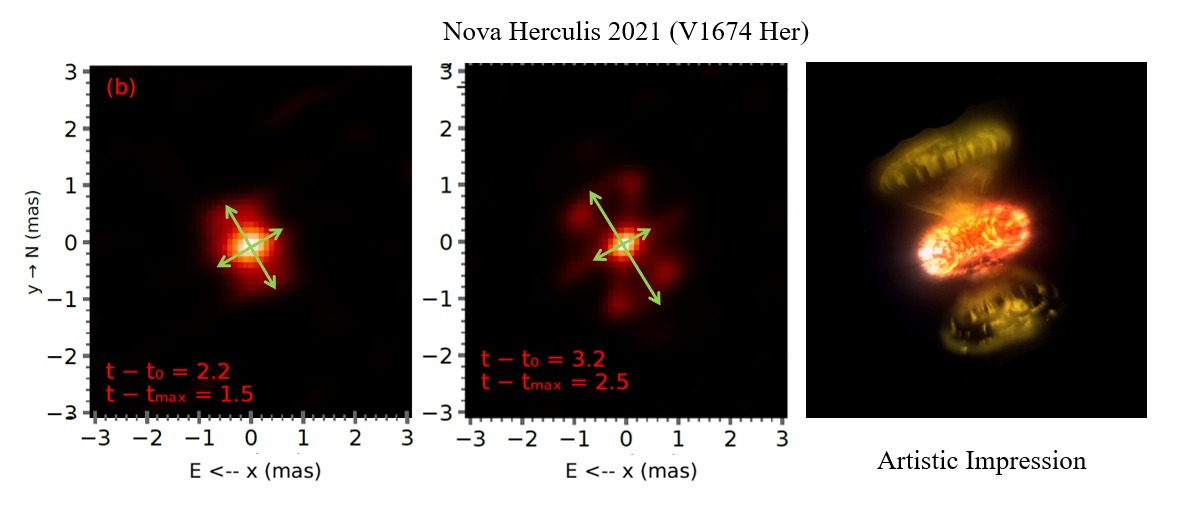
“We are beginning to uncover how complex this phenomenon is,” says lead author Elias Aydi of Texas Tech University.
Two novae – two different scenarios
The study showed that novae are far from uniform.
- V1674 Hercules is the fastest known nova. Its brightness faded in just a few days. Images revealed two separate gas ejections that collided. Unusually, these ejections emitted powerful gamma rays, which are usually associated with black holes.
- V1405 Cassiopeia developed in the opposite way – slowly, over more than 50 days. A double shell of ejected material formed around the white dwarf, enveloping both stars. When the shell dispersed, another gamma-ray burst occurred.
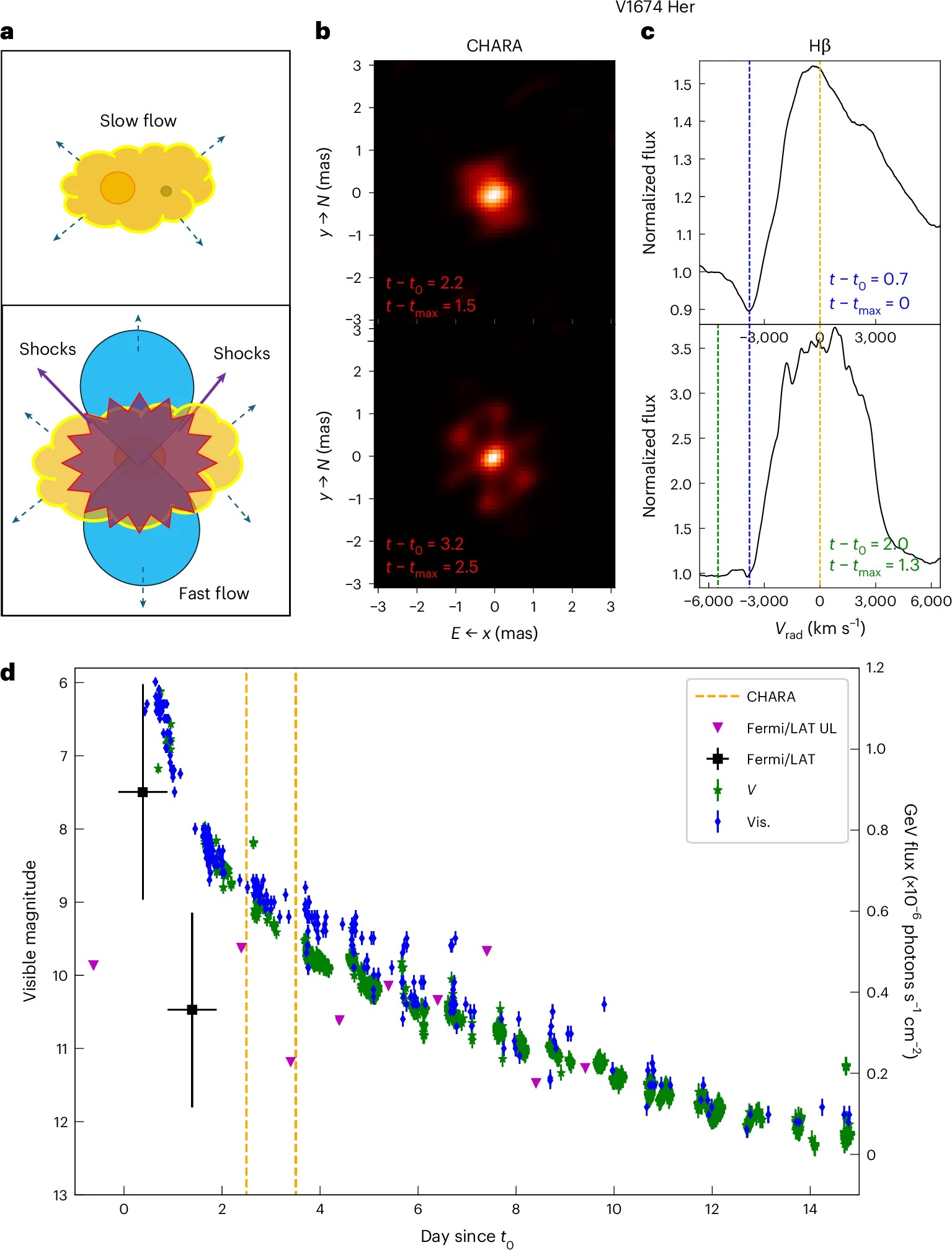
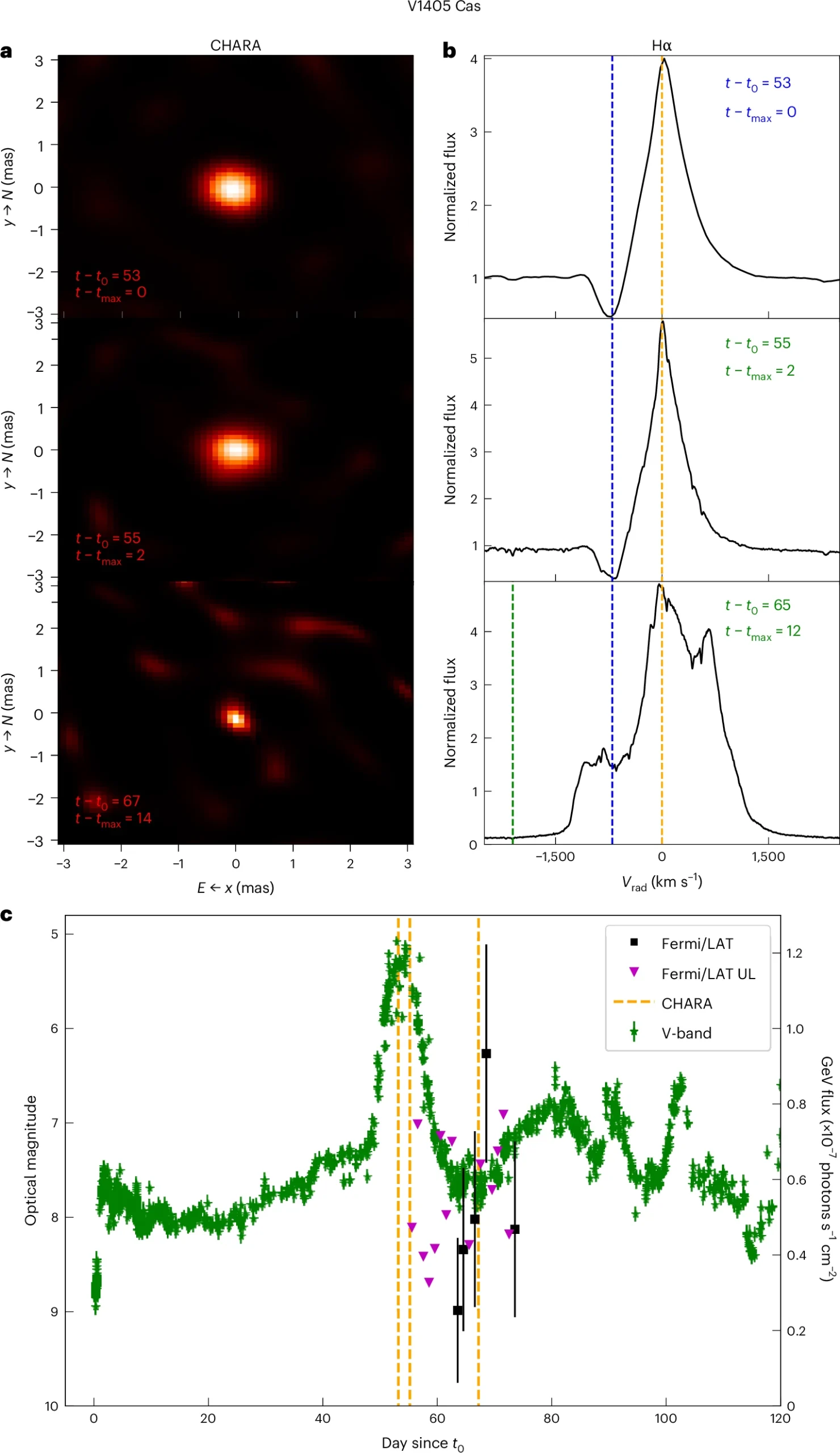
The detection of gamma radiation in both cases is a key discovery. It reveals a connection between nuclear processes on the star, the geometry of the ejections, and powerful radiation in space.
“New stars are laboratories for extreme physics,” emphasizes Professor Laura Chomiuk. These observations radically change our understanding of these phenomena, opening up new horizons in the study of the Universe.
Earlier, we reported on how astronomers accidentally discovered the most powerful explosions in the Universe.
According to gsu.edu

