

Galaxies, like cosmic predators, constantly devour their smaller neighbors. Even our Milky Way is currently slowly consuming the Magellanic Clouds. But how does this happen? New scientific work on the Andromeda Galaxy (M31) reveals dramatic details of this process — “suppression,” when small galaxies lose the fuel for new star formation.
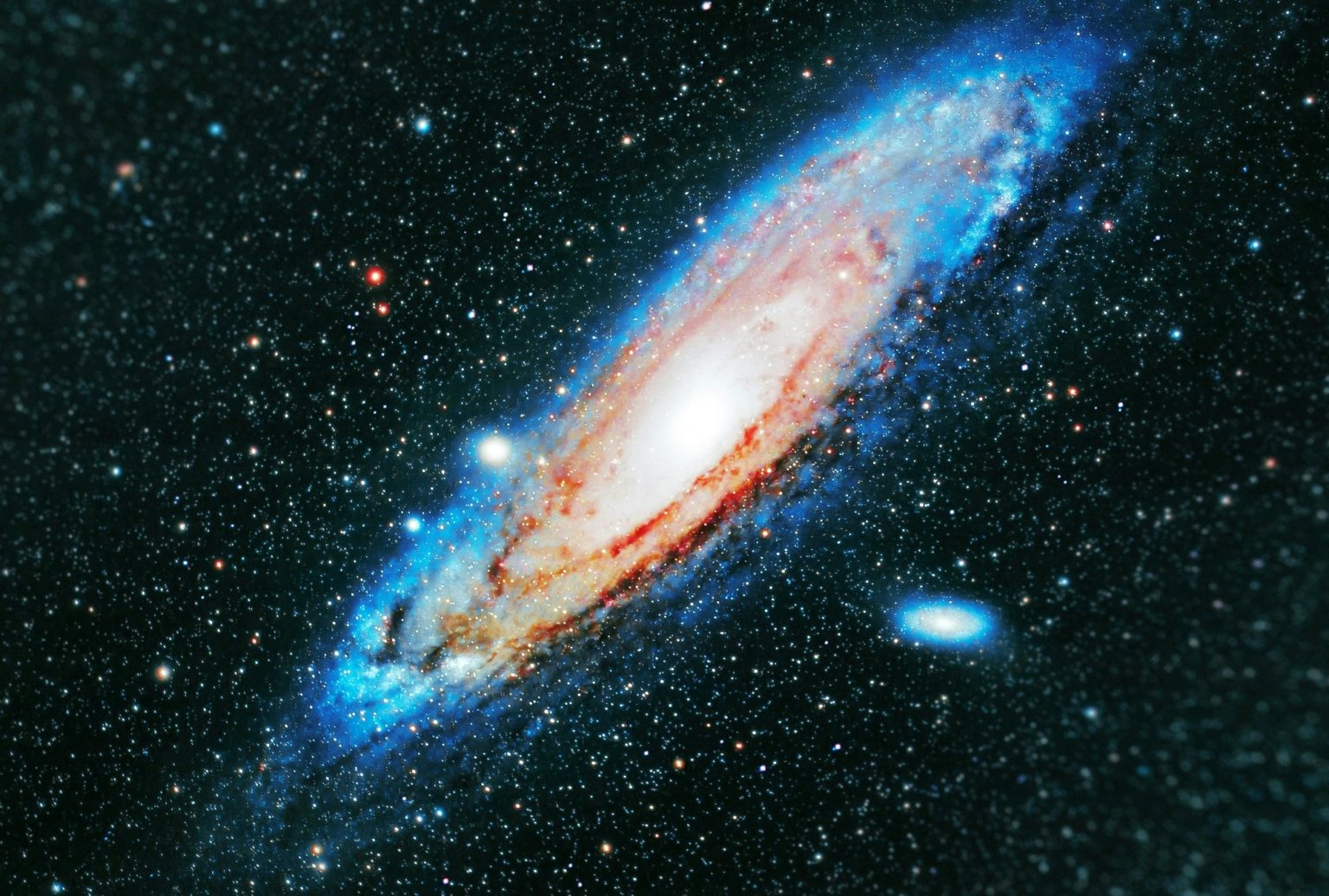
A significant breakthrough in this field was made possible by ESA’s Gaia mission, which provided accurate data on the motion of more than a billion stars. This allowed astronomers to reconstruct the past orbits of satellite galaxies. A study entitled The lives and deaths of faint satellite galaxies around M31, conducted by a team led by Alex Merrow of Durham University, combined this data with the history of star formation to understand how giant galaxies influence their smaller satellites.
Suppression mechanisms
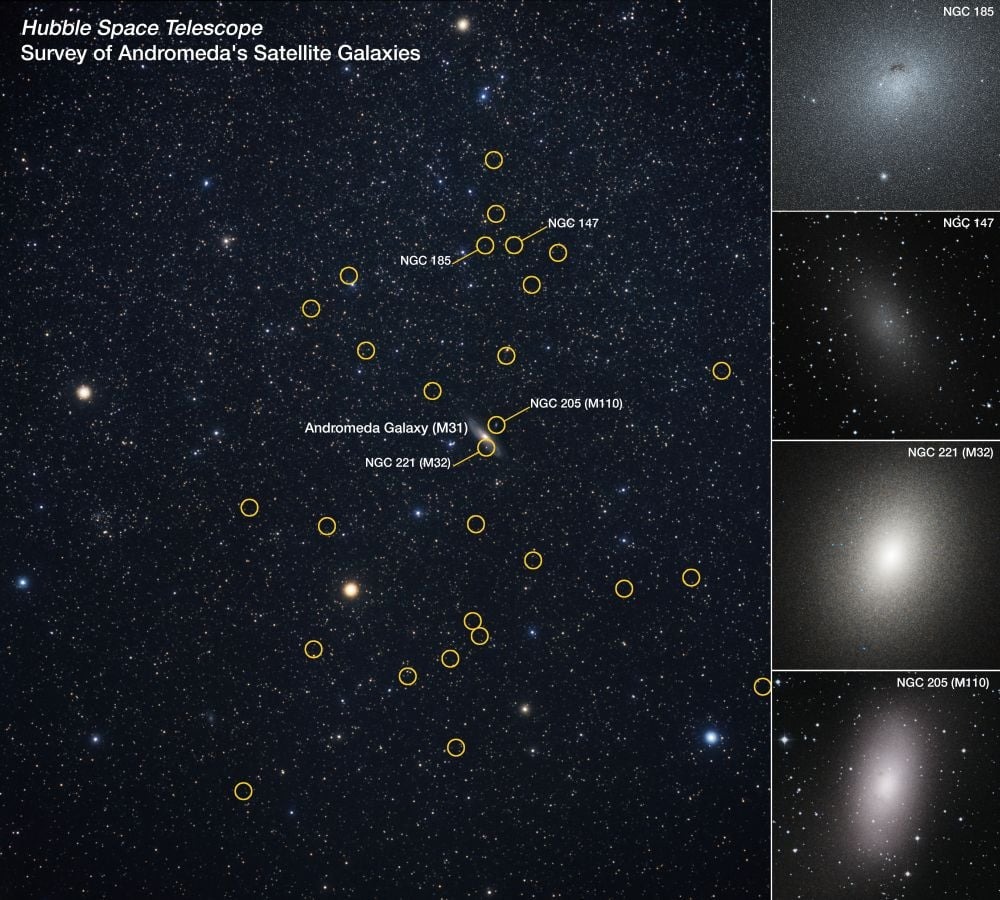
The main finding of the study is that only the most massive satellites of Andromeda are able to continue forming stars after approaching the pericenter—the point of closest approach to M31, where its gravity is strongest. Most dwarf galaxies with a mass of less than 10 million solar masses fade very quickly. The authors point out that this is due to intergalactic gas pressure, tidal disruption, or the cessation of new gas inflow.
Billions of years before absorption
The most interesting thing is that many small satellites stop forming stars long before they approach Andromeda. Some of them died out 10 billion years ago. Some were “killed” by reionization — the heating of gas by ultraviolet radiation in the early Universe. However, most underwent “pre-processing”: they had already lost their gas while near another, smaller host galaxy before falling into Andromeda’s gravitational trap.
Why is the Andromeda Galaxy special?
A comparison with the Milky Way revealed an interesting difference. The satellites of our galaxy were generally absorbed a long time ago and faded very quickly. Andromeda’s satellites, on the other hand, show a much wider range in both the age of their “fall” and the time of absorption. This may indicate that the Milky Way completed the main phase of satellite absorption earlier, while Andromeda continues to do so more gradually.
Thus, the study shows that the environment is unforgiving to small galaxies. Whether it is pressure, tidal forces, or gas loss, these mechanisms reliably stop star formation in dwarf galaxies, making them easy prey for giants such as Andromeda.
Earlier, we reported on what the collision between the Milky Way and the Andromeda galaxy would look like.
According to universetoday.com

