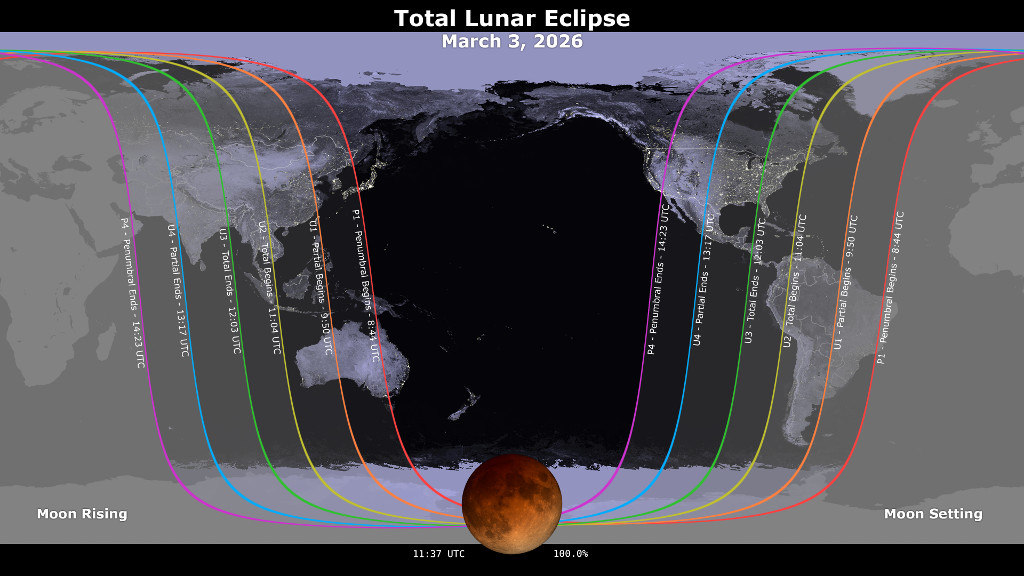
They say that eclipses “come in pairs.” And this is indeed true, sometimes even in threes: about two weeks pass between a solar and lunar eclipse, and about six months between pairs (or threes). The annular solar eclipse on February 17 will be paired with a total lunar eclipse on March 3. As with the solar eclipse, we are out of luck with the upcoming lunar eclipse: it will not be visible in Ukraine or anywhere else in Europe.
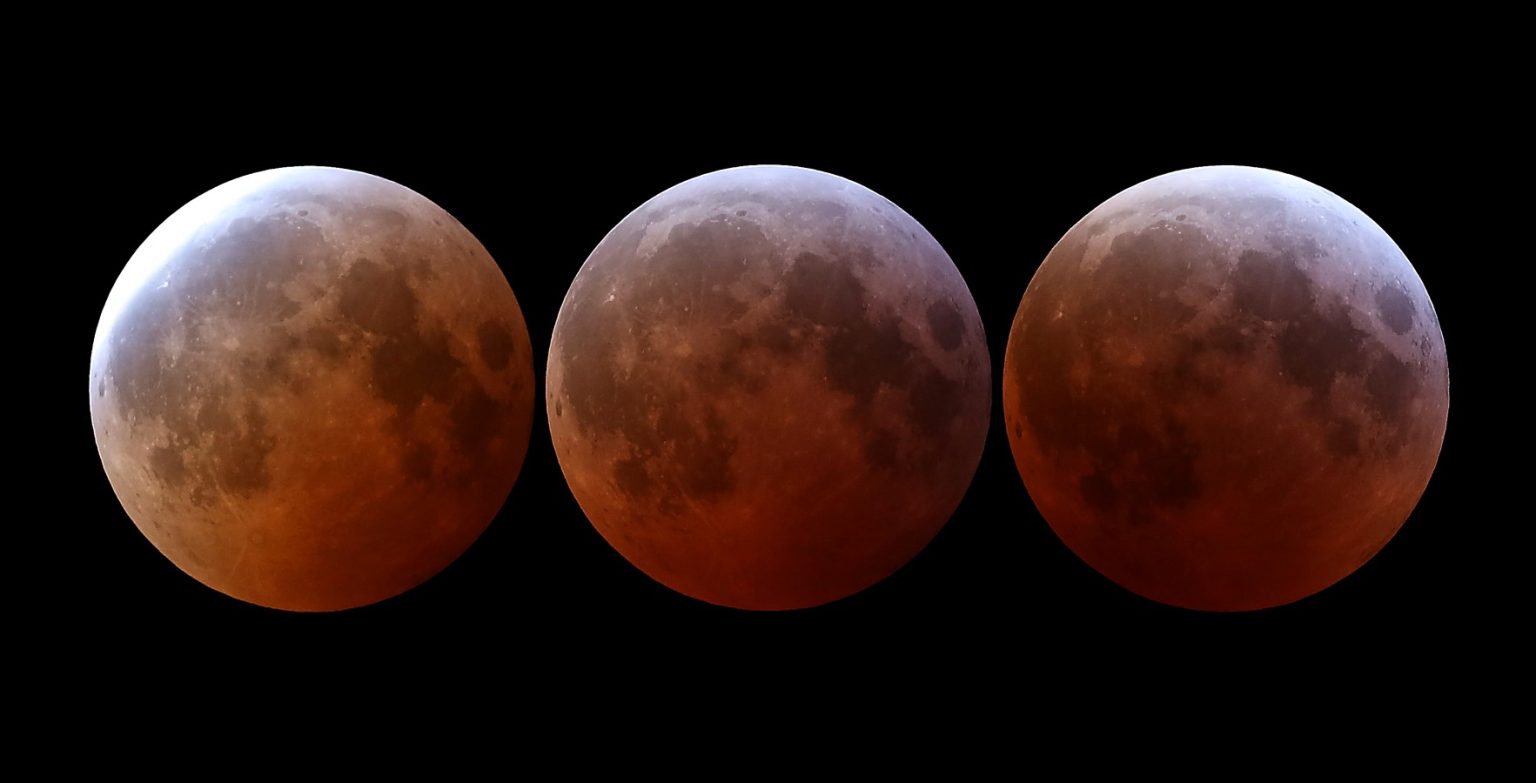
Source: Sky&Telescope
Bright planets will provide some moral compensation. Jupiter is clearly visible in the evenings, and the visibility of Venus is gradually improving – the Evening Star is moving further and further away from the Sun. However, the season of Neptune and Saturn is coming to an end: on March 22 and 25, respectively, they will be on the opposite side of the Sun relative to Earth. In astronomy, this configuration is called a conjunction.
Mercury’s brief period of evening visibility also ends this month with a conjunction with the Sun (March 7). But at the end of the month, the fastest planet will appear in the morning sky very low above the horizon.
March will equalize the length of day and night: the spring equinox will occur on the 20th. In addition, the weather usually improves in the first month of spring, with clearer nights, which opens up opportunities for visual and photographic observations of deep space objects, such as galaxies, which abound in the constellations Virgo and Coma Berenices. In March, this area of the sky is high above the horizon at around midnight.
If circumstances allow, in late March and early April, we will have the opportunity to observe the bright comet C/2026 A1 (MAPS) low above the western horizon. However, this is a very tentative prediction, as comets are unpredictable visitors, especially when it comes to the Kreutz family of sungrazing comets.
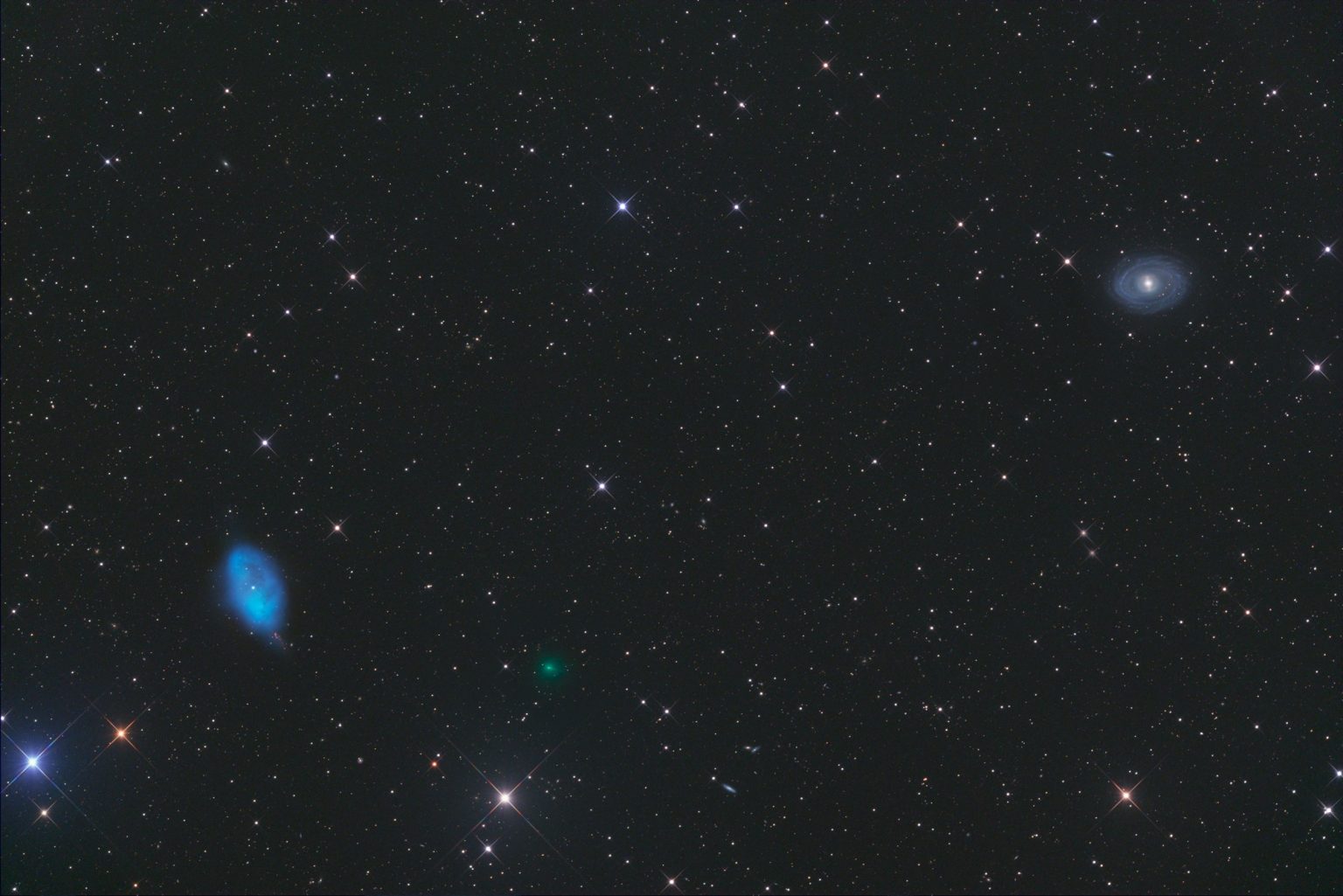
Photo: Gerald Rhemann, Michael Jäger
General circumstances
March 3 – full moon, exact time 1:38 p.m. Kyiv time (11:38 a.m. UTC).
March 3 – total lunar eclipse (not visible in Ukraine).
March 8 – conjunction of Venus (-3.8m) and Saturn (+1.0m); visible low above the western horizon after sunset.
March 19 – new moon, exact time 03:23 a.m. (01:23 a.m. UTC).
March 20 – the spring equinox, at exactly 4:48 p.m. (2:48 p.m. UTC).
March 20 – conjunction of the Moon (3%) with Venus (-3.9m). The exact time of conjunction is 09:44 a.m., but the best time for observation is immediately after sunset.
March 25 – Mercury will be at its highest point above the horizon in the predawn sky. However, the planet will be very low above the horizon, so even with a brightness of -0.4m, it will remain an extremely difficult object to observe. Conditions will be much more favorable in the southern hemisphere.
March 26 – conjunction of the Moon (60%) with Jupiter (-2.3m).
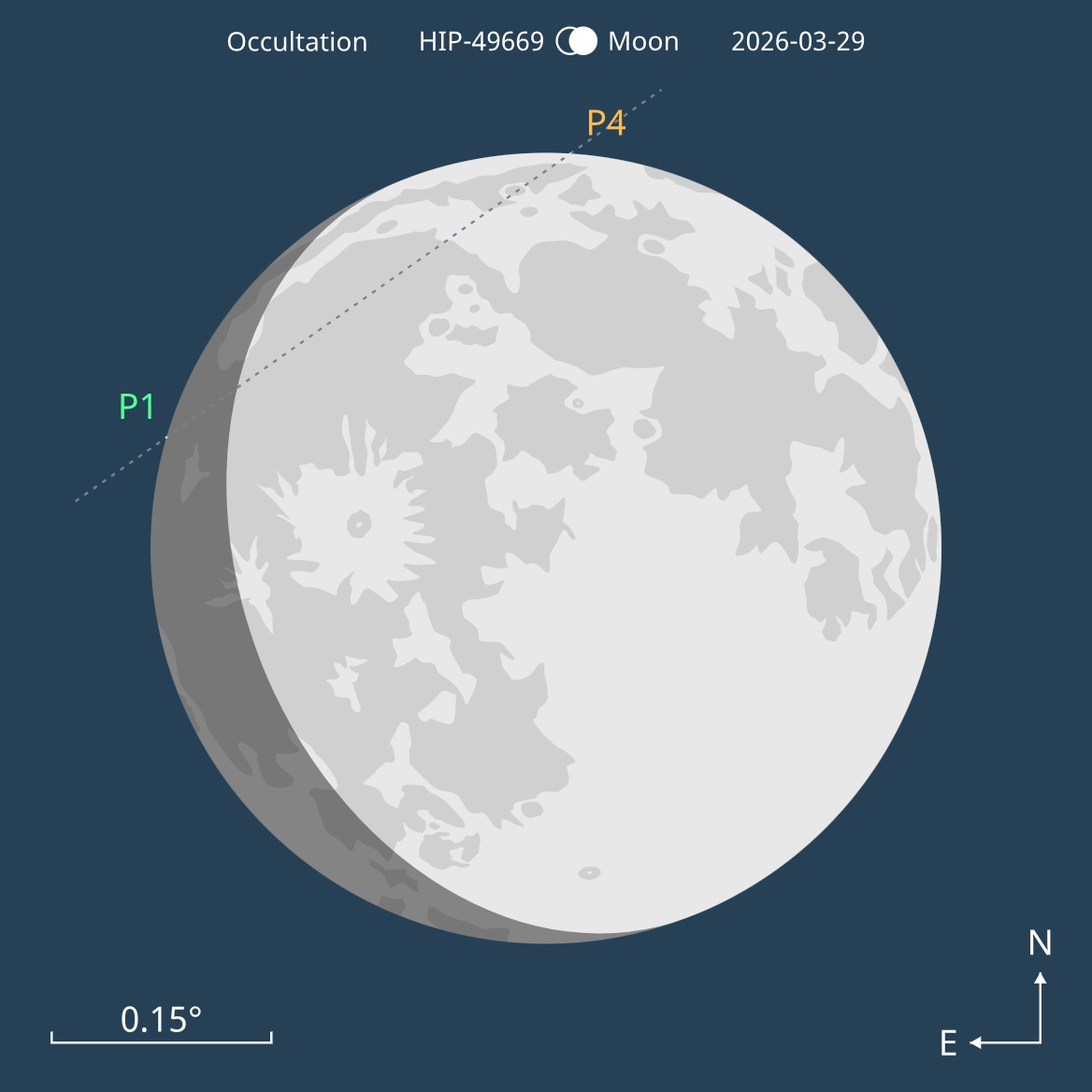
March 29 – Occultation of the bright star Regulus (+1.4m) by the Moon (89%).
A detailed overview of the most interesting circumstances
March 3: Total lunar eclipse
A total lunar eclipse occurs when the Moon is in the Earth’s shadow. At first, it enters the Earth’s penumbra and darkens slightly – a barely noticeable effect. When it enters the umbra, its blurred edge is clearly visible on the disk. The approach to the maximum phase of the eclipse is marked by a change in color, which, depending on conditions, can vary from brown to copper-red. This phenomenon has long been known as a Blood Moon.
Unlike a solar eclipse, a lunar eclipse can be observed by anyone for whom the Moon is above the horizon at that moment. We are out of luck this time: the maximum phase of the eclipse on March 3, 2026, occurs at 11:33 a.m. UTC, when the Moon is deep below the horizon for us. Therefore, the eclipse will be best observed in the Pacific Ocean – particularly in Hawaii and New Zealand. All phases will also be visible to residents of eastern Asia and western North America.
March 19: The new moon allows us to see the faintest objects in deep space
Amateur astronomers often begin their journey as observers by looking at the Moon through a telescope – after all, there is really something to see there, especially since each phase offers new opportunities. The absence of the Moon in the sky can be disappointing, but it also provides undoubted advantages for hunters of faint deep-sky objects.
In the absence of moonlight, you can test yourself and your telescope and search for objects invisible to the naked eye – nebulae, galaxies, and star clusters. Spring is traditionally considered the season for galaxies. And for good reason: rich “celestial landscapes” such as the Virgo Cluster and the Coma Star Cluster are often targets for both visual observation and small-aperture astrophotography.
Of course, the Whirlpool Galaxy (M51 in Canes Venatici), the pair of galaxies M81 (Bode) and M82 (Cigar) in Ursa Major, the galaxy M64 (Black Eye), and many others deserve special attention.
The Coma Star Cluster will be a much easier object to spot – it can be seen with the naked eye in a dark sky. And in the evening, the Beehive Cluster (in the constellation Cancer), the Pleiades, and the Great Orion Nebula will still be visible.
March 20: Conjunction of the Moon and Venus
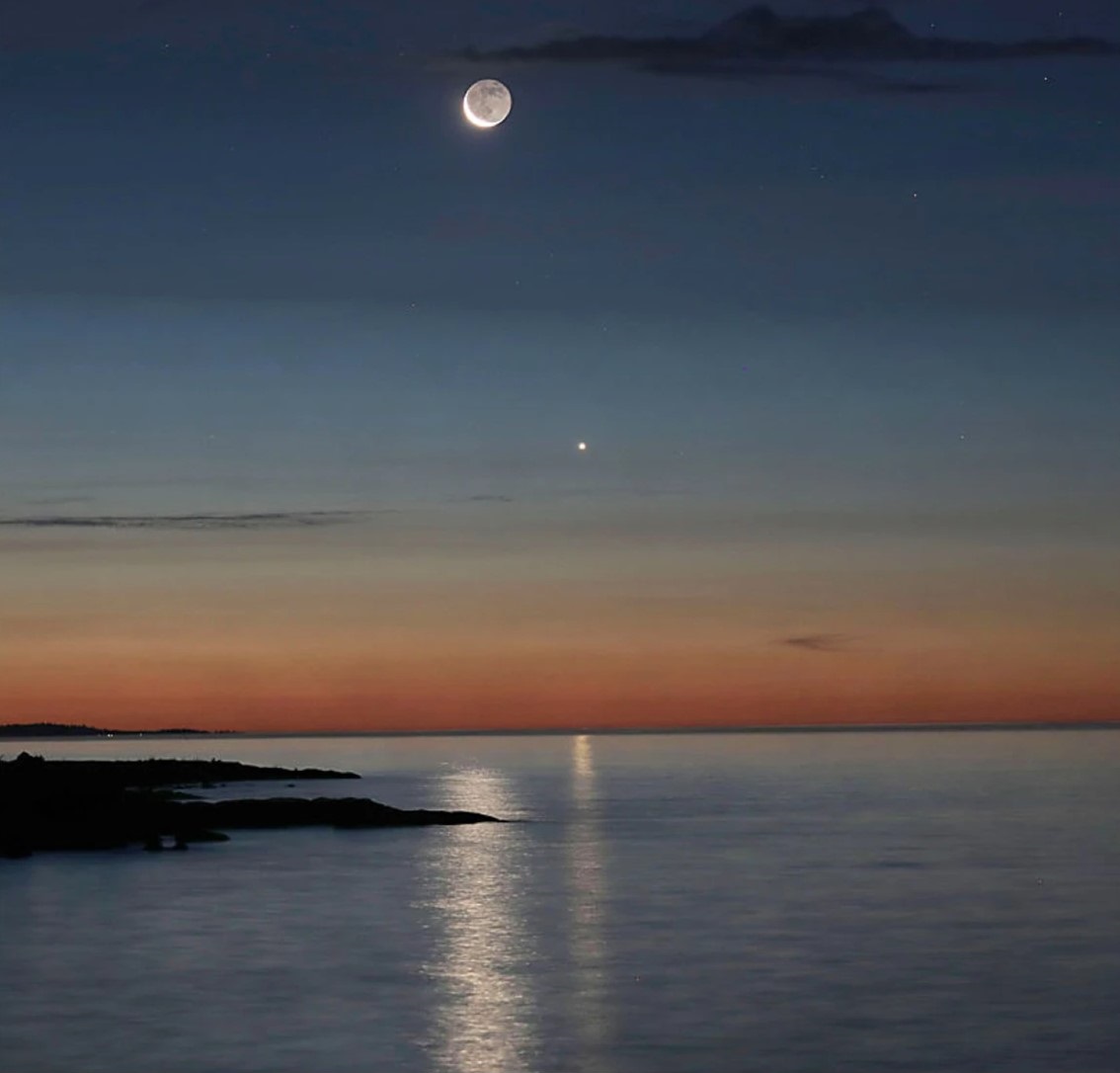
For several months now, since approximately November 2025, we have not seen the brightest planet, Venus. For most of last year, it delighted us as the Morning Star. Now it is finally returning to the evening sky, where it will surely attract much more attention.
Venus is not yet rising high above the horizon. But at least one configuration this month is definitely worth your attention – its conjunction with the Moon. The celestial bodies will be at their closest distance at 9:44 a.m., when both will be melting in the bright light of the Sun. Therefore, it is worth waiting until the moment when the morning star disappears behind the horizon.
For successful observations, in addition to clear skies, you will need a completely open western horizon, as both Venus and the Moon will be just a few degrees apart. But trust us, it is worth it!
March 29: Occultation of the Regulus by the Moon
You have probably noticed from time to time that there is a bright star next to the Moon. One of them is Regulus, the brightest star in Leo and one of the brightest in our sky. Regulus is located quite close to the ecliptic and, therefore, is occasionally occulted by the Moon, which also never strays more than a few degrees from it.
On March 29, we will have a wonderful opportunity to watch Regulus suddenly disappear behind the unlit side of the Moon. It will be much more difficult to track the moment when it appears on the opposite side – after all, you need to know exactly when and where this will happen, and notice the star next to the bright side of the Moon.
Our natural satellite moves across the sky very quickly, so these unique eclipses last from a few minutes to an hour and a half. Occultation conditions depend on your geographical location. In particular, the phenomenon will be visible throughout Ukraine and most of Europe, but it will remain inaccessible to most of Africa and Asia.
Below is the trajectory of Regulus behind the Moon for an observer in Kyiv. The star will disappear at 21:58:56 (18:58:56 UTC) and reappear at 22:45:55 (19:45:55 UTC). For your location, you can find out the conditions for observing the eclipse on a specialized resource supported by the French Institute of Celestial Mechanics and Ephemeris Calculation – Institut de Mécanique Céleste et de Calcul des Éphémérides.