

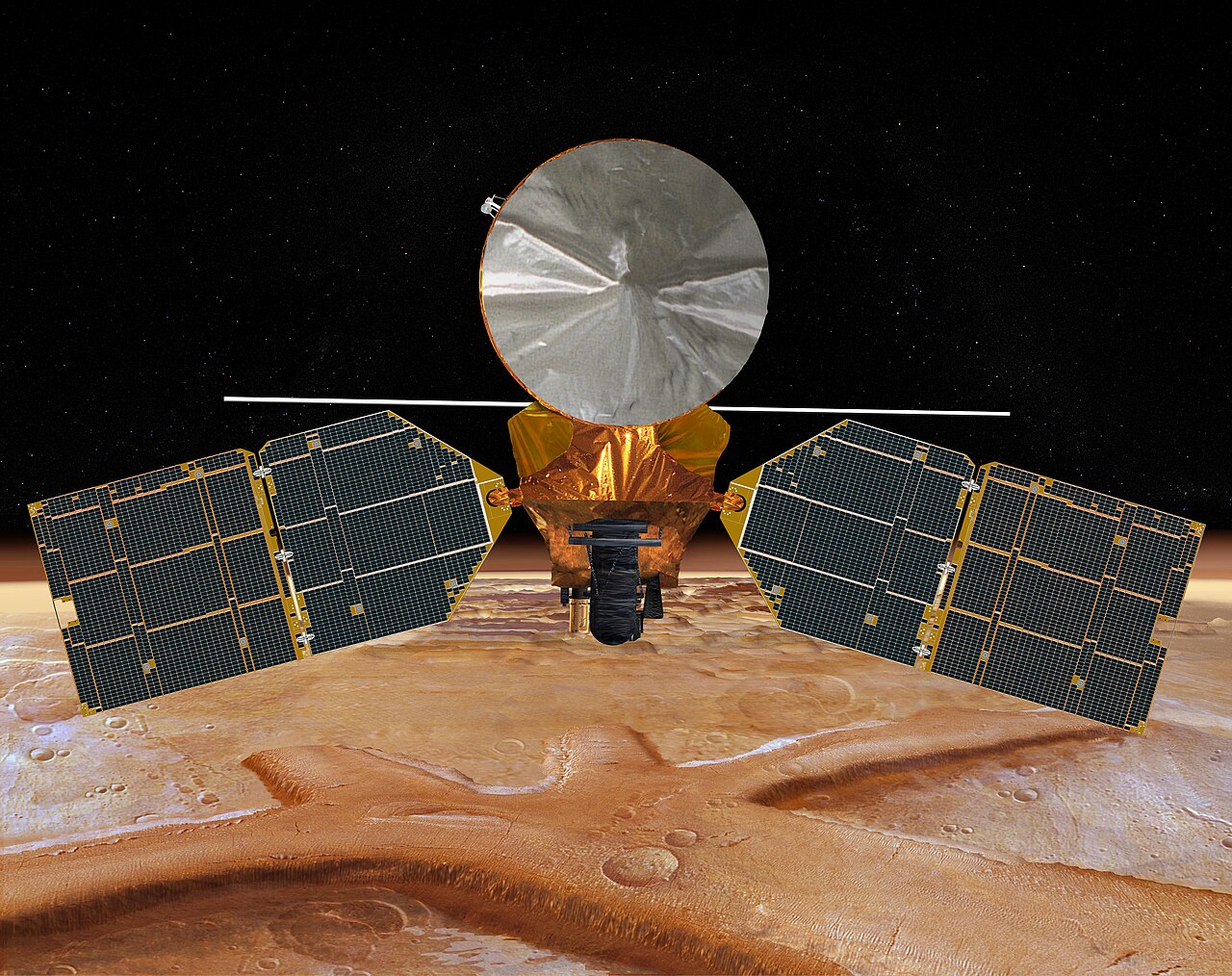
The Mars Reconnaissance Orbiter (MRO) is a real reconnaissance satellite, only it operates not above Earth, but in Mars’ orbit. It arrived there exactly 20 years ago. Since then, this device has solved many practical and scientific problems and regularly provides astronomy enthusiasts with amazing images.
Mars rover
Exactly 20 years ago, on March 10, 2006, the Mars Reconnaissance Orbiter (MRO) entered Mars’ orbit, with its main purpose being to photograph the planet’s surface in high resolution.
MRO was not the first spacecraft designed for this purpose. The first images of the Red Planet from orbit were obtained back in the 20th century. And in 2006, Mars Odyssey was already operating above Mars. However, no Martian moon had such powerful observation equipment before.
Its history began with the experience of operating the Mars Global Surveyor satellite. It had been operating in the orbit of the Red Planet since 1996 and had performed very well, but from the outset, it was not designed for long-term use. By the mid-2000s, it was significantly outdated, while NASA needed reliable support for missions on the planet’s surface.
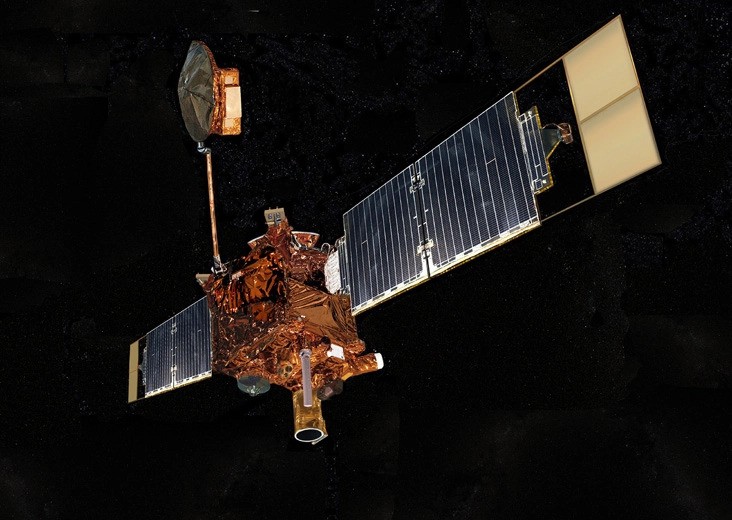
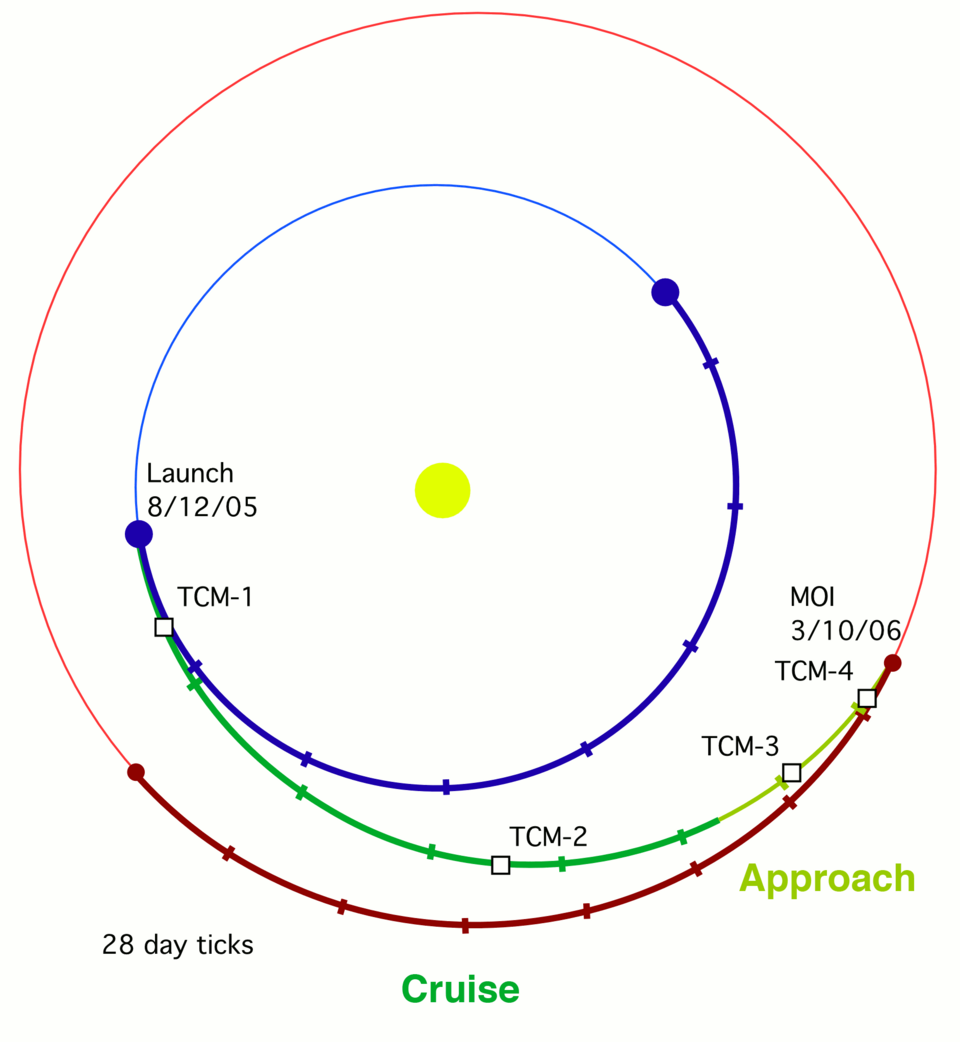
Initially, the Mars Reconnaissance Orbiter was planned for launch in 2003, but the launch window was then given to the Spirit and Opportunity rovers. However, there were many tasks for the Martian explorer, so it was launched during the next launch window (on Earth and Mars, these open every 26 months) on August 12, 2005.
Even though the launch took place at the most favorable time, the journey to Mars took a full seven months. And on March 10, it was not actually complete. The Mars Reconnaissance Orbiter was in a high polar orbit and needed to be lowered to reach its operational orbit. To do this, the spacecraft performed a series of braking maneuvers in the upper atmosphere, each of which slightly reduced its apogee.
So, MRO completed its maneuvers in just a few months and transmitted its first image in September 2006. It must be said that it did so just in time. About a month earlier, contact with Mars Global Surveyor was finally lost.
What is inside the Mars Reconnaissance Orbiter?
But what has allowed MRO to become one of the main tools in the exploration of the Red Planet and remain so for 20 years? The answer is its unique equipment for observing the surface. It consists of several cameras.
The most important of these is HiRISE. Essentially, it is a telescope with a mirror diameter of 0.5 m that observes the surface of Mars from an altitude of 300 km. This allows it to distinguish surface details as small as 30 cm.
At the time when the Mars Reconnaissance Orbiter entered Mars orbit, such accuracy remained unattainable for the vast majority of satellites observing Earth. Even now, this is the level of the most advanced military devices. In addition, the camera can take pictures not only in the visible range, but also in the near-infrared range.
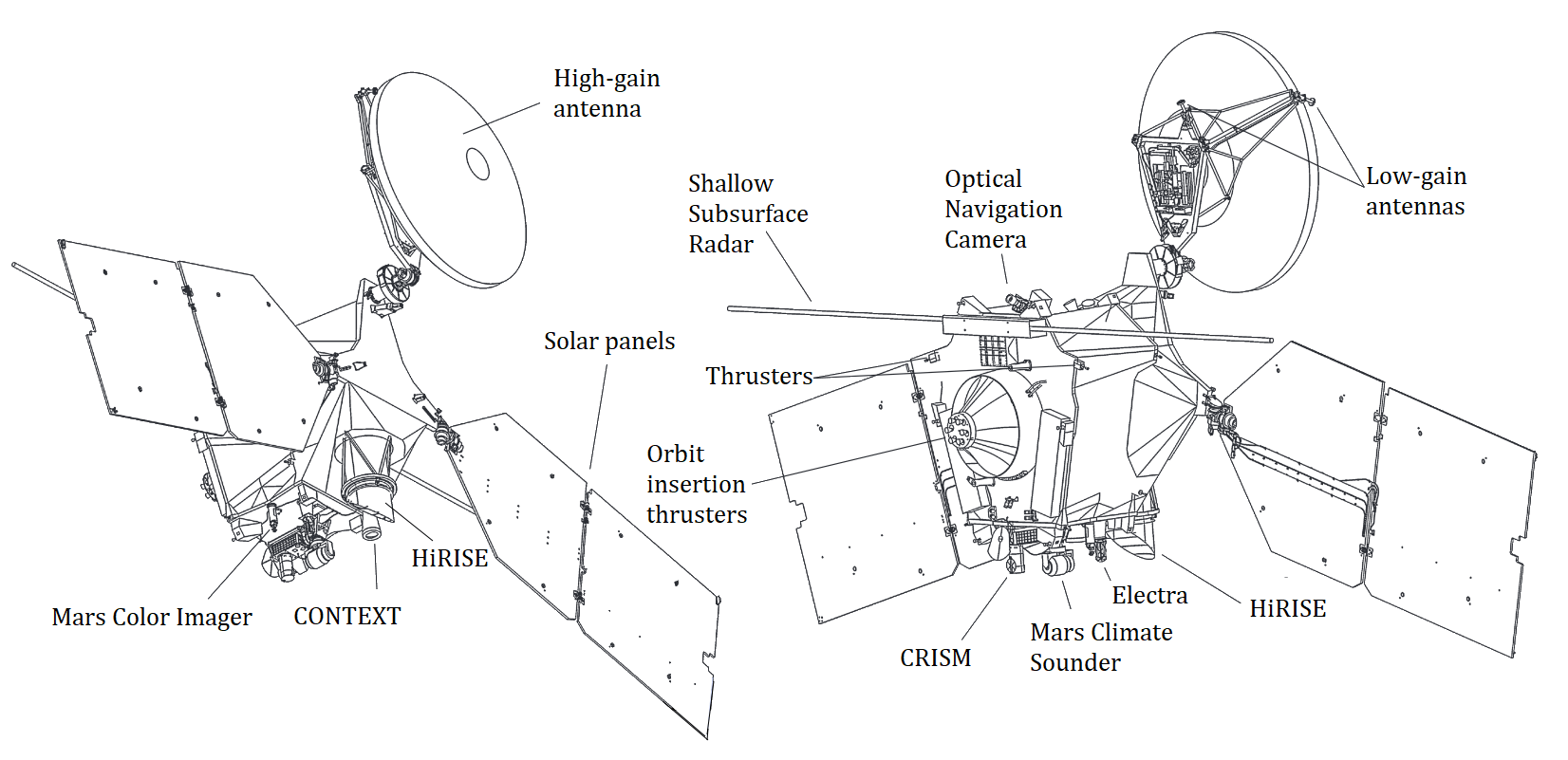
The second camera on board is CTX. Its resolution is only 6 m per pixel, but it can capture a 30 km-wide strip of the surface, and its internal memory is sufficient to store data for a 160 km-long strip. Then it has to be transmitted to Earth. Its main purpose is to compile a high-precision map of the Red Planet.
The third camera on board is the Mars Color Imager (MARCI). It is a wide-angle device capable of taking beautiful panoramic images. In addition, it can operate in two ultraviolet ranges. MARCI allows you to forecast the weather on Mars, as well as detect ozone and water vapor in its atmosphere.
There are also two spectrometers on board. The first, CRISM, provides a resolution of 18 m from an altitude of 300 km and remotely determines the surface chemical composition in this area. Its main purpose is to search for minerals on Mars.
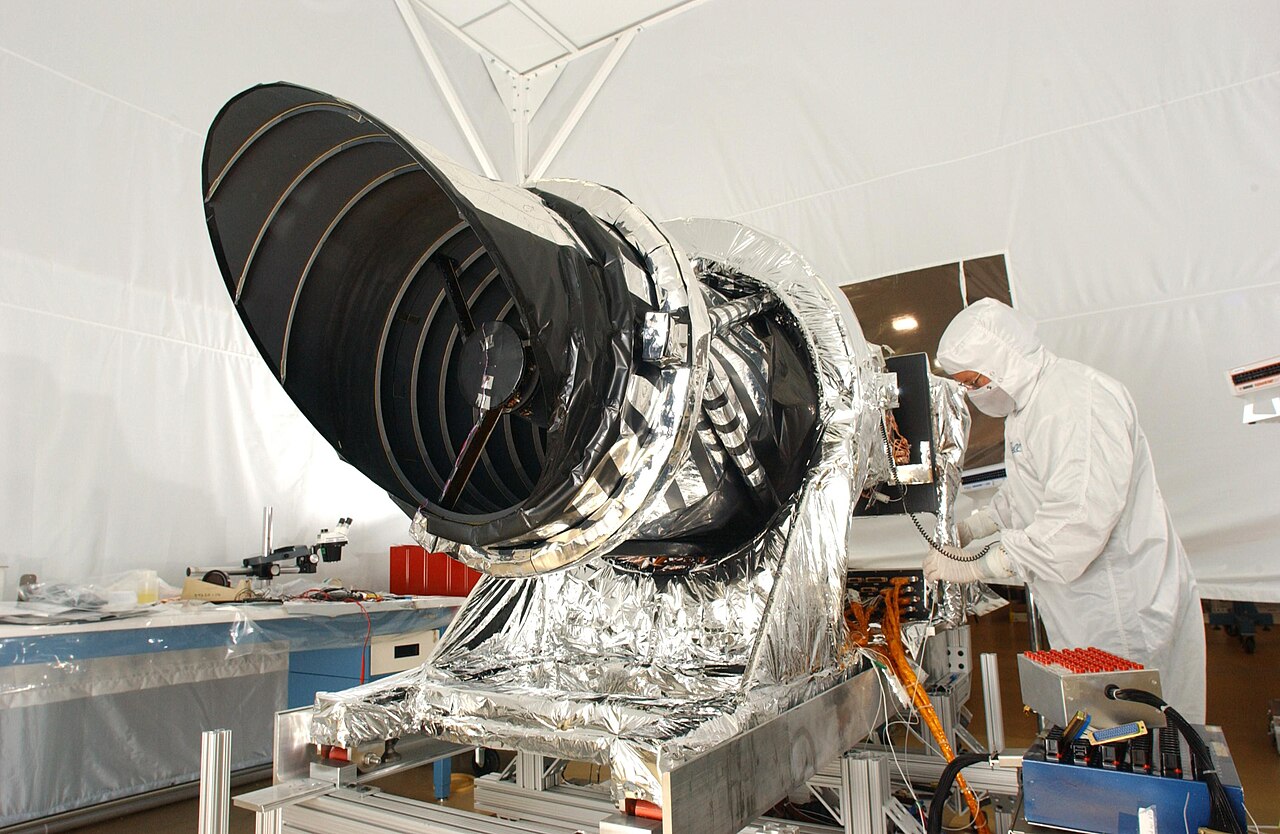
The second spectrometer, Mars Climate Sounder, consists of two telescopes operating in the visible and infrared ranges. They are designed to study the atmosphere of the Red Planet and assess its chemical composition.
The spacecraft also carries an experimental Shallow Subsurface Radar (SHARAD) instrument. It not only allows us to obtain images of the surface of Mars at night, but also to look beneath it. This enables it to search for hidden objects.
The MRO instrument suite is completed by a set of accelerometers that can measure the planet’s gravitational field and map its anomalies.
In other words, if the Mars Reconnaissance Orbiter were in Earth’s orbit, it would still be considered one of the most advanced reconnaissance satellites today. However, it performs scientific rather than military tasks.
Practical tasks Mars Reconnaissance Orbiter
One of the first practical opportunities for scientists and engineers when the Mars Reconnaissance Orbiter began operations was to observe artificial objects on the planet’s surface from orbit. On Earth, geospatial data is one of the most popular topics, allowing us to assess the condition of fields and industrial enterprises. But predicting such opportunities for other planets – especially 20 years ago – was pure fantasy.
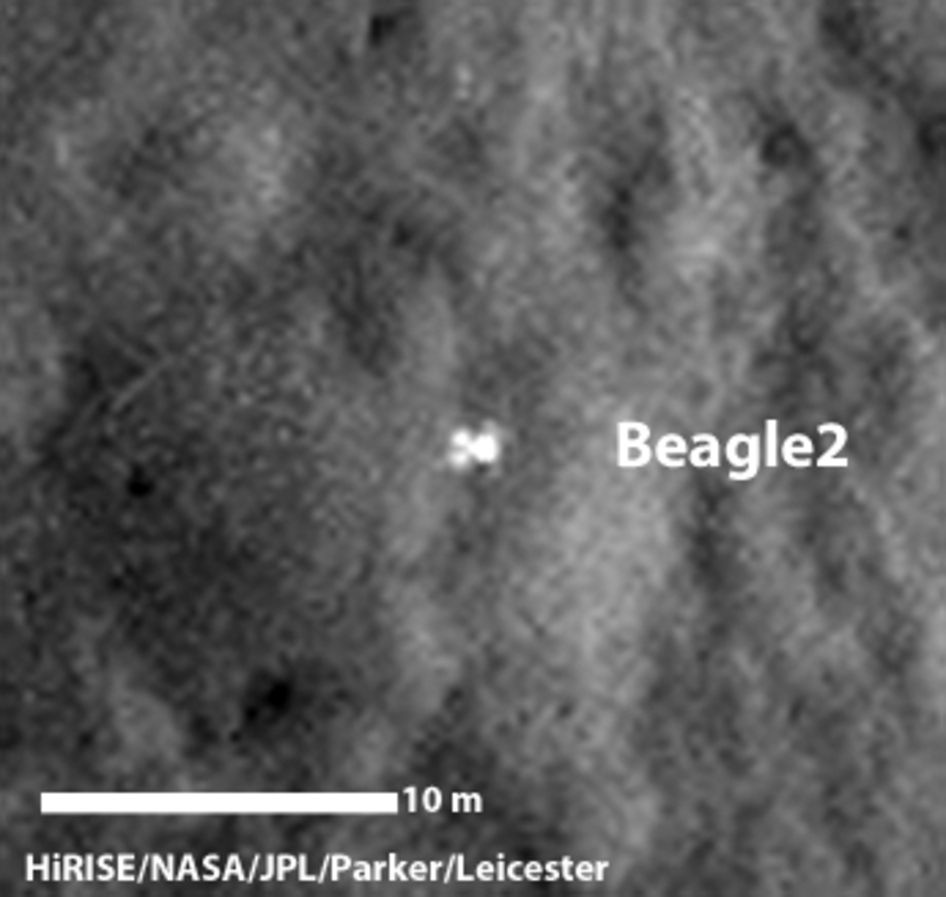
However, one of the first tasks facing MRO was quite realistic. In 2003, the Beagle 2 research module was supposed to land on Mars. Immediately after landing, it failed to establish communication. Everyone thought that the device had crashed.
However, it was later determined that the probe had landed normally, but one of its solar panels had not opened properly, preventing the antenna from functioning correctly. It then photographed the Spirit and Opportunity rovers, as well as other devices on the surface, from orbit.
Another task facing the MRO was to find landing sites for future missions. The most important of these was the one that, in the 2000s, was called the Mars Science Laboratory and is now known to us as the Curiosity rover. The images taken by the Martian explorer proved that Gale Crater was worth exploring and that there were safe landing sites nearby.
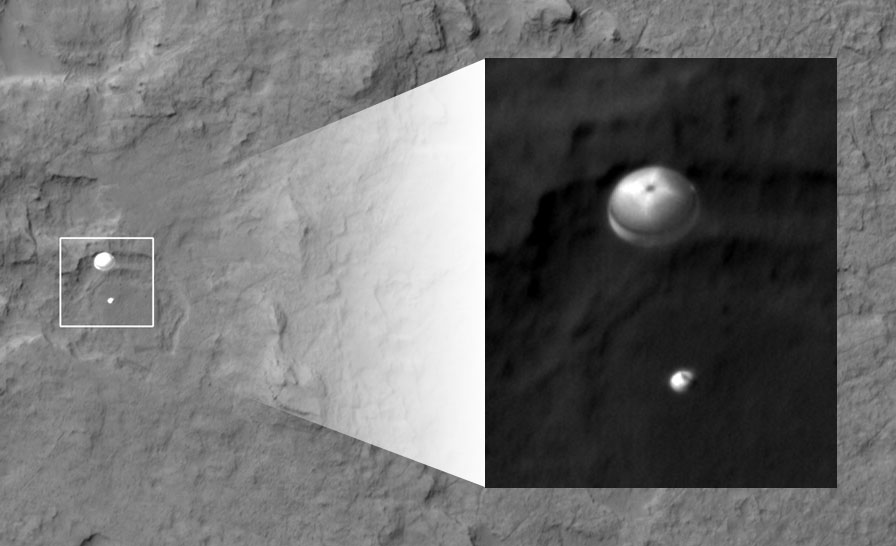
Similarly, MRO images and data were used to select landing sites for the Phoenix, InSight, and Perseverance probes. However, in the case of Curiosity, the assistance in determining the landing site was not limited to that. The moon even photographed the platform with the rover on it as it deployed one of its parachutes during landing. In addition, the MRO often acted as a relay, transmitting data from probes on Mars’s surface to Earth.
Scientific discoveries
However, MRO’s main tasks were scientific, and for 20 years, it has remained a major source of Mars-related discoveries. The most important of these is data on the presence of water on the fourth planet from the Sun.
Initially, scientists used the spacecraft’s cameras and spectrometers to study the rocks ejected during a recent large meteorite impact on Mars. Incidentally, it was the MRO that observed the formation of the largest impact crater in modern history. The diameter of the newly formed depression was 150 meters.
So, by studying the spectra of minerals that were ejected as a result of the collision, scientists realized that water ice was among them. This means that even though the surface of Mars is completely dry, there may be considerable reserves hidden beneath it.
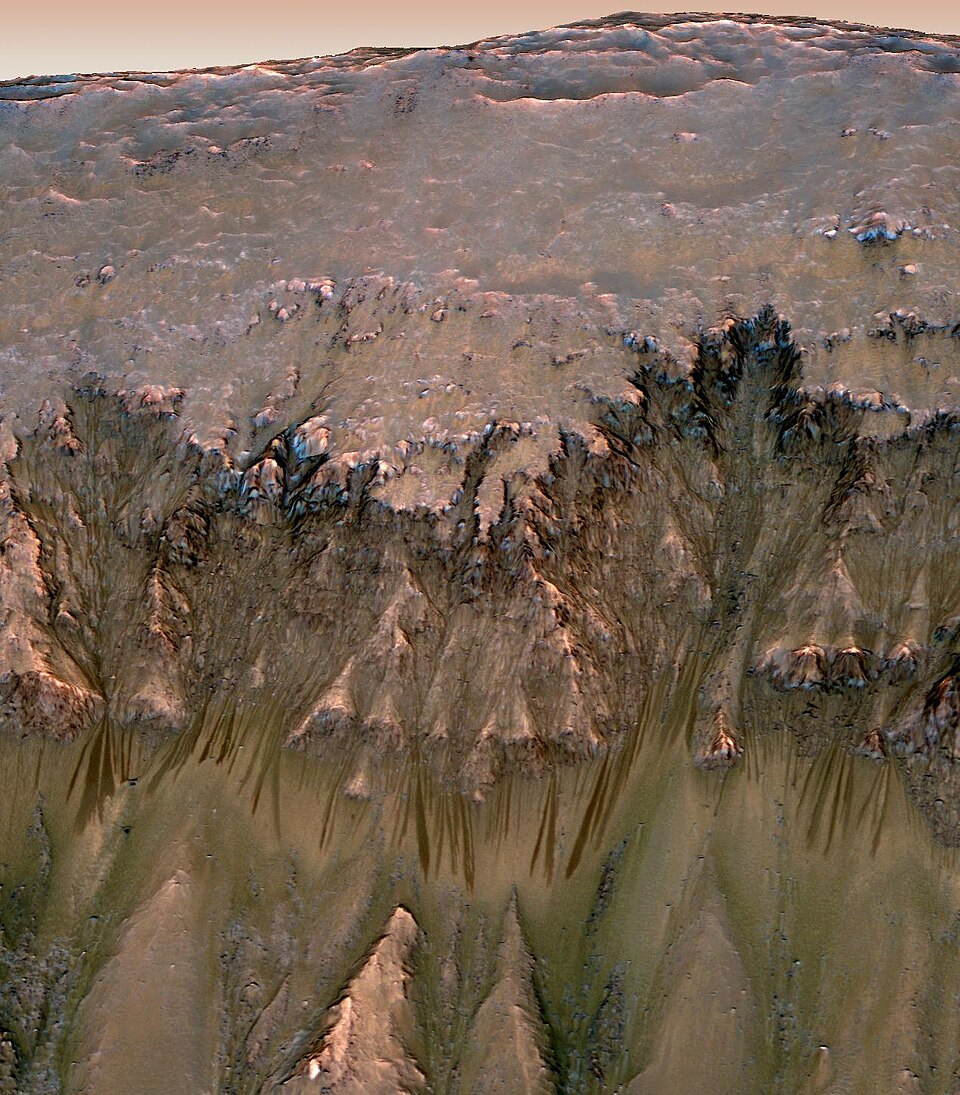
Then there were studies of the polar caps. The SHARAD radar showed that large deposits of pure ice, or possibly liquid water, lie beneath them. Finally, in 2015, the HiRISE camera showed dark streams appearing on the slopes of some craters on the warmest days.
Scientists are certain that it is not just water but supersaturated salt solutions called perchlorates. This liquid cannot sustain life on Earth in most of its forms, but the main point remains: sometimes liquid does flow on Mars’s surface.
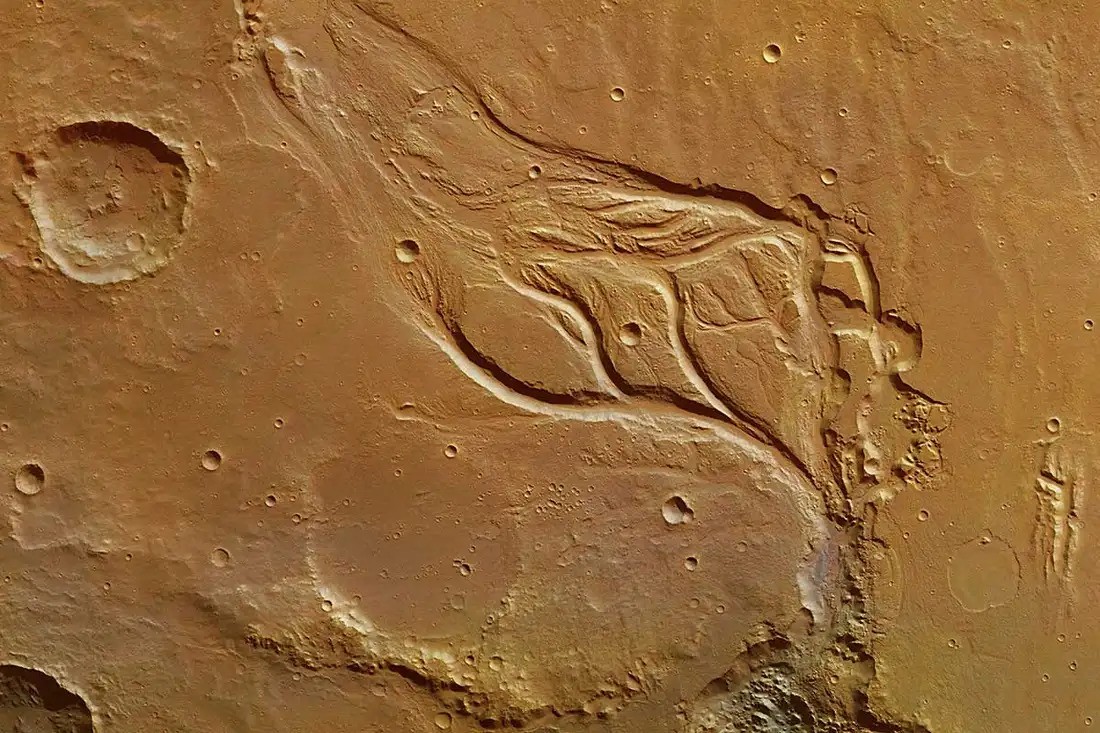
At the same time, there used to be even more water on Mars. It was MRO that provided the first serious evidence of this. HiRISE images clearly show that the planet once had a developed system of rivers and channels. In some places, the camera even captured relief features that form when waves crash against the shore over time. The CRISM spectrometer also found traces of minerals on the surface that could only have been formed in water.
The Mars Reconnaissance Orbiter also discovered glass on the surface of Mars. It is of natural origin and was formed as a result of meteorite impacts. In 2014, the spacecraft even conducted scientific observations beyond Mars. Comet McNaught flew past it, allowing it to take many close-up pictures.
In total, the number of images transmitted by the device to Earth has long exceeded 100,000. They show everything from the dunes on the slopes of the Matar crater to bizarre spider web-like relief formations, dust devils, and the Chinese Mars rover.

