

Where exactly is the edge of the Milky Way? Answering this question is much more difficult than it might seem at first glance. Since the Solar System is located right in the center of the galaxy, we are unable to view it from the side or from above. The situation is further complicated by the fact that there is simply no clear physical boundary: the density of stars, gas, and interstellar dust merely decreases gradually as one moves away from the galactic center, slowly dissolving into the intergalactic void.
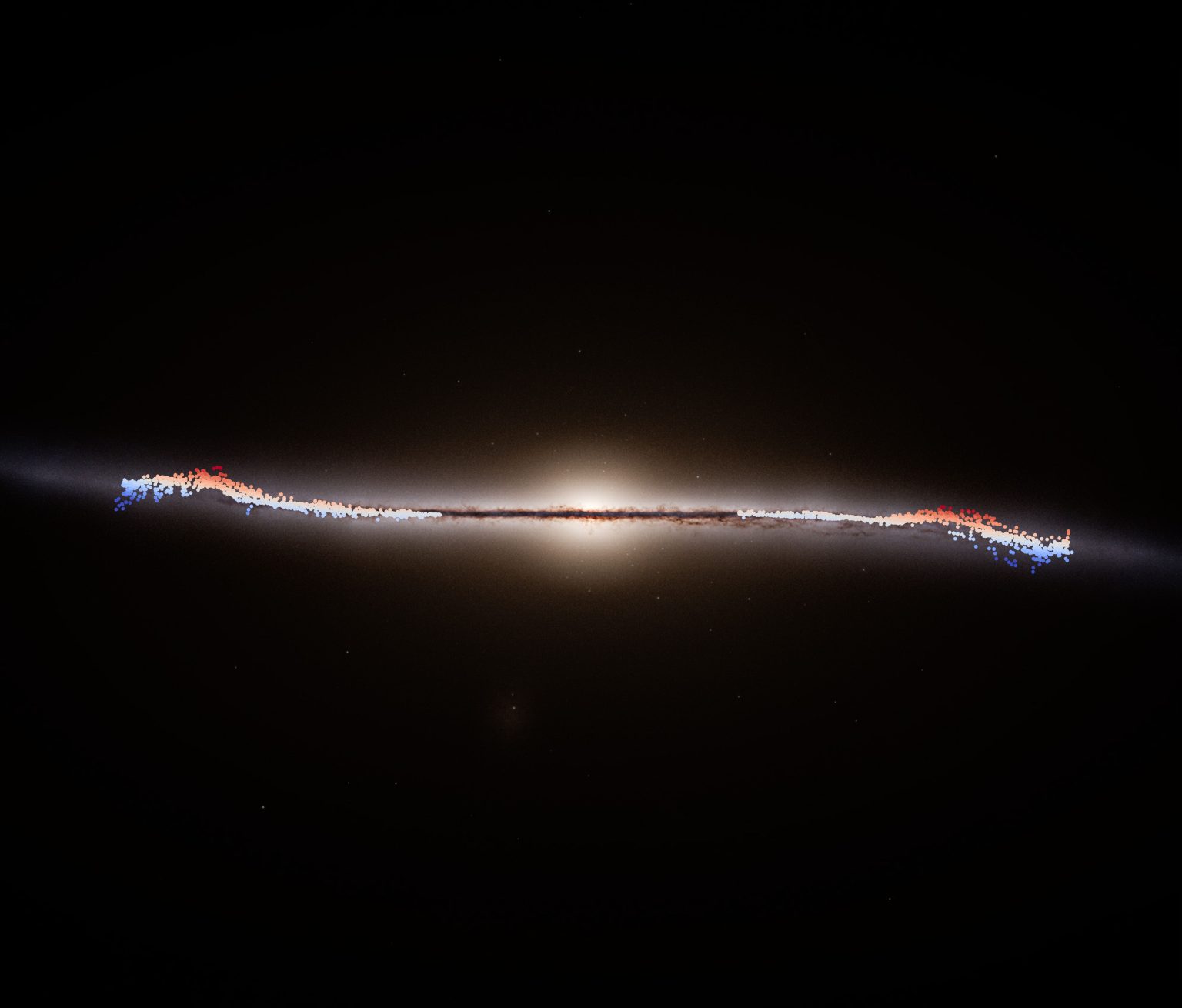
However, a group of scientists formerly based at the University of Malta has proposed an innovative approach to solving this cosmic mystery. In their study, published in the prestigious journal Astronomy & Astrophysics, they demonstrated that it is indeed possible to identify and measure the “edge” of our galaxy.
A new boundary criterion and space telescopes
Instead of searching for the visual edge of the galaxy, astronomers proposed defining the edge as the outer boundary of the region of active star formation—that is, the point where the galaxy ceases to produce new stars. According to their calculations, this zone ends at a distance of between 11.28 and 12.15 kpc (≈40,000 light-years) from the supermassive black hole at the center of the Milky Way.
To reach this groundbreaking conclusion, the researchers had to carry out a massive amount of analytical work. They analyzed the ages of more than 100,000 massive stars using data sets from advanced observation instruments, including the APOGEE-DR17, LAMOST-DR3, and Gaia space telescope missions and projects.
U-shaped evolution of stars
While analyzing these massive datasets, scientists stumbled upon an extremely interesting pattern linking the evolution of stars’ positions to their ages. On the graph, this relationship appears as a U-shaped curve, where the vertical axis (Y) represents the star’s age and the horizontal axis (X) represents the distance from the galactic center.
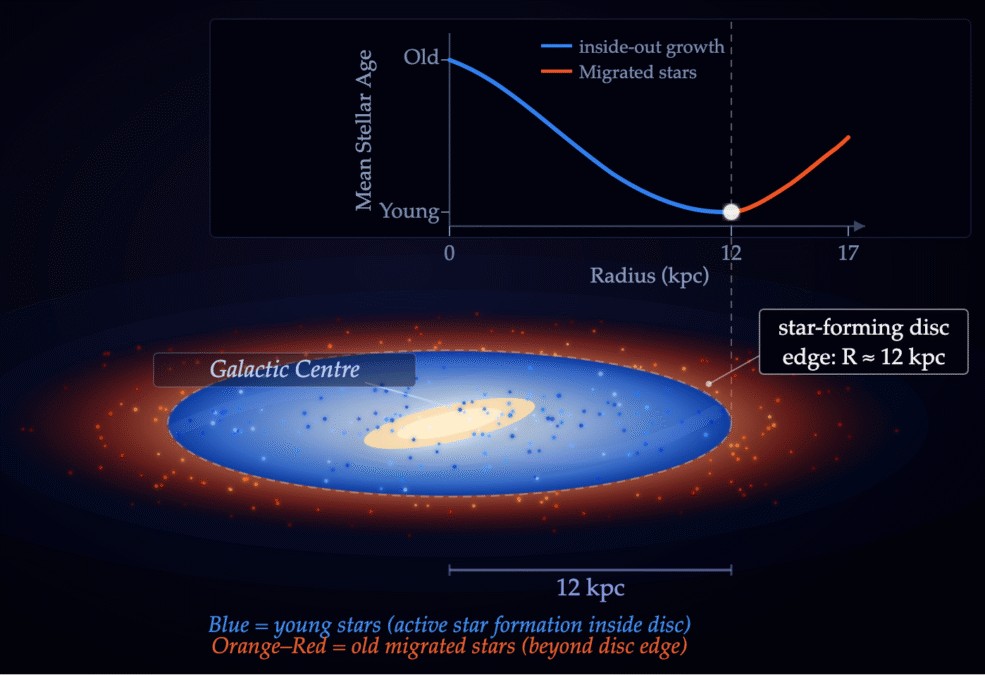
The physics behind this process can be explained as follows: near the center of the galaxy, where there has always been the greatest abundance of building materials (gas and dust), stars formed first. That is why the oldest stars are concentrated there. The farther away from the center, the more widely dispersed the interstellar gas becomes; gravitational processes are stretched out over time, and, consequently, the stars there become younger.
It would seem that the trend is clear. But at a certain point, 40,000 light-years away, the pattern suddenly breaks down: the stars stop “getting younger” and begin to age. It is precisely this inflection point on the curve that the researchers identified as the boundary of the star-forming region.
Why does the star factory stop?
This raises the question: why does star formation come to a clear halt at this specific distance? Scientists cite three main reasons:
- Outer Lindblad Resonance. The central bar of our galaxy creates specific gravitational disturbances that disrupt the normal flow of gas, effectively trapping it within the inner regions and preventing it from feeding the surrounding areas.
- Galactic warp. Over long distances, the plane of the Milky Way becomes distorted. This warp further disperses interstellar gas across vast areas.
- Density deficit. Interstellar gas at such distances becomes so rarefied that it loses the ability to cool sufficiently and accumulate to trigger the thermonuclear reactions that form a new star.
Mystery of the outskirts
If no new stars are forming outside of star-forming regions, where do the older stars that make up the right side of the U-shaped curve come from?
The answer lies in interstellar migration. The outer reaches of the galaxy are inhabited by exiled stars. They formed in the inner regions but were subsequently pushed out to the periphery by the powerful gravitational forces of the spiral arms or the central bar. This migration process lasted billions of years, gradually populating the outer regions with ancient stars.
The significance of the discovery for science
These findings are of fundamental importance for understanding our galaxy. They clearly classify the Milky Way as a Type II spiral galaxy (galaxies with a truncated, downward-curving disk profile), placing it among approximately 60% of similar star systems in the local universe.
But most importantly, this discovery helps astronomers piece together the history of our home. Now we can clearly draw the line: where the productive, energetic part of the Milky Way ends and where its vast, quiet outskirts begin. This knowledge brings us one step closer to understanding the architecture of our entire galactic neighborhood.
We previously reported on how the Milky Way at the edge of a supervoid could explain the Hubble constant paradox.
According to sciencealert.com

