

Researchers from the Max Planck Institute for Radio Astronomy have obtained a detailed image of an object resembling the Eye of Sauron from “The Lord of the Rings.” The shot helped reveal its long-held secret.
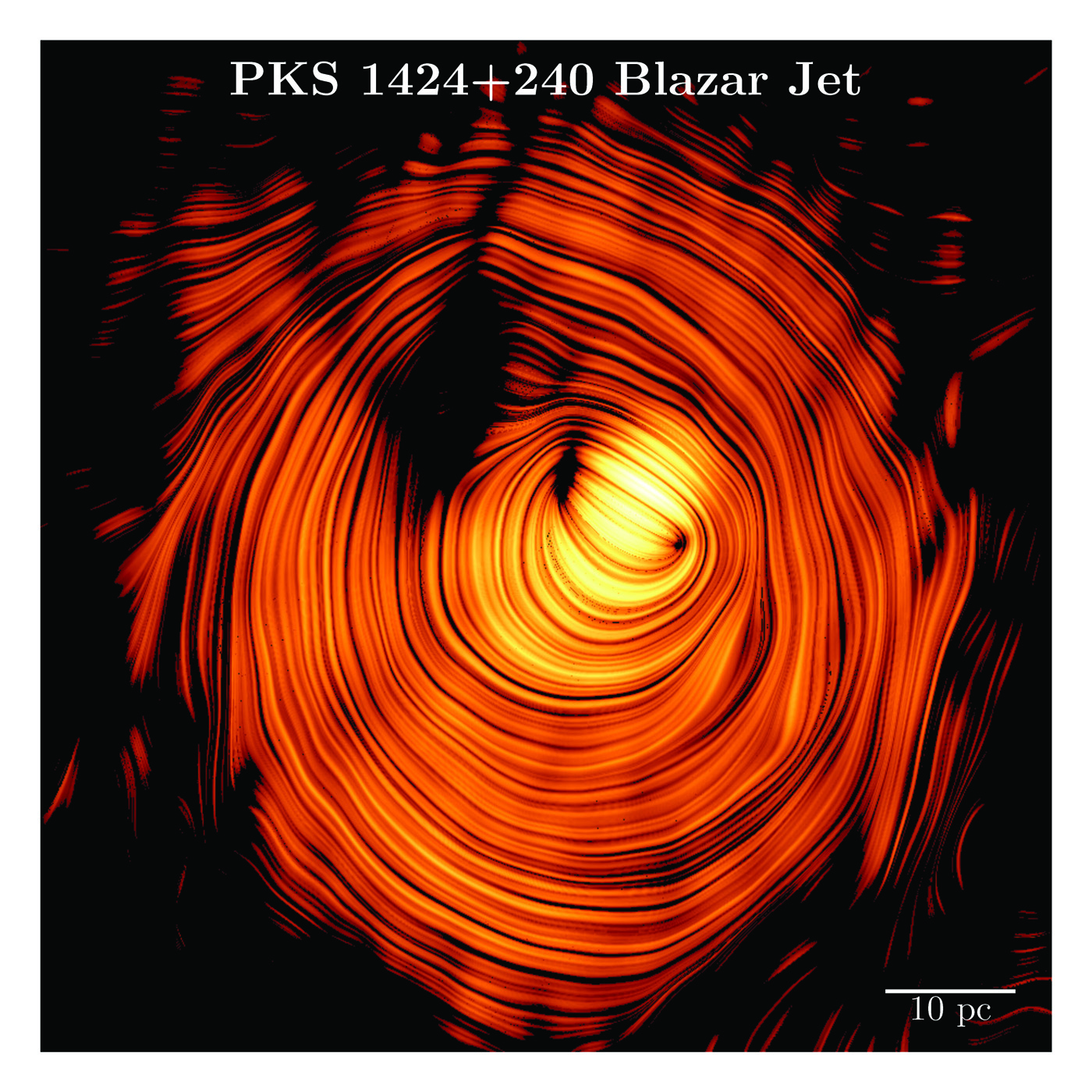
The object captured in the photo is known as PKS 1424+240. It is located billions of light years from Earth and is a blazar — a galaxy with a supermassive black hole at its center that actively absorbs matter. The jet it produces is directed toward us, which makes it appear much brighter than usual.
PKS 1424+240 has long puzzled astronomers. It stands out as the brightest of the known blazars emitting neutrinos, and is also a source of very high-energy gamma rays. However, strangely enough, its radio jet moves slowly, which contradicts models according to which only very fast jets can be the source of such powerful radiation.
Now, thanks to 15 years of super-precise radio astronomical observations using the VLBA radio telescope, researchers have been able to create a detailed image of this jet with unprecedented resolution. It showed an almost perfect toroidal magnetic field with a jet directed straight at us.
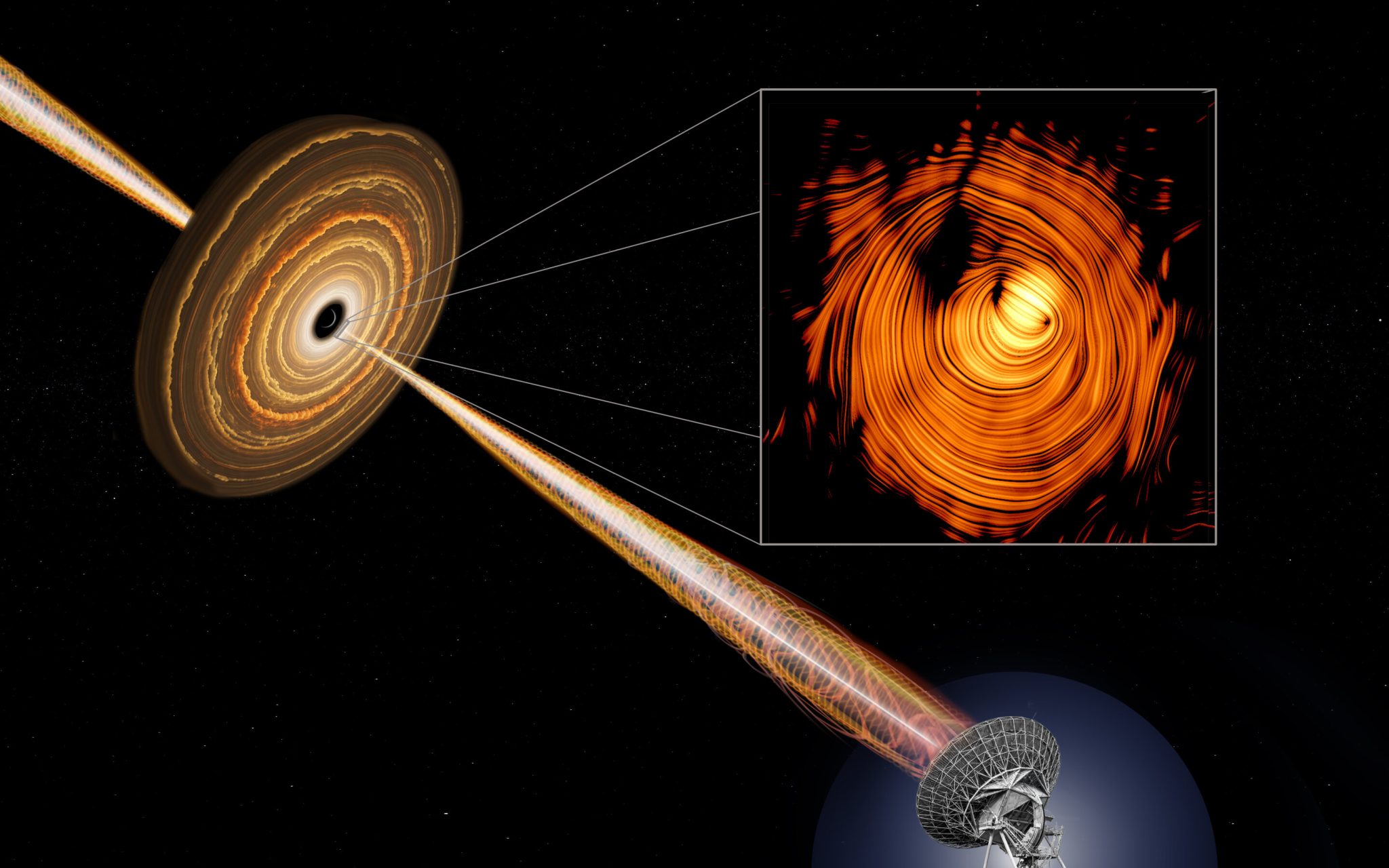
Since the jet is directed almost exactly toward Earth, its high-energy radiation is significantly amplified by the effects of special relativity. This alignment results in a brightness increase of 30 times or more. At the same time, the jet appears to move slowly due to projection effects — a classic optical illusion.
This geometry allowed scientists to look directly into the heart of the blazar jet — an extremely rare opportunity. Polarized radio signals helped the team map the structure of the jet’s magnetic field, revealing its probable spiral or toroidal shape. This structure plays a key role in launching and collimating the plasma flow and may be necessary for accelerating particles to extreme energies.
According to scientists, solving this mystery confirms that active galactic nuclei with supermassive black holes are not only powerful accelerators of electrons, but also protons — sources of the observed high-energy neutrinos.
This discovery is a triumph for the MOJAVE program, under which VLBA has been monitoring relativistic jets in active galaxies for decades. Scientists use very long baseline interferometry (VLBI) technology, which connects radio telescopes around the world to form a virtual telescope the size of the Earth. This provides the highest resolution available in astronomy, allowing us to study the smallest details of distant cosmic jets.
Earlier, we reported on how astronomers found one of the largest known black holes, whose mass is 36 billion times greater than that of the sun.
According to Phys.org

