

For a planet with the mass of Earth to become similar to it, the protoplanetary disk must be enriched with radioactive elements with a short half-life. It is commonly believed that only an extremely rare event – a supernova explosion at a certain distance – can provide them. However, there is now speculation that this event was not so exceptional.
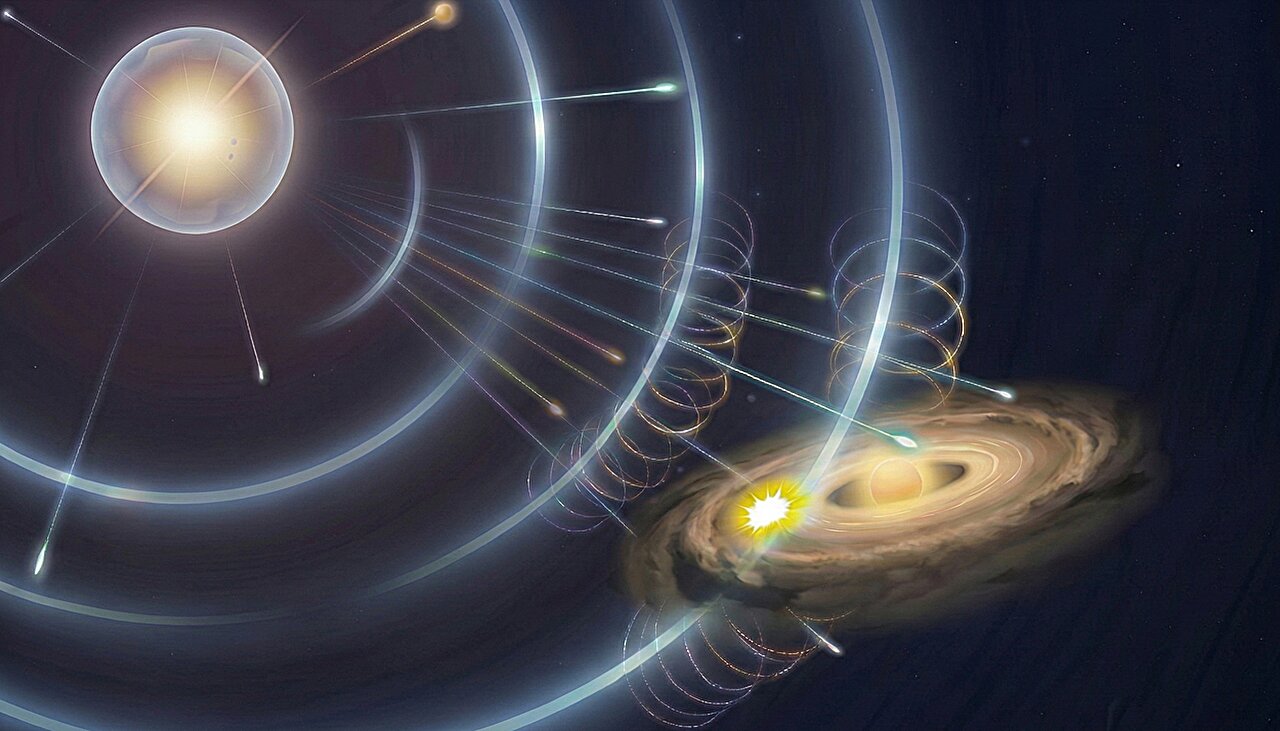
Injection of radioactive materials
Supernovae are usually considered a threat to life on Earth. However, there has long been a theory that they made our planet suitable for living beings in the first place. This is because there could have been too much water on it, and oceans stretching for many kilometers would have made the existence of multicellular organisms problematic.
This is usually explained as follows: at the protoplanetary disk stage, it contained many short-lived radioactive elements, such as aluminum-26. Later, they completely decayed, but in doing so, they released enough heat for the planetesimals to get rid of excess water. But where did these substances come from?
Usually, their appearance is attributed to a supernova explosion. In this case, it would have had to occur extremely close by, but not quite close enough to destroy the protoplanetary disk itself. Only then could the latter receive enough radioactive material that would arrive with the shock wave. Therefore, such an “injection” seems extremely unlikely.
New idea
This low probability could fit perfectly into the theory of a unique Earth. However, scientists already know that the universe is full of planets similar to ours. This needs to be explained somehow, and this is the subject of a new study published in Science Advances.
In it, researchers drew attention to another possibility for obtaining aluminum-26. During a supernova explosion, a large number of high-energy particles are produced. They fly in all directions and are quite capable of ionizing the protoplanetary disk that happens to be in their path. And in it, the same radioactive substances can easily form.
At the same time, the young star may be located much further away from the supernova, at a distance of several parsecs. This is quite normal for star clusters where stars similar to the Sun are born. In other words, the controversy simply disappears.
Provided by: phys.org

