

A new study published in the journal Science Advances has shed light on some important details about the largest and oldest impact crater on the Moon, which spans more than 1,200 miles (2,000 km) on the far side of the Moon. This new data could be useful in planning NASA’s upcoming Artemis mission to the Moon, which is scheduled for 2028.
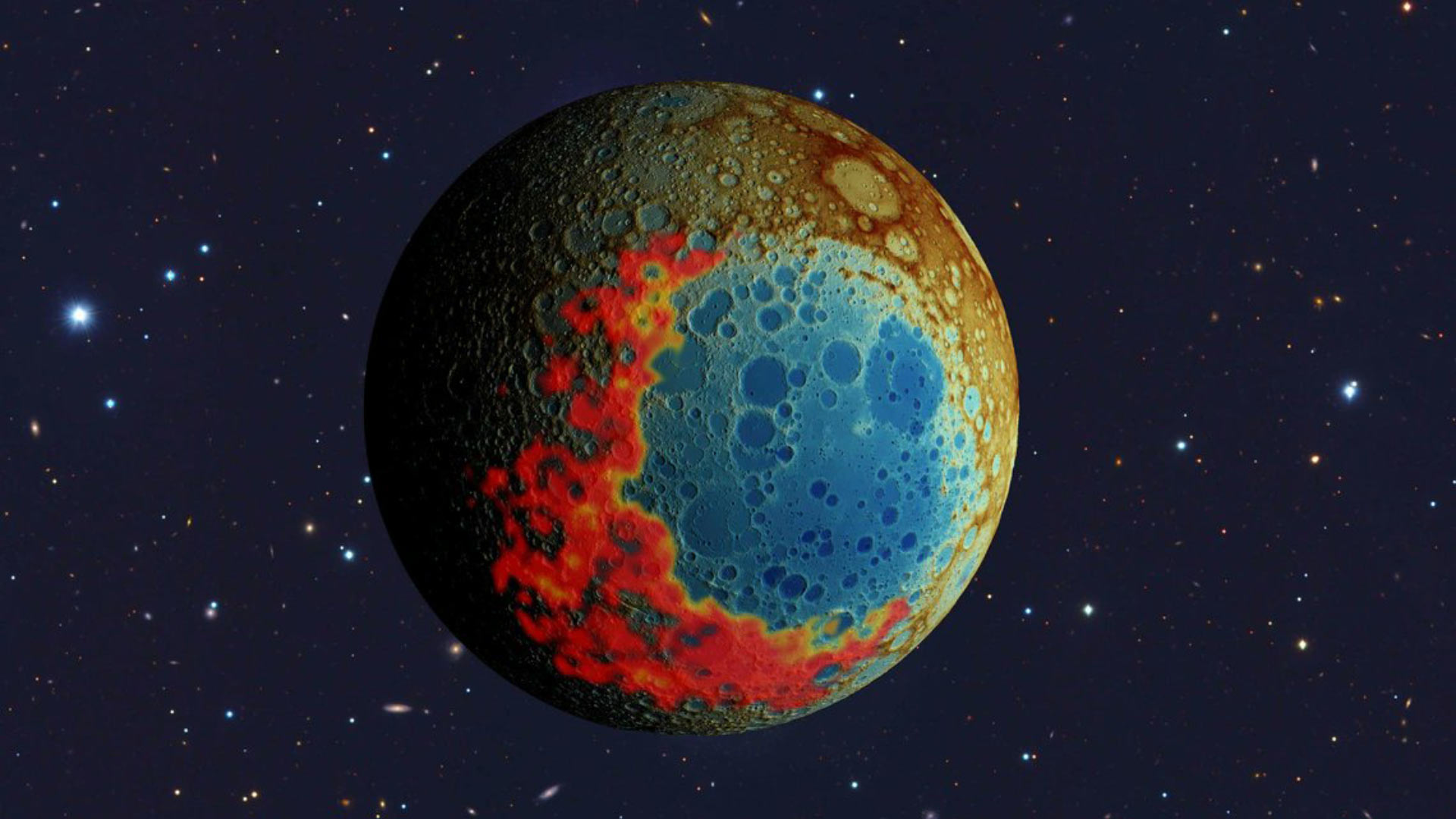
The largest impact basin on the Moon
The South Pole–Aitken (SPA) basin is the largest and oldest confirmed impact basin on the Moon. It has a unique conical-elliptical shape that has puzzled scientists and sparked debate regarding the direction and nature of the impact that formed it. Certain asymmetries in the crust suggest a northward impact trajectory, while the shape and structure of the basin suggest a southward trajectory.
Large impact basins on the Moon and other solid bodies (such as Mars and Pluto) are shaped like ellipses that narrow in the direction away from the impact site. The narrowing of the SPA toward the south, the steeper crustal thickness gradient toward the north, and the presence of a thorium- and iron-rich deposit southwest of the SPA beyond the basin rim all confirm a southward impact trajectory.
This direction also helps determine where ejecta—including material from the Moon’s mantle—might have landed during and after the impact. Previous models estimated that the impactor was between 200 and 400 km wide, with an impact angle of between 30° and 45°. However, previous models did not analyze the relationship between the direction of the impact and the observed distribution of SPA crust thicknesses, nor did they examine the relationship between its tapered shape and the distribution of ejecta. Determining these details could help us understand the Moon’s history and plan future missions.
How was the South Pole–Aitken crater formed?
To better understand the SPA pool and the object that formed it, the team used high-resolution 3D modeling to simulate a collision with a lunar analogue under various conditions. In their simulations, the scientists used both differentiated and undifferentiated bodies, with the materials in the differentiated bodies having separated into a dense core and outer layers as a result of heating during the early stages of their formation. The simulations also varied the size, angle, and velocity of the impacting object. The team compared the results of each simulation with the observed characteristics of the basin.
The simulation results showed that the shape of the SPA basin is best explained by the impact of a 260-km-wide differentiated impactor that struck from north to south at a slight angle without penetrating the lunar surface completely. Scientists claim that it is the impactor’s dense core that is responsible for the basin’s characteristic narrowing. Models show that material is ejected, and then, toward the end, the temporary crater collapses under the force of gravity, forming a large, asymmetrical central uplift. Most of the material from the Moon’s mantle that was ejected by the impact fell back into the basin.
Differences in the objects’ speeds resulted in different crater shapes. At a speed of 10 km/s, the models produced a shape similar to the team’s preferred option, but the narrowing was too exaggerated. At a speed of 16 km/s, the crater was too circular compared to the actual SPA, which suggests that the object’s speed was likely somewhere in between. The speed also provides clues about its origin.
Scientists believe that, given the dynamic evolution and collisions of planetesimal remnants, the SPA impactor most likely originated from the Mars region rather than from Venus or Earth. Objects in the Mars region were transported there and formed in situ in the early Solar System.
The Artemis mission’s potential
The main objective of the study was to determine the distribution of mantle emissions around the SPA and to determine whether samples could be obtained during future missions. Simulations showed that the emissions spread out in a butterfly shape, with mantle material extending approximately 550 km beyond the edge in the downward direction and 650 km in the transverse direction. However, it was found that there were no mantle emissions in the upward direction.
Since the upcoming Artemis lunar mission plans to land near the Moon’s south pole, close to the southern edge of the SPA, the team believes that collecting samples of the lunar mantle is a very likely outcome—provided their modeling is correct.
Scientists note that while the resolution of the study is high for 3D models, it may still fail to capture finer details of crustal deformation and the distribution of emissions. However, samples from the Artemis mission are likely to directly test these predictions over the next few years. The team notes that these samples could help determine the age of the SPA and the composition of the lunar mantle.
According to phys.org

