

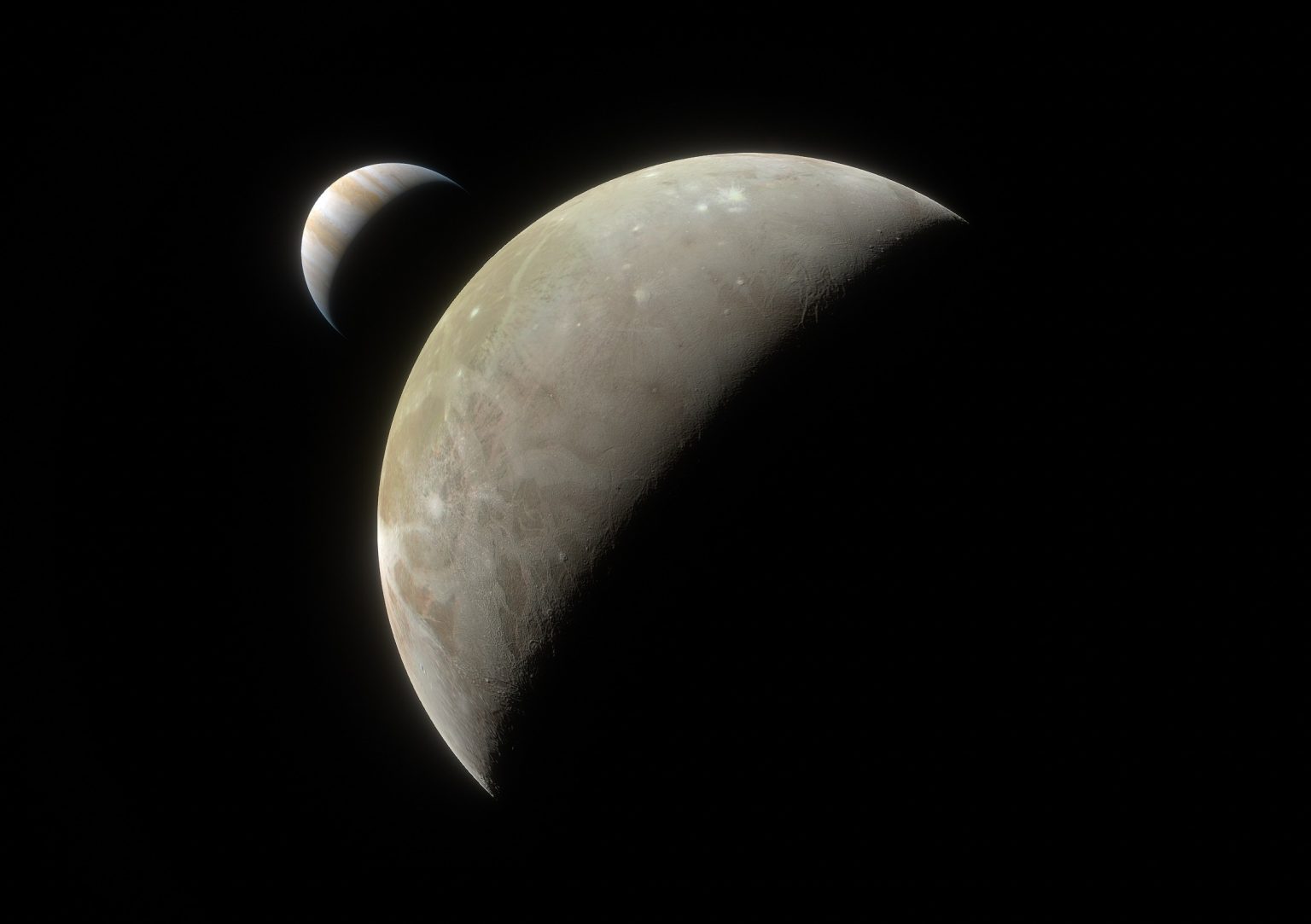
In search of the answer to one of the most mysterious secrets of the Universe, scientists are taking bold and even ambitious steps. Physicist William DeRocco from the University of Maryland has proposed a radically new approach: turning Ganymede, Jupiter’s largest moon, into a giant detector for searching for dark matter.
Dark matter is a hypothetical form of matter that does not emit or absorb light, making it completely invisible to modern instruments. However, astrophysicists are certain that it exists, because its gravity is what keeps galaxies from falling apart. It accounts for about 85% of the total mass of the Universe, but it has not yet been possible to directly detect its particles. The search is being conducted using large underground detectors, but DeRocco suggests taking a different approach — significantly increasing the scale.
Ganymede — Space Explorer
The idea outlined in the preprint on arXiv is to search not for the particles themselves, but for traces of their interaction. Scientists think there might be super heavy dark matter particles. When such a particle crashes into Ganymede’s thick ice shield at high speed, it should leave behind a characteristic “crater” — not just a dent, but a deep crack with melted and reshaped ice. These structures can reach depths where ice meets the underground ocean, bringing unique minerals to the surface.
Fortunately, this theory can be tested in the near future. Two space missions are heading to Jupiter: the American Europa Clipper (NASA) and the European JUICE (ESA). Both are equipped with powerful radars capable of “looking” under the ice and mapping the terrain in detail. DeRocco suggests that the scientific teams involved in these missions pay attention to the anomalous craters on Ganymede, which may be the very “fingerprints” of dark matter.
Cautious optimism
The scientific community has responded to the idea with cautious optimism. Bradley J. Kavanagh, an astrophysicist at the University of Cantabria, acknowledges that the principle sounds promising, but points out that the existence of such massive particles is still only a hypothesis.
This proposal is a striking example of how solving fundamental mysteries requires not only precise calculations, but also bold imagination. There is currently no evidence to support or refute this claim. We will only know whether Ganymede is the key to dark matter once spacecraft transmit the first detailed images of its surface back to Earth.
According to newscientist.com

