

Scientists have studied the exoplanet TOI-561 b. It is a lava world that orbits extremely close to its star, a red dwarf. Astronomers were surprised to learn that it has an atmosphere.
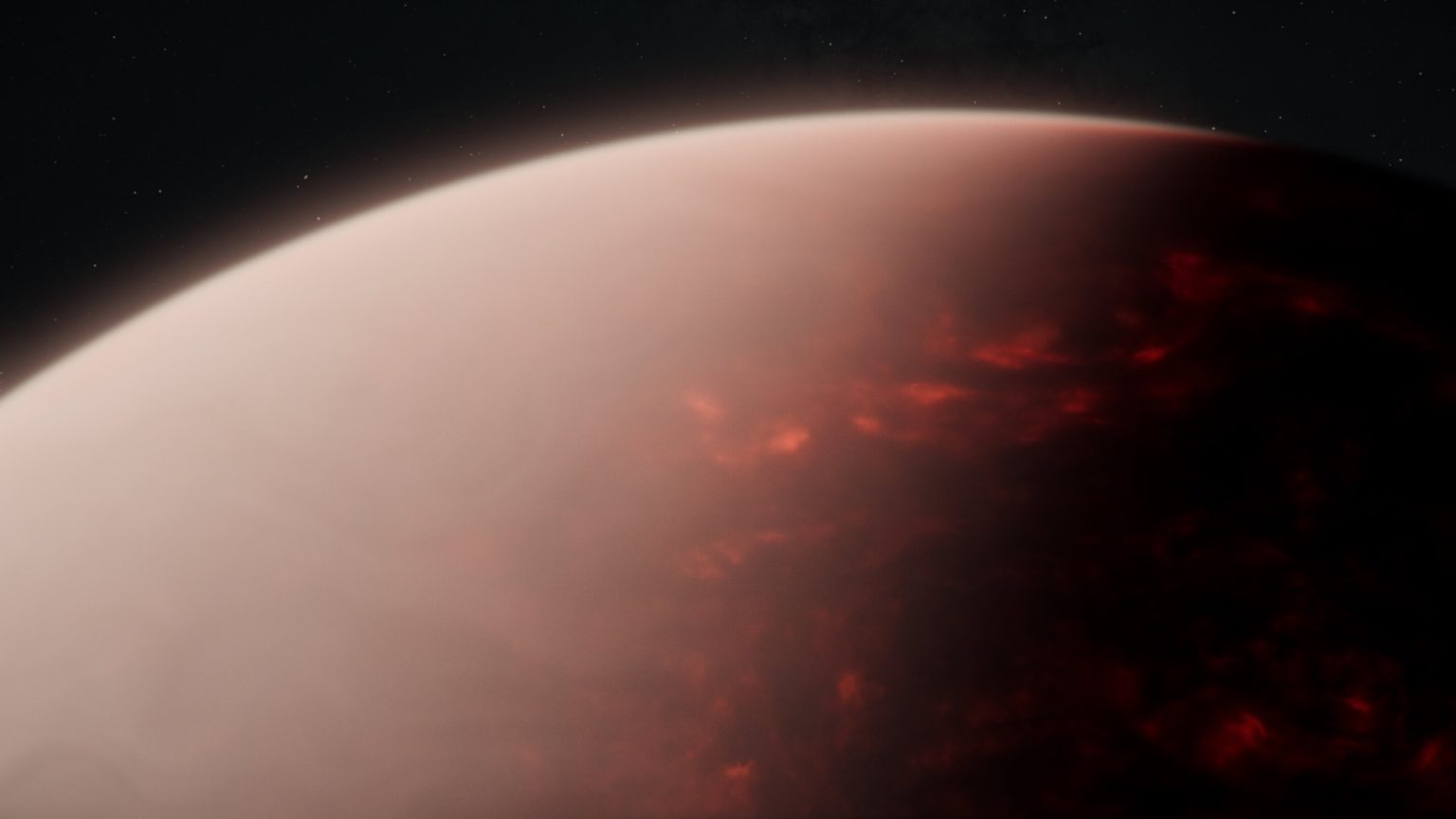
A rocky exoplanet with an atmosphere
A Carnegie-led team of astronomers detected the strongest evidence yet of an atmosphere around a rocky planet beyond our solar system. Their work, published in The Astrophysical Journal Letters, used NASA’s JWST to reveal an alien atmosphere in an unexpected place – an ancient, ultra-hot super-Earth that likely hosts a magma ocean.
TOI-561 b is a rocky world that’s about twice Earth’s mass but bears little resemblance to our home planet due to its proximity to its host star. Although the star is slightly less massive and cooler than our sun, the planet orbits at one fortieth the distance of Mercury in our own solar system. On TOI-561 b, a year lasts just 10.56 hours, and one side of the planet is in perpetual daylight.
“Based on what we know about other systems, astronomers would have predicted that a planet like this is too small and hot to retain its own atmosphere for long after formation,” explained Carnegie Science Postdoctoral Fellow Nicole Wallack, the paper’s second author. “But our observations suggest it is surrounded by a relatively thick blanket of gas, upending conventional wisdom about ultra-short-period planets.”
In our own solar system, smaller and hotter planets were not able to hang on to the primordial envelope of gas that surrounded them in their formative years. But TOI-561 b’s host star is much older than our sun, and its atmosphere remains intact.
Explanation for the low density of the exoplanet
In designing the observing program, the team considered that the planet’s low density could be explained by a relatively small iron core and a mantle made of rock that is less dense than the rocks that comprise Earth’s interior.
Johanna Teske notes that this could make sense: “TOI-561 b is distinct among ultra-short period planets in that it orbits a very old – twice as old as the sun – iron-poor star in a region of the Milky Way known as the thick disk. It must have formed in a very different chemical environment from the planets in our own solar system.”
This means that its composition could be representative of planets that formed when the universe was relatively young. But an exotic interior composition can’t explain everything.
In deciding to study TOI-561 b, the research team also suspected that it might be surrounded by a thick atmosphere that makes it look larger and thus less dense.
Infrared studies of the planet
To test the existence of TOI-561 b’s atmosphere, the astronomers used JWST’s Near-Infrared Spectrograph (NIRSpec) instrument to measure the planet’s dayside temperature based on its brightness in the near-infrared. The technique, which involves measuring the decrease in brightness of the star-planet system as the planet moves behind the star, is similar to that used to search for atmospheres in the TRAPPIST-1 system and on other rocky worlds.
If TOI-561 b were a bare rock with no atmosphere to carry heat around to the nightside, its dayside temperature should be approaching 4,900 degrees Fahrenheit (2,700 degrees Celsius). But the NIRSpec observations show that the planet’s dayside appears to be closer to 3,200 degrees Fahrenheit (1,800 degrees Celsius) – still extremely hot, but far cooler than expected.
To explain the results, the team considered a few different scenarios. The magma ocean could circulate some heat, but without an atmosphere, the nightside would probably be solid, limiting flow away from the dayside. A thin layer of rock vapor on the surface of the magma ocean is also possible, but on its own would likely have a much smaller cooling effect than observed.
Therefore, scientists needed a dense atmosphere rich in volatile substances to explain all their observations.
Atmosphere retention
While JWST’s observations provide compelling evidence for such an atmosphere, the question remains: How can a small planet exposed to such intense radiation hold on to any atmosphere at all, let alone one so substantial? Some gases must be escaping to space, but perhaps not as efficiently as expected.
“We think there is an equilibrium between the magma ocean and the atmosphere. At the same time that gases are coming out of the planet to feed the atmosphere, the magma ocean is sucking them back into the interior,” said co-author Tim Lichtenberg from the University of Groningen in the Netherlands, who is also a member of the Carnegie-led Atmospheric Empirical Theoretical and Experimental Research (AEThER) project team.
The impressive results of the James Webb Telescope in research
These are the first results from JWST’s General Observers Program 3860, which involved observing the system continuously for more than 37 hours while TOI-561 b completed nearly four full orbits of the star. The team is currently analyzing the full data set to map the temperature all the way around the planet and narrow down the composition of the atmosphere.
Teske and Wallack’s leadership on this JWST paper represents a tradition of Carnegie Science excellence dating back to the mission’s earliest conception three decades ago and extending through the first four cycles of time allocation on the revolutionary space telescope.
Since JWST finished calibrations and began collecting data for astronomical research programs, Teske, Wallack, and other Carnegie Earth and Planets Laboratory and Observatories-affiliated scientists have led more than a dozen JWST teams and announced groundbreaking results about exoplanet atmospheres, galaxy formation, and more.
“These JWST-powered breakthroughs tap directly into our long-standing strength in understanding how exoplanet characteristics are shaped by planetary evolution and dynamics,” said Earth and Planets Laboratory Director Michael Walter. “There are more exciting results on the horizon, and we’re poised for a new wave of Carnegie-led JWST science in the year ahead.”
Provided by: phys.org

