

New computer simulation shows that the Milky Way has to have up to a hundred satellite galaxies. This could confirm the theory of star formation within halos of cold matter. However, astronomers have only observed approximately 60 small star systems around us to date.
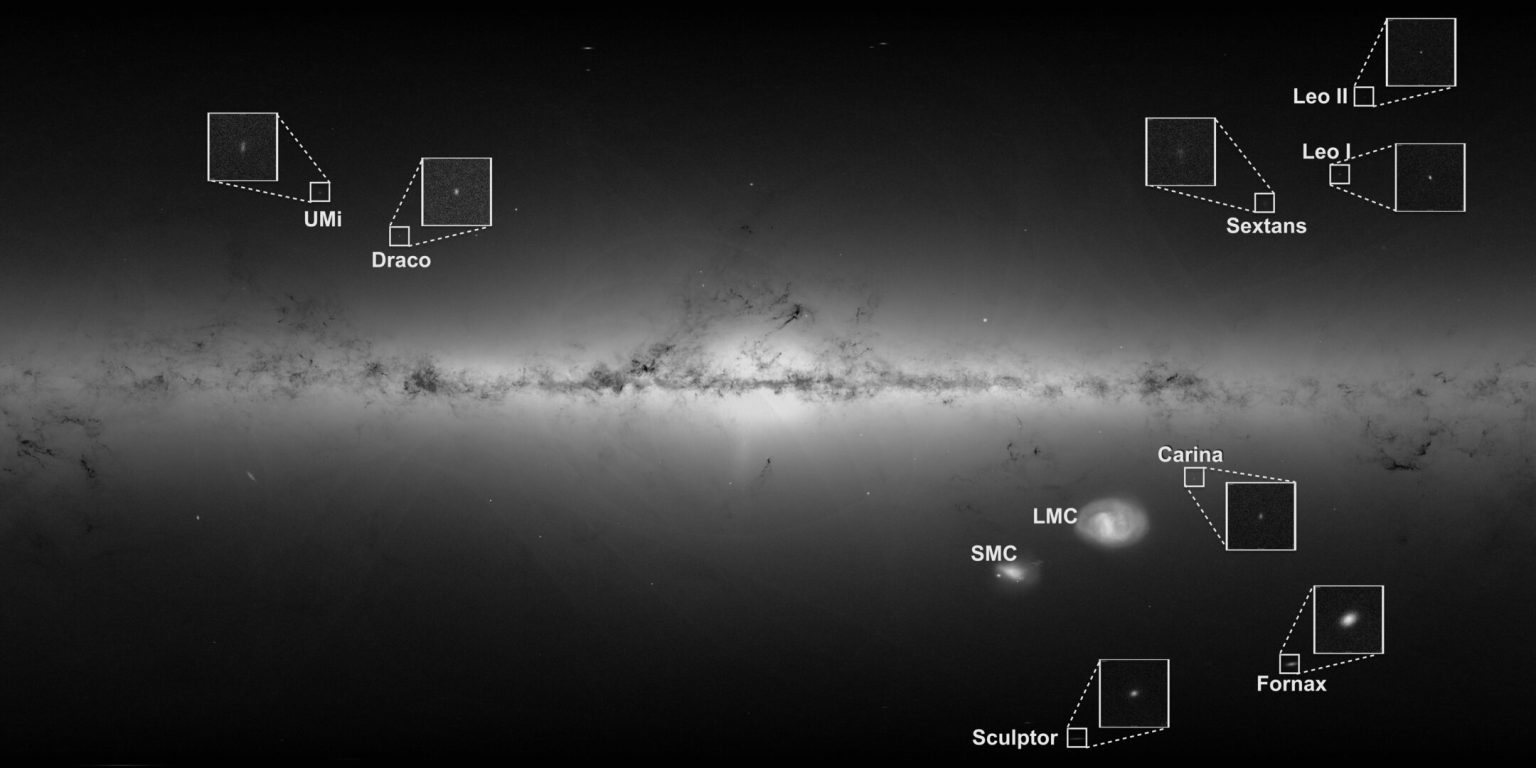
Satellite galaxies
Cosmologists at Durham University have used a new technique that combines the highest resolution supercomputer simulation available with new mathematical modeling to understand how many dwarf galaxies are hidden around us.
Modeling showed that there should be at least 80, possibly up to 100. This is consistent with the predictions of a much larger model called the Lambda Cold Dark Matter theory. It suggests that ordinary matter accounts for only 5 percent of the total mass of matter in the Universe.
There must be significantly more cold dark matter, and in this model it forms a halo around each galaxy and determines its shape. At the same time, satellite galaxies lose their own halos and are located inside a common bubble. And there really should be about a hundred of them.
Invisible galaxies
The problem with all these constructions is that astronomers currently know of approximately 60 dwarf galaxies that are satellites of the Milky Way. The question arises as to why they have not yet discovered the rest.
Of course, one might assume that these star systems are too dim to be seen even with the most advanced telescopes. And the authors of the new study are talking about this very thing. However, they also admit that their models are unable to tell astronomers exactly where to look for these dwarf galaxies.
The results of the study showed that dark matter halos, which may contain satellite galaxies, have been orbiting the central halo of the Milky Way for most of the Universe’s existence, leading to the loss of their dark matter and stellar mass, making them extremely small and dim.
The study focuses on approximately 30 recently discovered tiny candidates for satellites of the Milky Way, which are extremely dim and small. Scientists are not sure whether these are dwarf galaxies embedded in dark matter halos or globular clusters, i.e., a collection of self-gravitating stars. Researchers from Durham claim that these objects may be a subgroup of faint companion galaxies, whose existence they predict.
According to phys.org

