

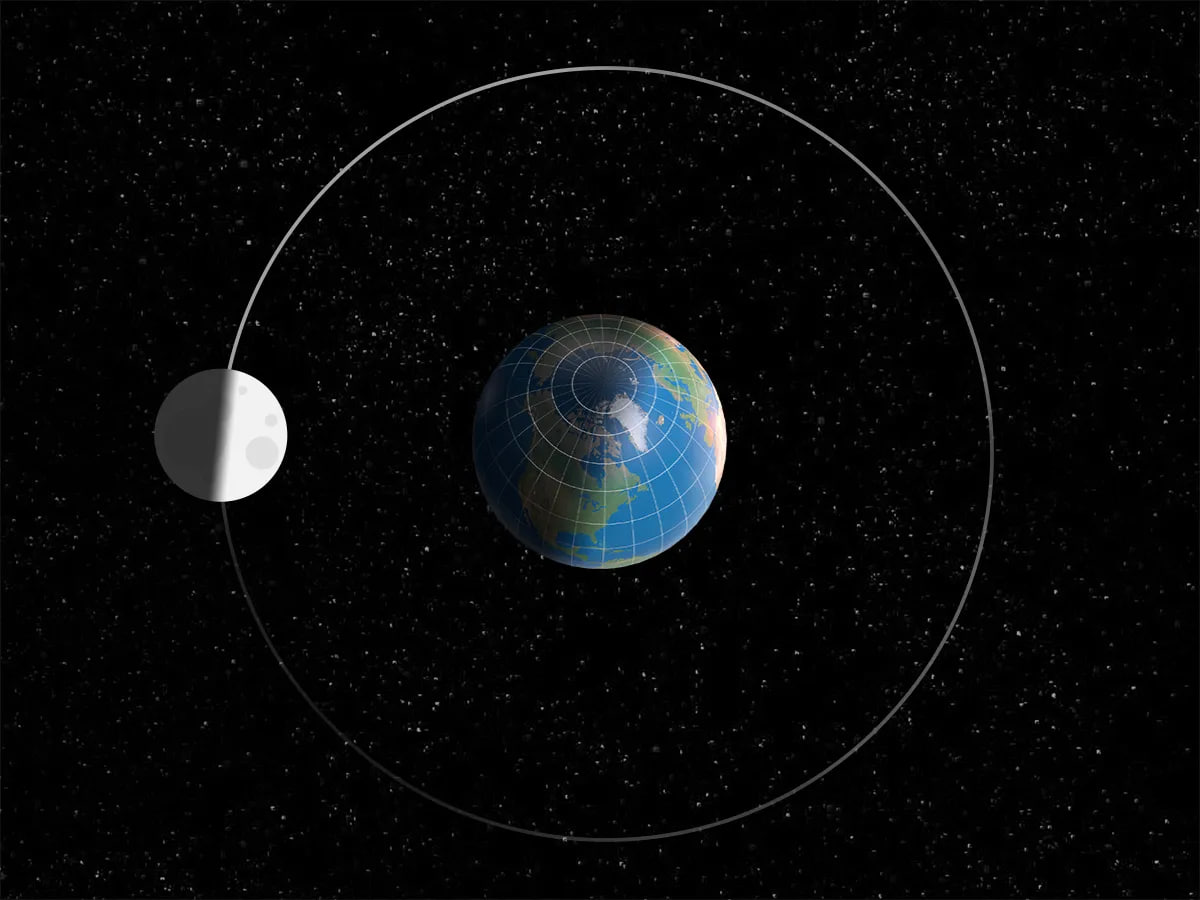
Scientists have discovered that the Moon is moving away from Earth by approximately 3.8 centimeters every year. At first glance, this seems insignificant, but, as American astrophysicist Steve DiKerby from Michigan State University explains, even such a tiny change has significant consequences for our planet over time.
To find out exactly how the distance to the Moon changes, scientists use very precise methods. In particular, during the Apollo missions, astronauts installed special reflective mirrors on the lunar surface. Scientists send laser pulses to them and measure how long it takes for light to reach the Moon and return. In this way, they can detect even microscopic changes.
On average, the Moon is located at a distance of 384,000 km, but its orbit is not perfectly circular. Therefore, during its movement, it changes by approximately 20,000 km. This is why some full moons appear larger than others – these are called supermoons.
After scientists established the fact of gradual separation, the question arose: Why is this happening? The main reason is the tides created by the Moon’s gravity. The Moon’s gravitational pull is slightly stronger on the side of the Earth facing it and weaker on the opposite side. This creates two tidal bulges in the oceans: one facing the Moon and the other lagging behind the planet. As the Earth rotates, these bulges shift forward, as if “pulled” by the planet’s rotation. They are not perfectly aligned with the Moon and are slightly ahead of it.
“These water bulges pull the Moon forward in its orbit, like a sports car getting an extra boost on a turn,” explains DiKerby.
As a result, the Moon moves slightly faster and thus gradually moves into a larger orbit. At the same time, the Earth loses some of its rotational momentum, its rotation slows down, and the day becomes longer – only slightly, but noticeably over millions of years.
In the distant past, billions of years ago, the Moon was much closer to our planet, and Earth’s days were shorter.
“The Moon formed about 4.5 billion years ago after a collision between the young Earth and a protoplanet the size of Mars. Initially, it was much closer and would have appeared enormous in the sky,” notes DiKerby.
According to paleontologists, about 70 million years ago, a day lasted 23.5 hours, which coincides well with astronomical calculations.
If we imagine the future billions of years from now, the Earth and Moon may reach a state where the Earth will always face the Moon with one side, just as the Moon always faces us with one side. Then it will stop moving away. However, as Steve DiKerby assures us, this will most likely never happen.
“In about a billion years, the Sun will become brighter and evaporate the oceans, and eventually expand into a red giant and destroy both the Earth and the Moon. But this will happen so far in the future that there is no point in worrying about it,” he concludes.

