

We will never see the Milky Way from the outside, because we are inside it. From Earth, we can only see part of it—a striped structure of stars and dust in the night sky. This is our view of the galactic plane in visible light, obscured by clouds of cosmic dust. But if our eyes could see radio waves, we would see a true wonder.
A titanic effort
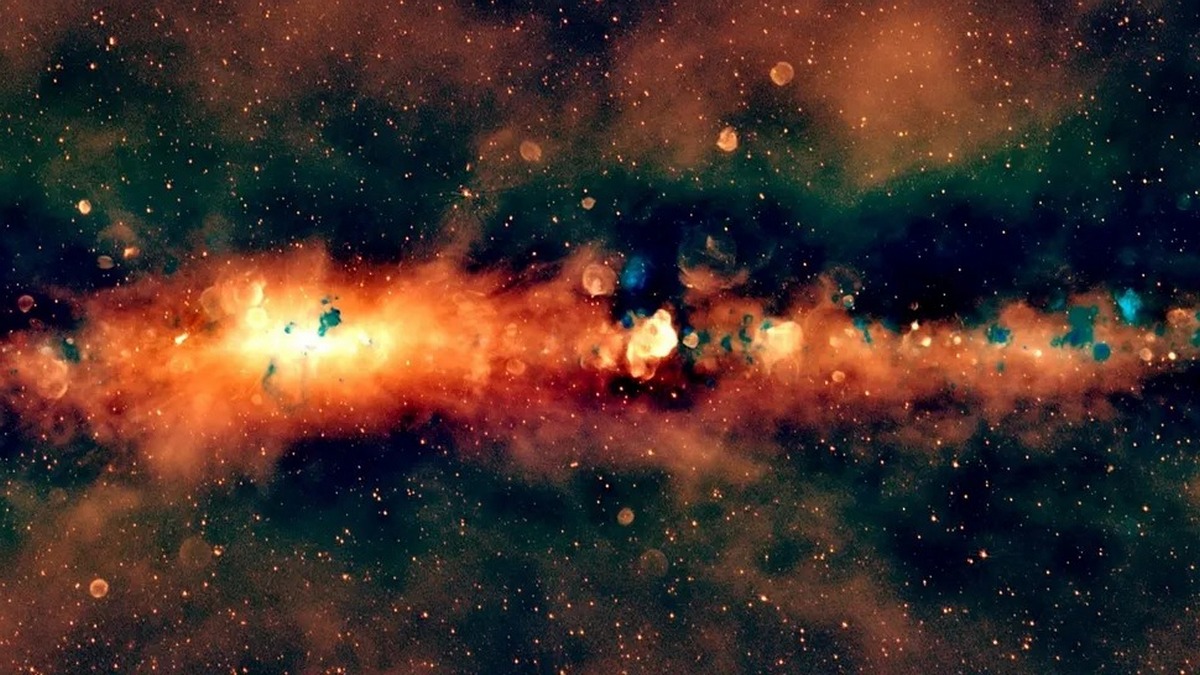
A team of astronomers from Australia has managed to achieve this “miracle.” They presented the largest and most detailed low-frequency radio image of the galactic plane visible from the Southern Hemisphere. It is ten times clearer and has twice the resolution of previous images. Researchers claim that only the future giant SKA-Low telescope will be able to surpass this level.

This masterpiece is based on data from the GLEAM and GLEAM-X projects collected by the Murchison Widefield Array telescope. Silvia Mantovanini, a graduate student at Curtin University, spent more than 40,000 hours processing and analyzing the data. The result is impressive: the new image covers twice the area and reveals regions that have never been observed at these frequencies before.
What do the “colors” of radio waves reveal?
In the image, radio waves of different frequencies are represented by colors, allowing astronomers to “paint” the cosmic landscape and identify objects.
- The large red bubbles are the remains of stars that once exploded as supernovae.
- The compact blue areas are active stellar nurseries where new stars are born.
This radio portrait contains more than 98,000 sources, including pulsars and nebulae. It is unique in that it simultaneously displays the entire life cycle of stars — from their birth in gas clouds to their grand death, which scatters material for future generations. This is a real milestone in the study of our galaxy.
Earlier, we reported on how a giant shock wave was spreading across the Milky Way.
According to Live Science

