

Astronomers from the University of North Carolina at Chapel Hill have made a sensational discovery: the famous group of bright stars known as the Pleiades is only the visible part of a much larger structure. It turns out that the Pleiades is 20 times larger than previously thought!
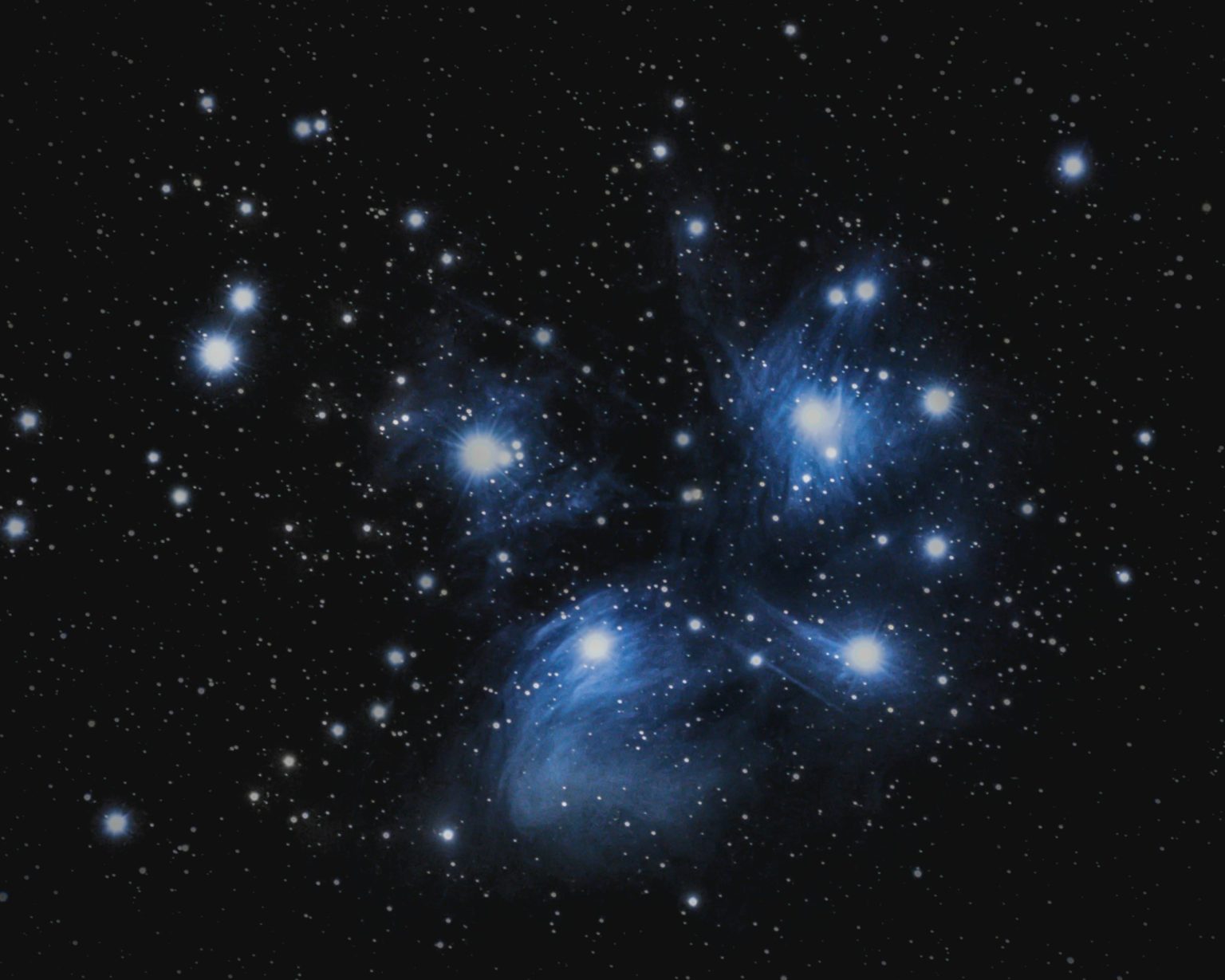
The breakthrough came thanks to the combination of data from two space missions: NASA’s Transiting Exoplanet Survey Satellite (TESS) and the European Space Agency’s Gaia telescope. The research team used a clever method: they measured the rotation speed of the stars. Young stars rotate very quickly, and their rotation slows down as they age. Since the Pleiades is a relatively young cluster, its true members should rotate at a certain speed.
By analyzing TESS data on the rotation of thousands of stars and combining it with precise maps of motion and position from Gaia, scientists have discovered an entire army of “lost sisters.” These stars are scattered across the sky, forming what is known as the Greater Pleiades Complex.
A window into the hidden structure of the Milky Way
The discovery has far-reaching implications. First, it changes our view of the Milky Way. Many stars that we have thought of as “loners” are actually part of huge star families with complex structures. Second, the Pleiades serve as a key laboratory for studying young stars and the planetary systems around them. Understanding the true scale of the cluster will help us better understand the conditions in which stars and planets are born.
“This research changes our understanding of the Pleiades,” says study leader Andrew Boyle. “They are not just seven bright stars, but thousands of long-lost brothers and sisters scattered across the sky.”
This study opens up a new way of mapping our galaxy. The method of measuring the rotation of stars allows us to find star families that are too scattered for traditional search methods.
Future research using this method may even shed light on the origin of our own star. Scientists hope to find out whether the Sun was born in a similar huge stellar family or was a “loner” from the very beginning. Each such discovery is another step toward unraveling the main mystery: how solar systems like ours are formed.
According to unc.edu

