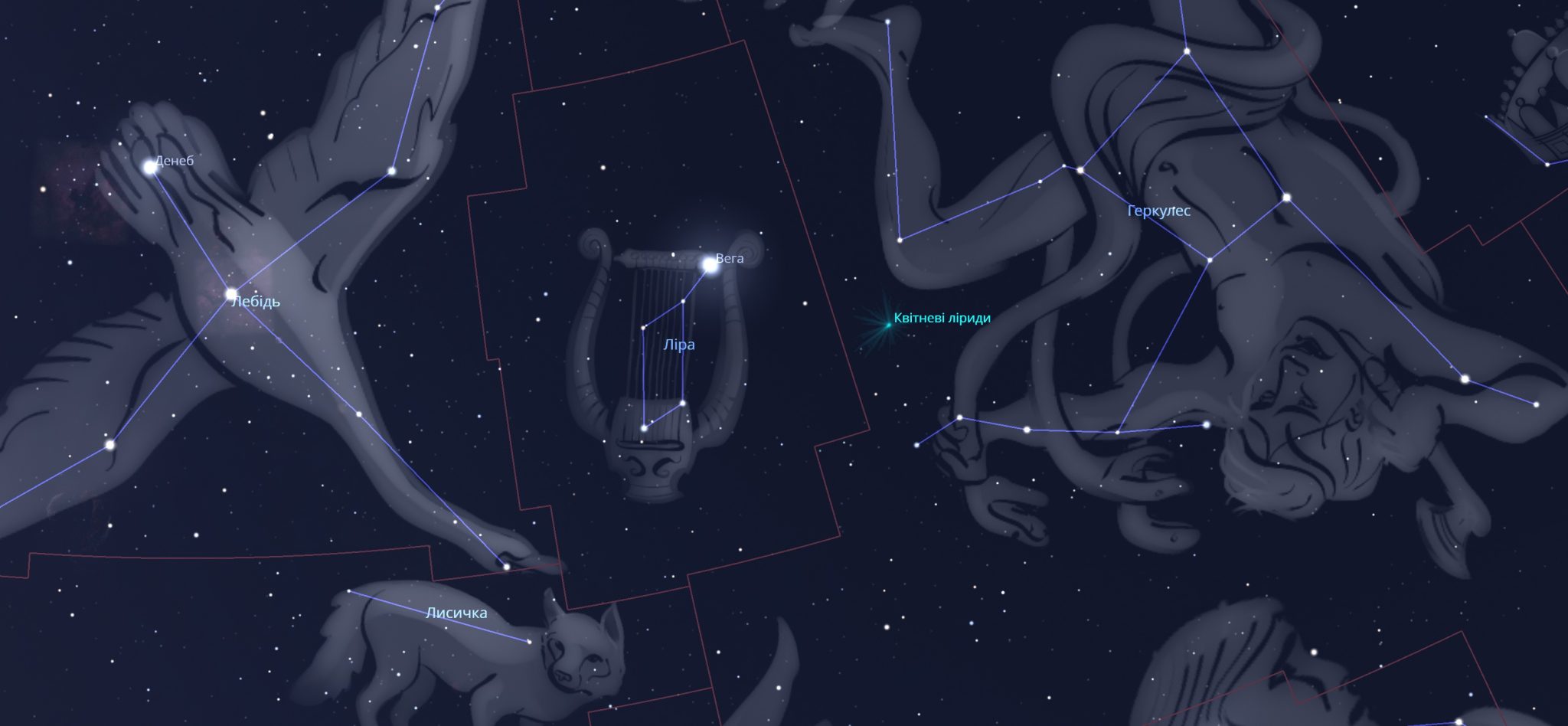
While the attention of the space-loving community is focused on the Artemis II mission, two comets are flying across the April sky. The fate of one of them may turn out to be quite dramatic, while the other can already be observed before dawn in the east. Comet C/2026 A1 (MAPS), discovered in the first half of January this year by an amateur survey, will pass through perihelion on April 4 at a distance of just 162,000 km from the Sun’s photosphere. As for the second comet, C/2024 R3 (PanSTARRS), it promises to be a fine binocular (or telescopic) object in the first half of April.
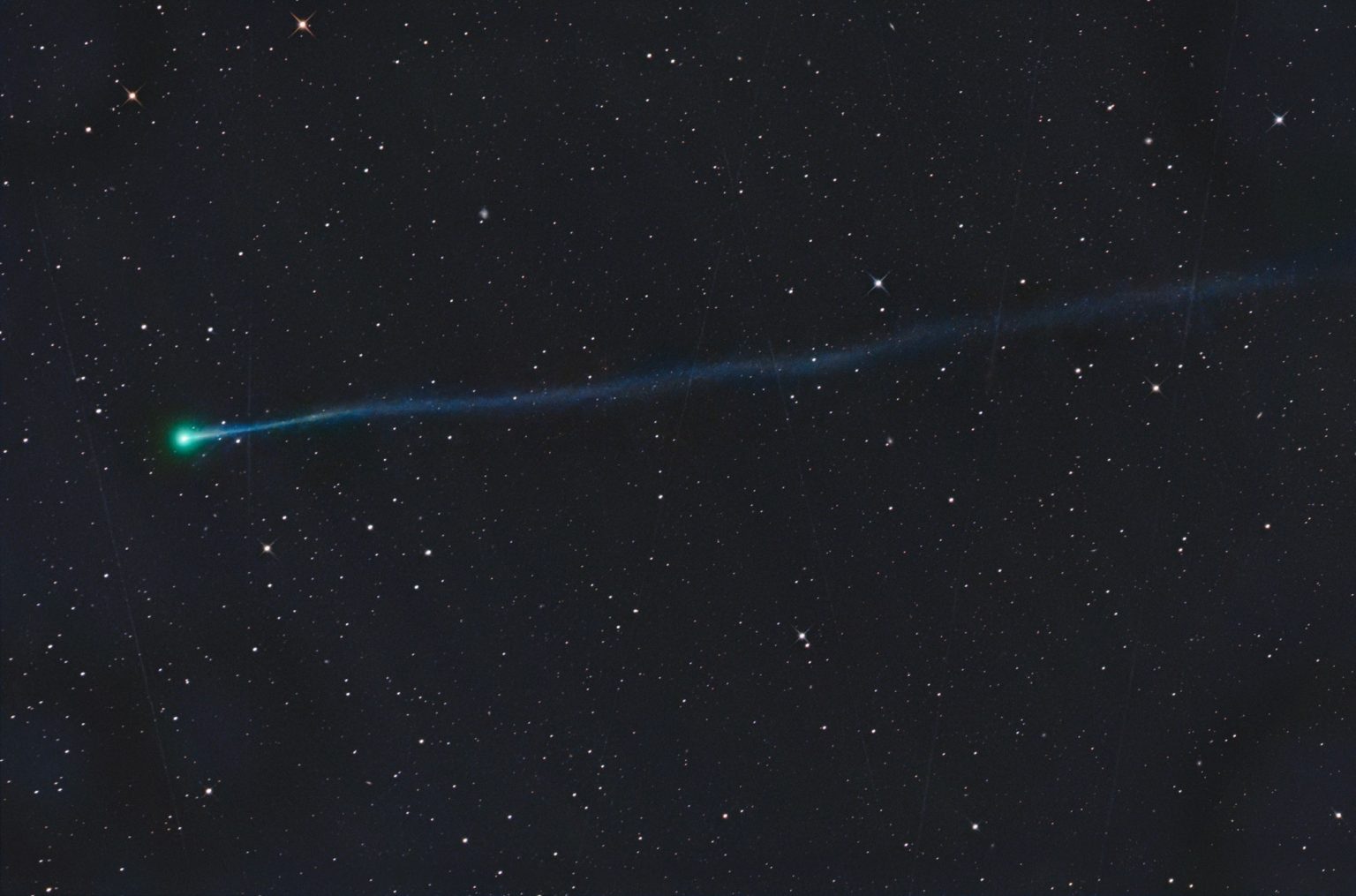
In addition, April is known for the first relatively intense “meteor shower” following the “winter-spring drought” – the Lyrid meteor shower is expected to peak on the 22nd, with a fairly favorable moon phase of just 26%. With a ZHR of 18, the Lyrids are not a particularly spectacular event, but you can definitely count on seeing at least a few meteors per hour during rural observations.
The April evening sky will be graced by the two brightest planets. Venus, though still low on the horizon, is easily visible immediately after sunset. And as civil twilight sets in, Jupiter will shine high in the sky in the constellation Gemini. Technically, Uranus is in the evening sky near the Pleiades cluster. But even for an experienced observer, it will be difficult to spot it in April through a telescope or binoculars against the fairly bright sky.
Among this month’s notable planetary alignments, Mercury will reach its greatest western elongation. This usually marks the best time to observe the fastest planet in the predawn sky. However, the current elongation will be extremely unfavorable for us – the planet rises shortly before the Sun, so it is unlikely we will be able to spot it so low above the horizon.
The second ten days of the month will feature another interesting event: Mercury, Mars, Neptune, and Saturn will be clustered closely together. However, the same problem applies as with Mercury’s greatest elongation: the planets will be too low in the sky and will appear above the horizon just before sunrise.
General circumstances
April 2 – Full Moon, exact time 5:12 a.m. Kyiv time (2:12 a.m. UTC).
April 3 – Mercury (+0.2m) at its greatest western elongation. Although it will be as far as 27° from the Sun (close to the maximum theoretically possible angular distance), Mercury rises only about 40 minutes before the Sun in our latitudes, so it will be nearly impossible to see. At the same time, for the Southern Hemisphere, the configuration is indeed the most favorable.
April 4 – Comet C/2026 A1 (MAPS) reaches perihelion.
April 16-20 – Mercury, Neptune, Mars, and Saturn will be clustered closely together in the predawn sky. Due to their proximity to the Sun, this spectacular event will not be visible.
April 17 – new moon, exact time 2:52 p.m. Kyiv time (11:52 a.m. UTC).
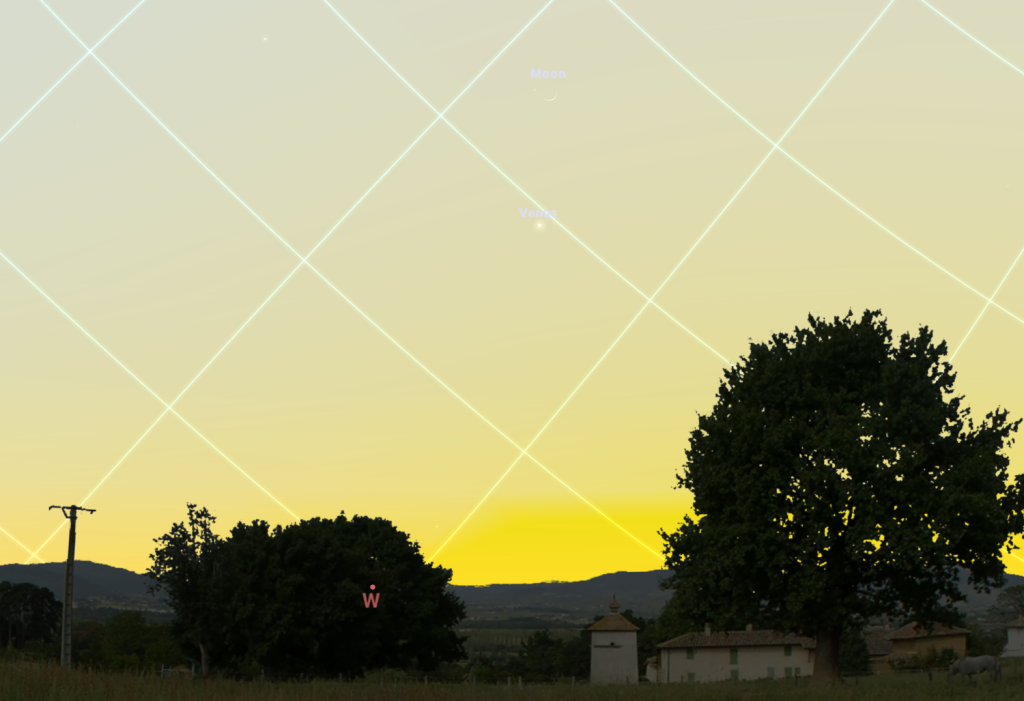
April 19 – conjunction of the Moon (7%) and Venus (-3.9m) in the evening sky.
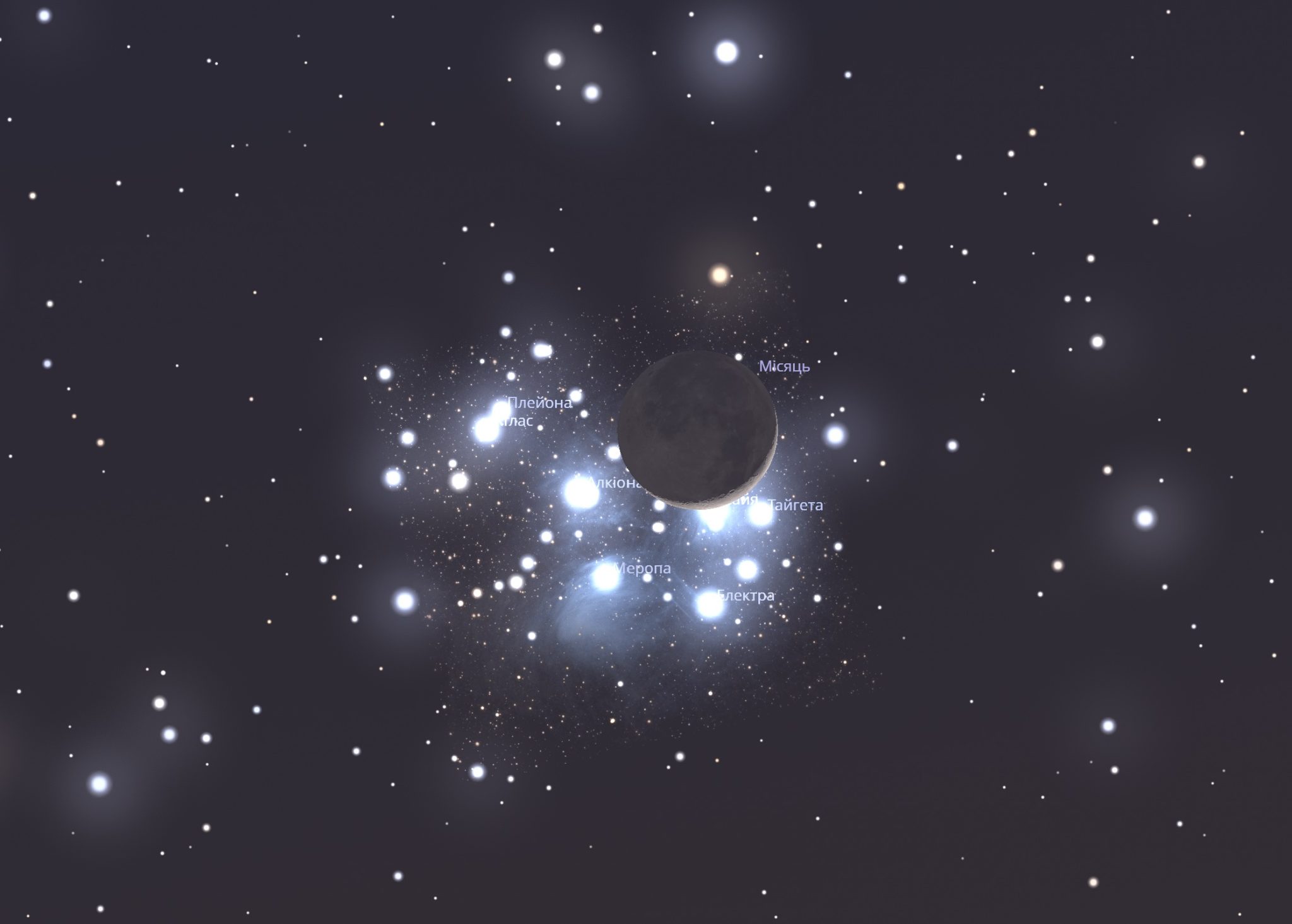
April 19 – occultation of the Pleiades star cluster (M45) by the Moon (8%).
April 19 – Comet C/2025 R3 (PanSTARRS) reaches perihelion.
April 22 – the Moon will come very close (36%) to Jupiter (-2.1m). From an astronomical standpoint, the conjunction will occur on April 23 at 2:56 a.m. Kyiv time. However, at that time, the celestial bodies will already be below the horizon. Therefore, the best time for observation will be the evening of April 22.
April 22 – peak of the Lyrid meteor shower, ZHR = 18.
April 23 – Venus (-3.9m) and Uranus (+5.8m) will make a close approach. The former is easily visible to the naked eye even in a bright sky, but Uranus will be very difficult to spot.
A detailed overview of the most interesting circumstances
April 4: A pivotal moment for Comet C/2026 A1 (MAPS)
Immediately after the discovery of Comet C/2026 A1 (MAPS) in mid-January 2026, it was identified as belonging to the Kreutz family. This group of comets comes extremely close to the Sun at perihelion and often either partially disintegrates, completely sublimates, or loses a significant amount of mass. Members of the family have highly elongated orbits that lie predominantly in the southern celestial hemisphere and only spend a few days near perihelion in the northern hemisphere.
In the case of C/2026 A1 (MAPS), the cometary nucleus, which is approximately 400 meters in size, will pass just 162,000 kilometers from the Sun’s photosphere. And given the outbursts in February and March and the unusually slow increase in brightness, it can be assumed that partial fragmentation has already occurred.
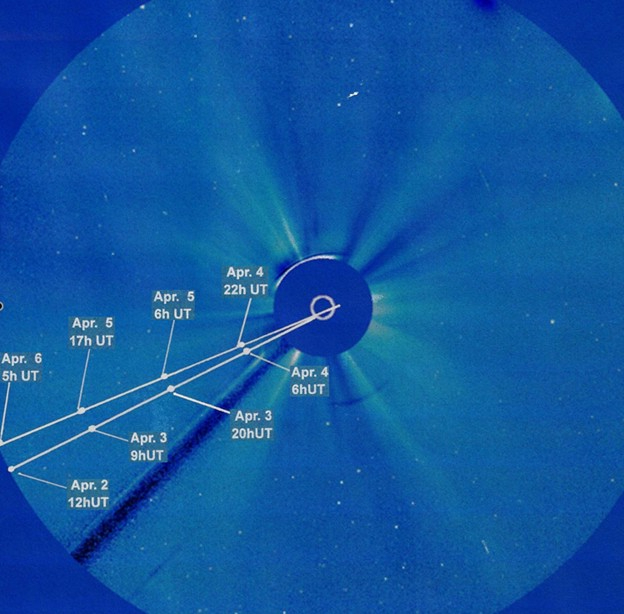
However, by the end of March, the comet’s fate had not yet been definitively decided, and the critical moment is expected to occur in early April. The comet is not bright enough to be observed low on the horizon against a bright sky. Therefore, in late March and early April, it can only be tracked by spacecraft studying the space around the Sun: SOHO, PUNCH, STEREO-A, and others. In particular, on April 2-3, the comet is expected to appear in the field of view of the SOHO coronagraph – LASCO C3. The corresponding trajectory is shown below.
April 17: New Moon – the perfect time for deep-sky objects
When “hunting” for faint objects, it is always best to choose an observation site outside the city, as far away from light pollution as possible. And this is especially true during the spring season. The nights are still long enough, but not as cold as in winter, so you can enjoy the variety of galaxies and star clusters.
One of the most interesting objects of the season is the Whirlpool Galaxy (M51). In fact, it is not a single galaxy, but two: the larger (spiral) one interacts with its smaller companion. A medium-sized amateur telescope will allow you to see two faint, misty spots. A larger one will let you make out the ghostly structure of the spiral arms.
Other interesting galaxies include the brighter M83 and M101, as well as M94. You can also focus on clusters (M3, M53) and planetary nebulae – such as the Cat’s Eye Nebula (NGC 6543) and the Owl Nebula (M97). Keep in mind, however, that the latter object is quite challenging; it is best to attempt it under a truly dark sky.
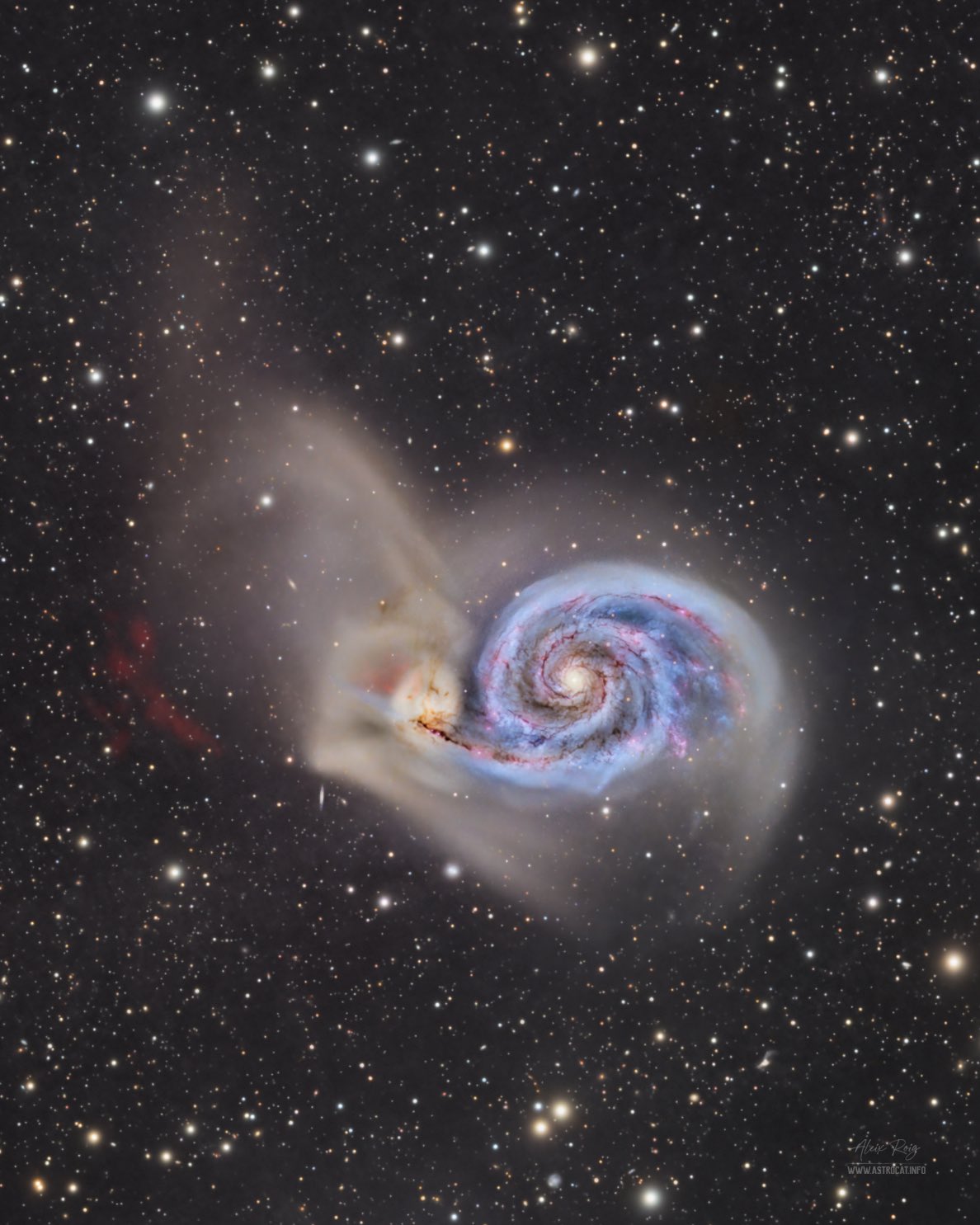
Photo: Aleix Roig
April 19: Venus, the Moon, and the Pleiades
Two spectacular astronomical events await you on the evening of April 19: a conjunction of Venus and the Moon, and a partial occultation of the Pleiades open star cluster by the Moon.
The first phenomenon is quite spectacular and catches the attention of even those with little interest in astronomy. The conjunction occurs at 8:13 p.m. (Kyiv time), which is obviously not a very convenient time for us to observe it. However, even in the evening, the crescent Moon will still be close enough to Venus.
For observations, choose a location with an unobstructed view of the sunset. Such scenes should be photographed for a period of time immediately after sunset. It is possible to observe how Venus and the Moon become increasingly visible against the darkening sky, followed by the first stars, and how the Moon’s ashen glow begins to appear.
Even before sunset, the Moon will begin to obscure the open star cluster Pleiades (M45) – the distinctive “bucket” in the constellation Taurus. Under normal conditions, this cluster is quite easy to see, even in the city. But the Moon is so bright that it will obscure the faint stars. Binoculars or a small telescope will come in handy – this way, you will be able to observe how the stars of the cluster disappear behind the Moon and then reappear on the side illuminated by the Sun.
April 19: Perihelion of Comet C/2024 R3 (PanSTARRS)
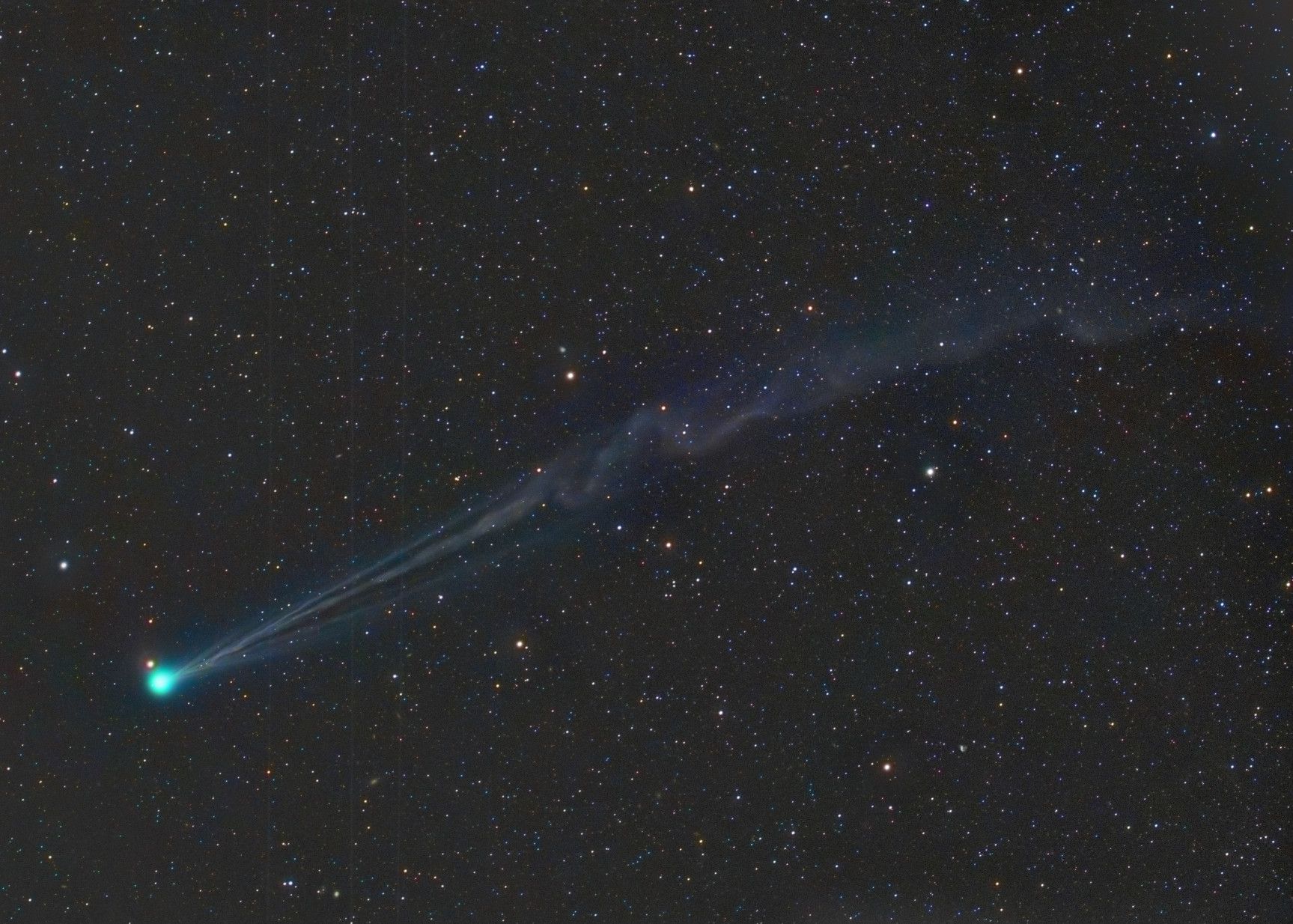
Comets are usually at their brightest near perihelion and after passing through it. However, when planning observations, it is important to take a number of factors into account. For example, C/2024 R3 (PanSTARRS) will pass through perihelion on April 19 and reach its closest approach to Earth on April 26. This time frame, however, is unlikely to be the most favorable for observations, as the comet will come too close to the Sun.
In fact, this comet can be observed through a small telescope or binoculars as early as the beginning of April in the east before dawn. The best days for observation will likely be April 14-17, closer to the new moon, when the sky is darker and before the comet gets too close to the Sun. Currently, it is predicted to reach a peak brightness of at least +3.0m in the last ten days of April. But it is not worth waiting for it, since by that time the comet will already be gradually moving into the Southern Hemisphere.
April 22: Peak of the Lyrid meteor shower (April 14-30)
Almost the entire first quarter of the year passes without any major meteor showers. In early January, we are treated to one of the most spectacular meteor showers, the Quadrantids, but this is followed by a lull lasting nearly four months.
According to data from the IMO (International Meteor Organization), the ZHR for the Lyrids is 18. However, this figure should be interpreted correctly. It represents the number of meteors an observer could see at the peak of activity under a completely open, perfectly dark sky, assuming the radiant (the imaginary point from which the meteors appear to originate) were at the zenith. In practice, the rural sky will allow you to see approximately 8 meteors per hour. Furthermore, the peak of activity is forecast for April 22 at around 7:40 p.m. UTC, when the radiant will still be below the horizon for us.
However, the duration of peak activity varies between 15 and 62 hours. Therefore, the best time to observe would be during the second half of the night, when the radiant rises high in the sky. By the way, here is an interesting fact: historically, during the Lyrid meteor shower’s peak, the radiant is located not in Lyra, but in Hercules.
Do you have to look specifically in the direction of the constellation? Not really. The meteors will appear unpredictably across the entire sky. In 2026, the Moon will not interfere with observing the Lyrids – by the second half of the night, its crescent will already be below the horizon. So make sure in advance to have a safe viewing spot, warm clothes, hot drinks, and good company, and get comfortable in a recliner to catch the “shooting stars.”