

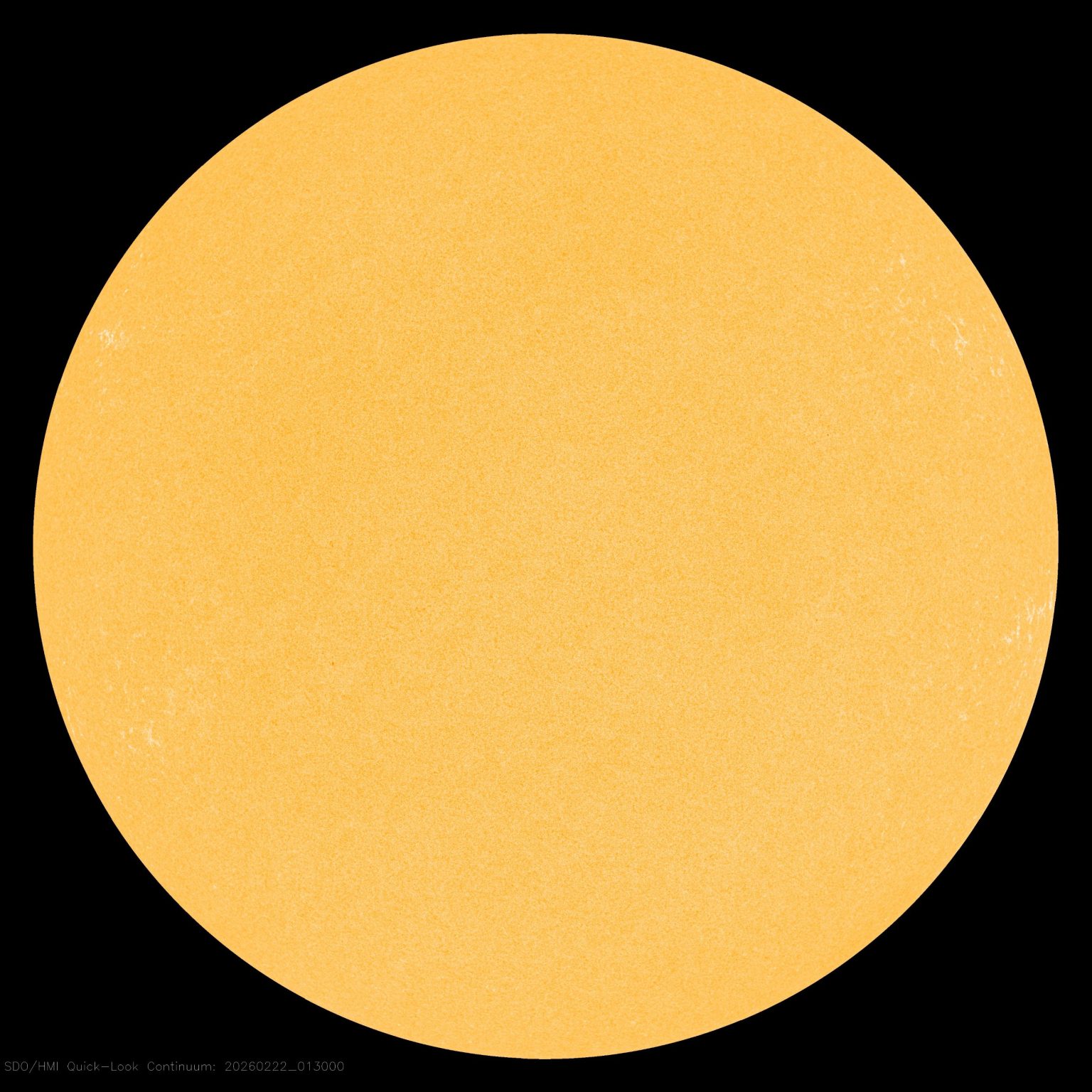
On February 22, 2026, something that astronomers had been waiting for more than 1,300 days finally happened: for the first time since June 2022, the Sun appeared completely clear to observers, without a single dark spot. This rare cosmic phenomenon gave scientists a glimpse into the future of our star.
Sunspots are not just “freckles” on the face of the Sun. These are colder and therefore darker areas where the enhanced magnetic field prevents hot plasma from rising to the surface. It is these areas that give rise to solar flares and coronal mass ejections — those very “shots” of charged particles that reach Earth, causing magnetic storms, communication failures, and even auroras in more southern latitudes.
When the Sun’s disk became clear on February 22, it meant only one thing: our star had temporarily switched to silent mode. The absence of spots is an indicator that the magnetic activity of the star has dropped sharply.
Calm before the storm
Darker, cooler areas on the Sun – aka sunspots – have been absent for almost 2 weeks, as of Feb. 1. This spotless period is a prelude to the approaching period of solar minimum next year, when the Sun’s activity will be at the low end of its 11-year cycle: https://t.co/LQB3bDLIU4 pic.twitter.com/UPrcEX6C3r
— NASA (@NASA) February 6, 2018
According to the Spaceweather portal, the “clear” period lasted only a few days. On February 24, the first signs of new activity appeared on the eastern edge of the Sun. However, the very fact of such a pause is significant. The last time something similar was observed on June 8, 2022. In other words, for almost four years, the Sun has been boiling incessantly, ejecting energy into space, and now there has been a brief respite.
What happens on the Sun?
Our star lives according to its own 11-year cycle. This cycle determines when there are many sunspots and when there are almost none. We are now in the 25th cycle since observations began. Its peak was in 2024, so activity should now gradually decline.
The February calm is most likely the first sign that the Sun is beginning to prepare for its “winter hibernation.” However, the current solar minimum is still far away — scientists predict it will occur sometime around 2030.
Should we be afraid of the “clean” Sun?
Although February 22 seemed unique, astronomers urge caution in drawing conclusions. Even during periods of deep minimum, the Sun sometimes “fires” unexpected powerful flares. Moreover, compared to the past, the current lull is nothing.
During the previous solar minimum (2018–2020), there were more than 700 days without a single sunspot! Then the star remained surprisingly calm for months. What we have just witnessed is only a brief moment that reminds us that even such a turbulent star sometimes pauses to resume its cosmic symphony a few days later.
We previously reported that the Sun has entered its most powerful period of activity.
According to DailyGalaxy

