
A space veteran who has spent years protecting and studying our Earth’s radiation belts is returning home. On the night of March 11-12, the massive Van Allen Probe A will enter the dense layers of the atmosphere. The event that scientists had expected to occur only in the next decade may happen sooner than expected. The Sun is responsible for this sudden change in plans.
Chronicle of the fall
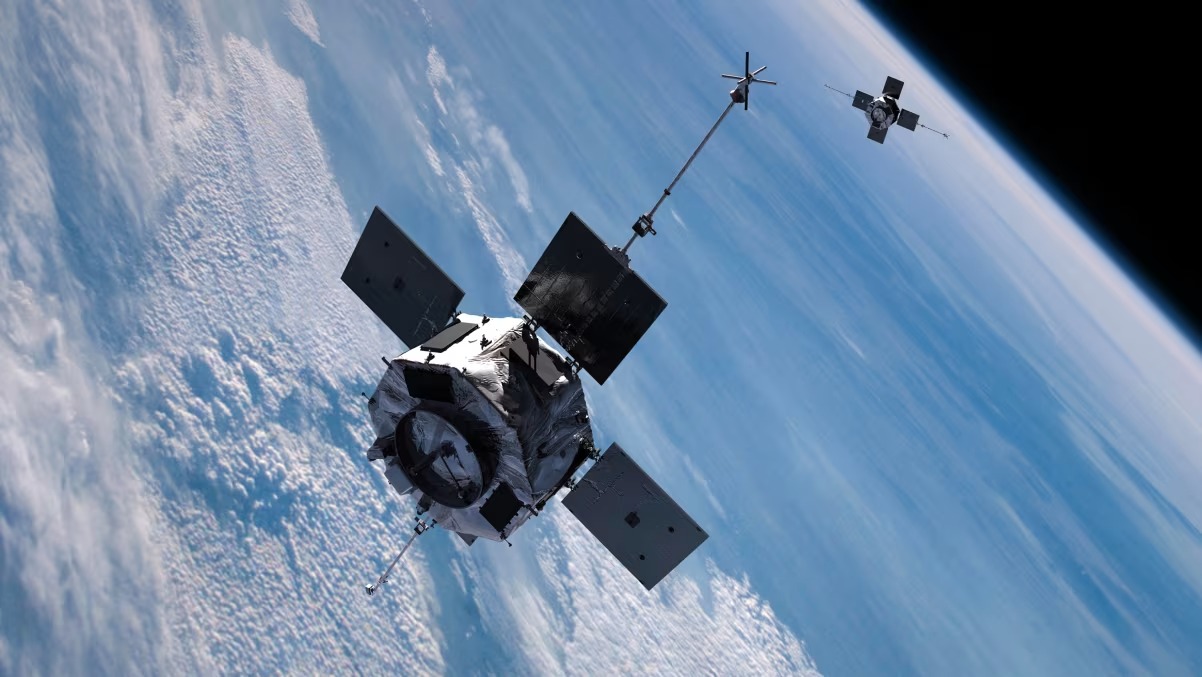
According to official data from NASA and the US Space Force, the Van Allen A probe, weighing more than 600 kilograms, is expected to enter Earth’s atmosphere at approximately 7:45 p.m. EDT on March 10, 2026. Although experts note that due to the complexity of atmospheric processes, there is a 24-hour “window of uncertainty,” the trajectory of the spacecraft is already irreversible.
Most of the probe should burn up in the upper layers of the atmosphere. However, NASA does not rule out that individual structural elements made of refractory materials could withstand the hellish temperatures and reach the Earth’s surface.
The biggest surprise for the scientific community was the timing of the event. According to initial calculations, the Van Allen probes were supposed to remain in orbit until 2034. But what went wrong?
The answer lies in solar activity. Our star operates in 11-year cycles, and the current cycle has turned out to be much more intense than predicted. NASA has confirmed that the Sun reached its solar maximum in 2024. Huge emissions of energy and particles caused the upper layers of Earth’s atmosphere to “inflate” and expand.
This created much stronger resistance for satellites in low orbits. Atmospheric drag acted as a brake on Van Allen A, literally pushing it down 8 years ahead of schedule. Its twin, the Van Allen B probe, is predicted to share a similar fate by 2030.
Mission that changed our understanding of space
Launched in 2012, Van Allen Probe A was a real breakthrough. The focus of its research was the Earth’s radiation belts — two giant toroidal zones where the planet’s magnetic field traps high-energy particles. These belts are our invisible shield, protecting Earth from destructive solar winds and cosmic radiation.
Over the years, the Van Allen probes have made several fundamental discoveries:
- Third belt. Scientists have recorded for the first time the temporary appearance of a third radiation layer during peak solar activity, a phenomenon previously considered impossible.
- Shield dynamics. Research was conducted on how belts contract and expand under the pressure of solar storms, which is critical for protecting the electronics of modern satellites.
The mission officially ended in 2019 when the spacecraft ran out of fuel. Since then, they have been drifting freely, awaiting their final encounter with the atmosphere.
Mathematics of injury risk
The main question that concerns ordinary residents is: will this space debris fall on someone’s head? NASA estimates the probability of human injury as 1 in 4,200.
At first glance, this sounds alarming, especially when compared to the return of the Chinese Tiangong-1 space station in 2018, where the risk was only 1 in 1 trillion. However, experts are reassuring.
“We’ve had things that have reentered have a 1 in 1,000 chance, and nothing happened; if we have a few that are 1 in 4,000 or 5000, it’s not a horrible day for mankind,” notes Dr. Darren McKnight of LeoLabs.
For comparison, space debris falls to Earth much more often than we tend to think. According to McKnight, approximately one object (a rocket body or small satellite) reaches the surface every week. Most of them fall into oceans or deserts without making the news.
Who will see the fall?
As Van Allen Probe A prepares for its final burst, astronomers and amateurs in North America and over the Atlantic are setting up their cameras. The probability of debris causing damage remains negligible, but the scientific value of this mission — from its launch to its premature end — will remain in astronomy textbooks forever.
Earlier, we reported on how a radiation belt was discovered for the first time on a distant exoplanet.

