

On Wednesday, during the launch of the SLS rocket as part of the Artemis II mission, a U.S. Air Force NT-43A aircraft was spotted in the skies over Florida. This aircraft is designed to detect low-observable aerial targets and is so classified that sightings of it in the sky are extremely rare.
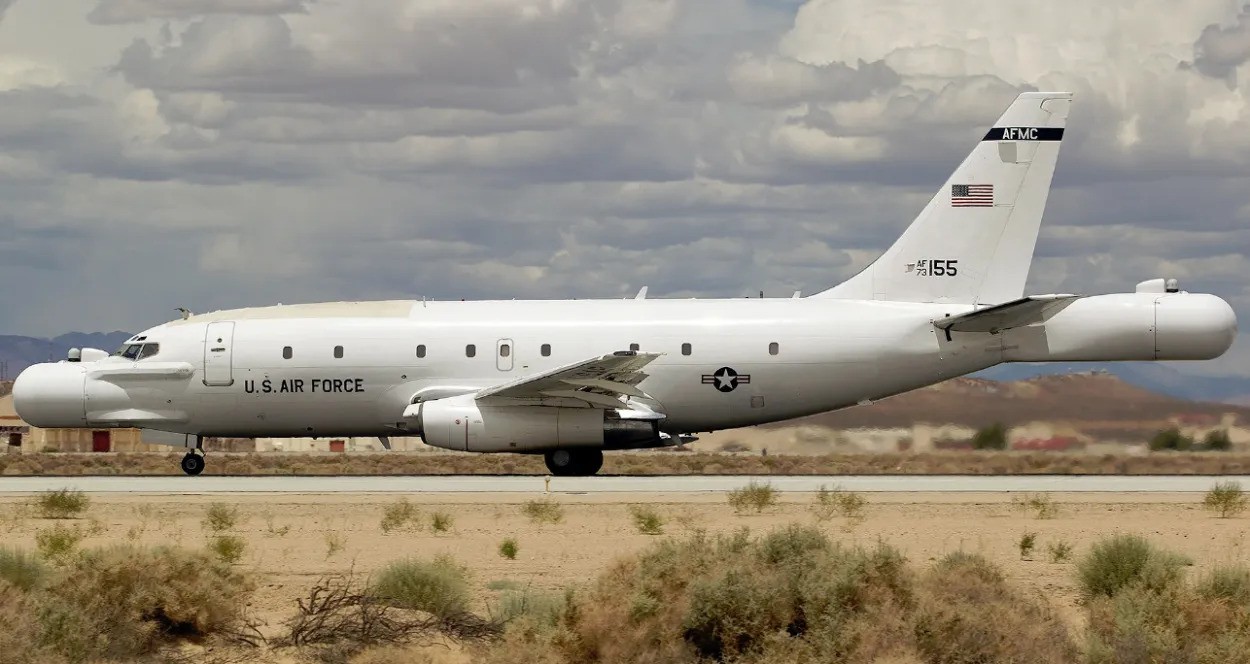
Secret aircraft and lunar rocket
On Wednesday, when the SLS rocket launched the Orion spacecraft into a near-Earth elliptical orbit, the whole world was watching. However, some of the observers turned out to be truly unexpected and unique.
For example, an NT-43A aircraft was spotted over Melbourne, Florida, that evening. It was close enough to the launch site to suggest that it was specifically interested in the Artemis II mission. And that’s truly intriguing, since this spacecraft is considered one of the most mysterious in the U.S. Space Force.
Actually, it’s a Boeing 737-200, but it’s been so extensively modified that it’s simply impossible to mistake its long nose and the protrusion at the rear of the fuselage for anything else. There is only one aircraft of this type, which is commonly known by the designation RAT55.
The NT-43A is a radar reconnaissance aircraft, but a highly unusual one. It was designed to detect low-observable enemy aircraft. It is equipped with two massive radars, a suite of electro-optical and infrared sensors, and other equipment.
A secret plane over Florida
Due to the nature of its mission, the NT-43A is classified as top secret and is rarely seen in the sky. This time, for example, it took off from Tonpa Air Force Base in Nevada—one of the U.S. Air Force’s most restricted facilities—but over Florida, it activated a false identification, posing as a C-130 military transport that had taken off from a local air base.
Although this aircraft is rarely seen, there are fairly simple reasons for its appearance near the launch site. NASA collects a massive amount of data during every major launch, monitoring the rocket’s performance using external observation systems.
Aircraft are typically used for this purpose. NASA has three of its own WB-57F aircraft, which are also equipped with surveillance equipment. One of them was also monitoring the launch. It is known that another one of these aircraft made an emergency landing in January, so it is difficult to say how serviceable it is now.
It is most likely that the U.S. Air Force deployed one of its secret reconnaissance aircraft to monitor this mission, as it is best suited for such tasks. Overall, the U.S. military has a long history of cooperation with NASA. Back in the 1960s, during the Apollo program, they used EC-135N aircraft for this purpose, which also tracked ballistic missile launches. However, the last one was decommissioned back in 2000.
According to phys.org

