

Jupiter is a gas giant that consists mainly of hydrogen and helium. However, scientists recently managed to peer into its depths and discovered a significant amount of oxygen there. In fact, there is more oxygen there than in the Sun, which is much larger than this planet.
A deeper look at Jupiter’s atmosphere
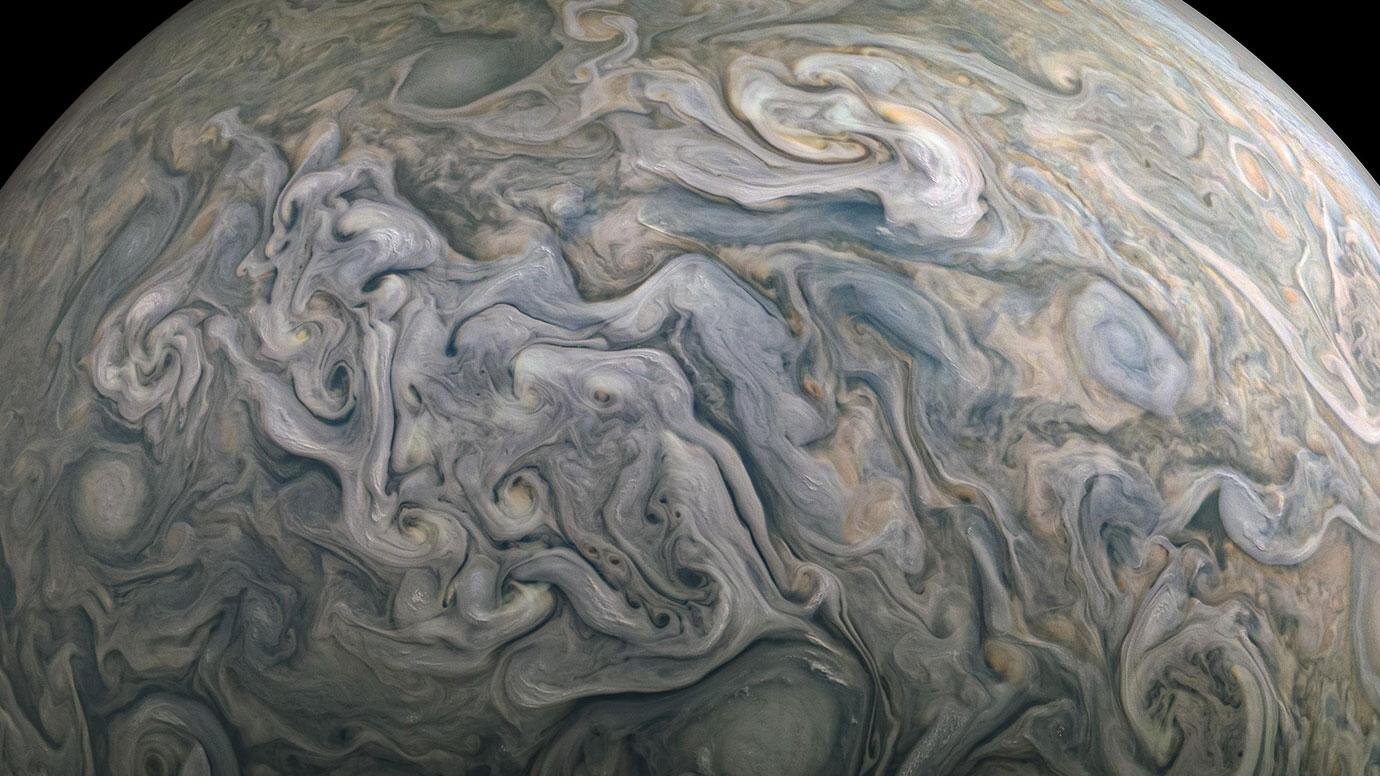
Impressive clouds swirl above Jupiter’s surface. These clouds contain water, just like on Earth, but they are much denser on the gas giant — so thick that no spacecraft has been able to accurately measure what lies beneath them.
But new research by scientists at the University of Chicago and the Jet Propulsion Laboratory has given us a deeper look at the planet by creating the most complete model of Jupiter’s atmosphere to date.
Among other things, the analysis touches on the long-standing question of how much oxygen the gas giant contains: estimates suggest that Jupiter has about one and a half times more oxygen than the Sun. This helps scientists refine their understanding of how all the planets in the Solar System were formed.
The turbulent atmosphere of Jupiter
We have known about Jupiter’s turbulent skies for at least 360 years — that’s when astronomers, using early telescopes, recorded an interesting large permanent spot on Jupiter’s surface.
The Great Red Spot is a huge storm, twice the size of Earth, that has been raging for centuries. It is just one of many on the planet, as strong winds and deep clouds mean that the entire surface of Jupiter is covered with a kaleidoscope of storms.
We don’t know exactly what lies beneath these storms. The clouds are so thick that NASA’s Galileo spacecraft lost contact with Earth when it plunged into the lower layers of the atmosphere in 2003. The next mission to Jupiter, Juno, is currently cataloguing the planet from a safe distance in orbit.
Combined research approach
These measurements from orbit allow us to determine the composition of the upper atmosphere: ammonia, methane, ammonium hydrosulfide, water, and carbon monoxide. Scientists have combined this data with knowledge of chemical reactions to create models of Jupiter’s deep atmosphere. But research differs on some issues, such as how much water — and with it, oxygen — the planet contains.
Jeehyun Yang, the lead author of the paper, saw an opportunity to apply a new generation of chemical modeling to this complex issue.
The chemistry of Jupiter’s atmosphere is very complex. Molecules move between extremely hot conditions deep in the atmosphere and colder upper layers, changing phases and rearranging into different molecules through thousands of different types of reactions. But the behavior of clouds and droplets should also be taken into account.
To better reflect all these phenomena, Yang worked with a group of scientists to incorporate both chemistry and hydrodynamics into a single model. “Both approaches are necessary,” Yang said. “Chemistry is important, but it doesn’t take into account water droplets or cloud behavior. Hydrodynamics alone oversimplifies chemistry. That’s why it’s important to combine them.”
Oxygen on Jupiter and the mysteries of the planet’s formation
Among the conclusions is a new calculation of how much oxygen is contained on Jupiter. According to their analysis, Jupiter probably has about one and a half times more oxygen than the Sun.
For decades, scientists have debated this number. A recent extensive study estimated it to be significantly lower — only one-third of the number in the Sun. But knowing this statistic is particularly important for understanding how our Solar System was formed.
All the elements that make up the planets — and ourselves — are the same materials found in the Sun. But the amounts of these materials can vary, and we can use these clues to form an idea of how the planets might have formed.
For example, did Jupiter form in the same place where we see it now, or did it form closer or farther away and shift over time? Clues may come from the fact that most of the oxygen on the planet is found in frozen water — and behaves differently — if it is too far from the Sun’s heat. Ice is much easier for planets to accumulate than water vapor.
In turn, knowing what conditions create certain types of planets can help us in our search for habitable planets beyond our own Solar System.
According to phys.org

