

Saturn’s largest moon, Titan, and its rings may have formed as a result of a collision between two moons. This is according to the results of a study conducted by scientists from the SETI Institute.
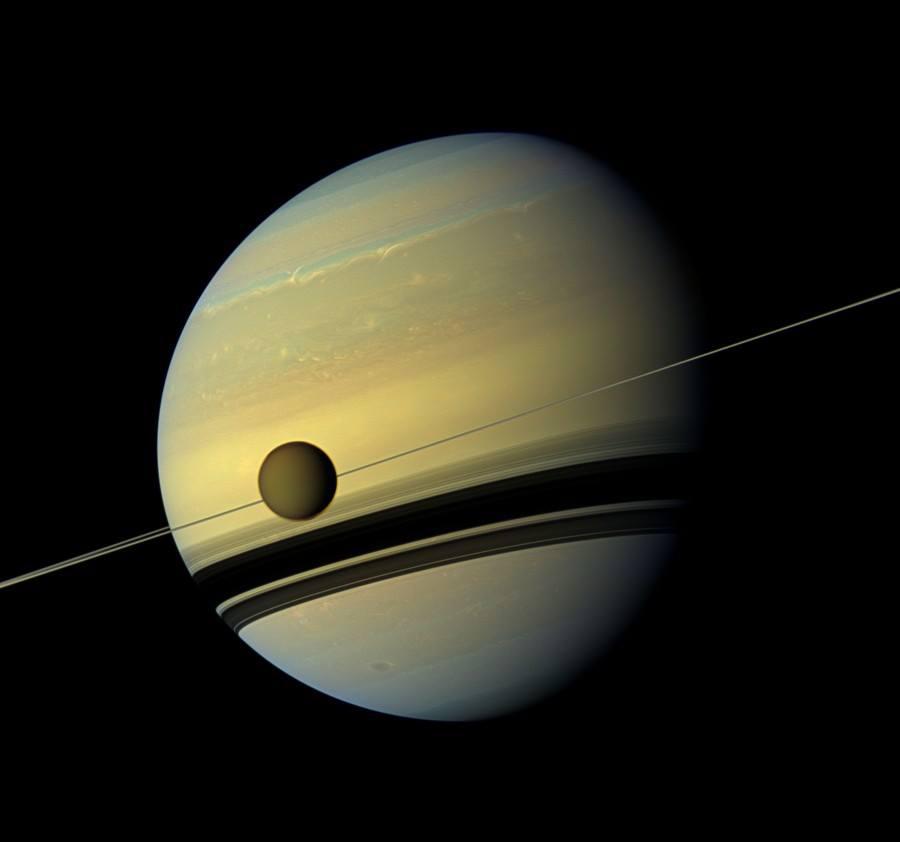
By the end of its mission, Cassini had measured Saturn’s internal mass distribution, which determines the planet’s slow rotation axis wobble, or precession. It turned out that the mass of the planet is slightly more concentrated in its center, and the speed of the procession does not correspond to what was expected. To explain this discrepancy, scientists have hypothesized that Saturn once had an additional moon that was destroyed after colliding with Titan and broke apart, forming the rings.
The simulation results revealed a connection between Titan and Hyperion, Saturn’s chaotically rotating moon. According to scientists, Hyperion could have been formed as a result of a collision between the proto-Titan and another moon of Saturn. This led to the ejection of debris, which then formed Hyperion and several smaller moons.
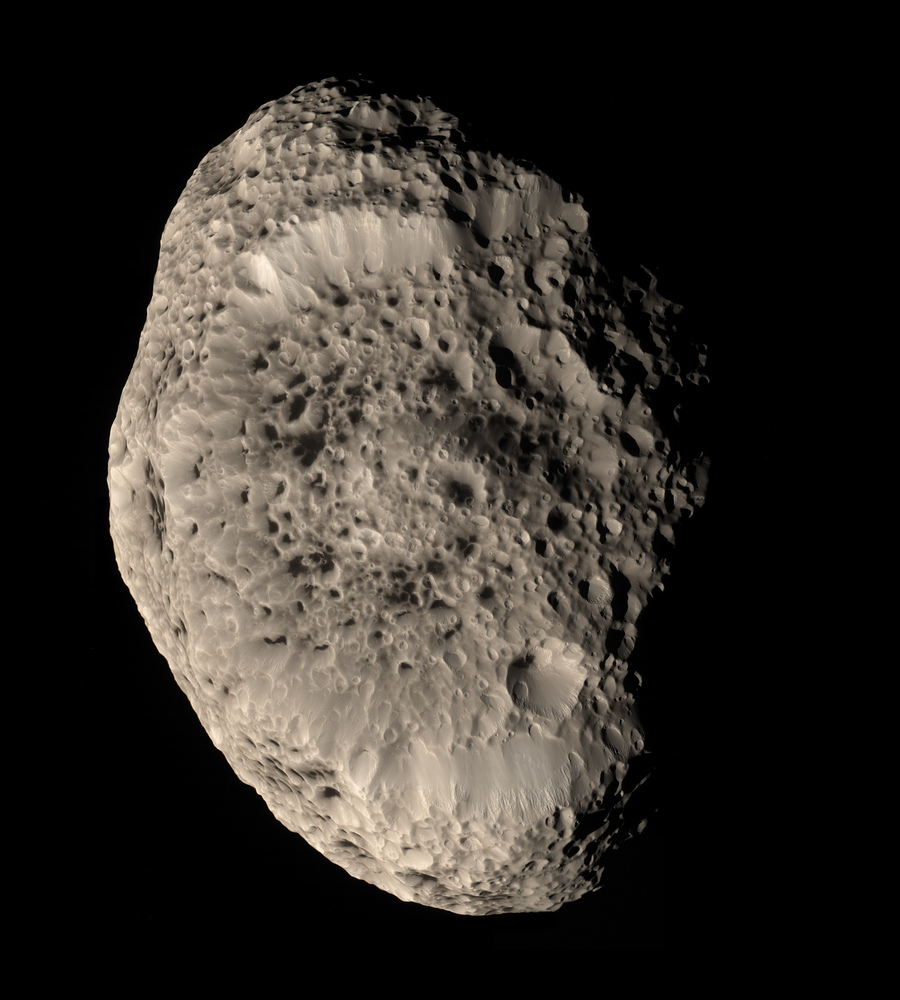
As for Saturn’s rings, they were formed as a result of subsequent collisions between small moons that formed together with Hyperion. Scientists estimate that this happened about 100 million years ago.
This scenario explains the small number of impact craters on Titan and the peculiarities of its orbit. Proto-Titan may have been similar to Jupiter’s moon Callisto — an ancient, cratered world with no atmosphere.
The Dragonfly mission, which is scheduled to arrive at Titan in 2034, will be able to test this hypothesis. An octocopter with a nuclear engine will analyze the geology and chemical composition of the moon’s surface and will be able to detect evidence that it was formed as a result of a collision.
According to SETI Institute

