

TOI-421 is an exoplanetary system with two planets whose orbital planes differ greatly from each other. Scientists believe that studying it could be the key to understanding why the orbits of planets larger than Earth but smaller than Jupiter are distributed in such a strange way.
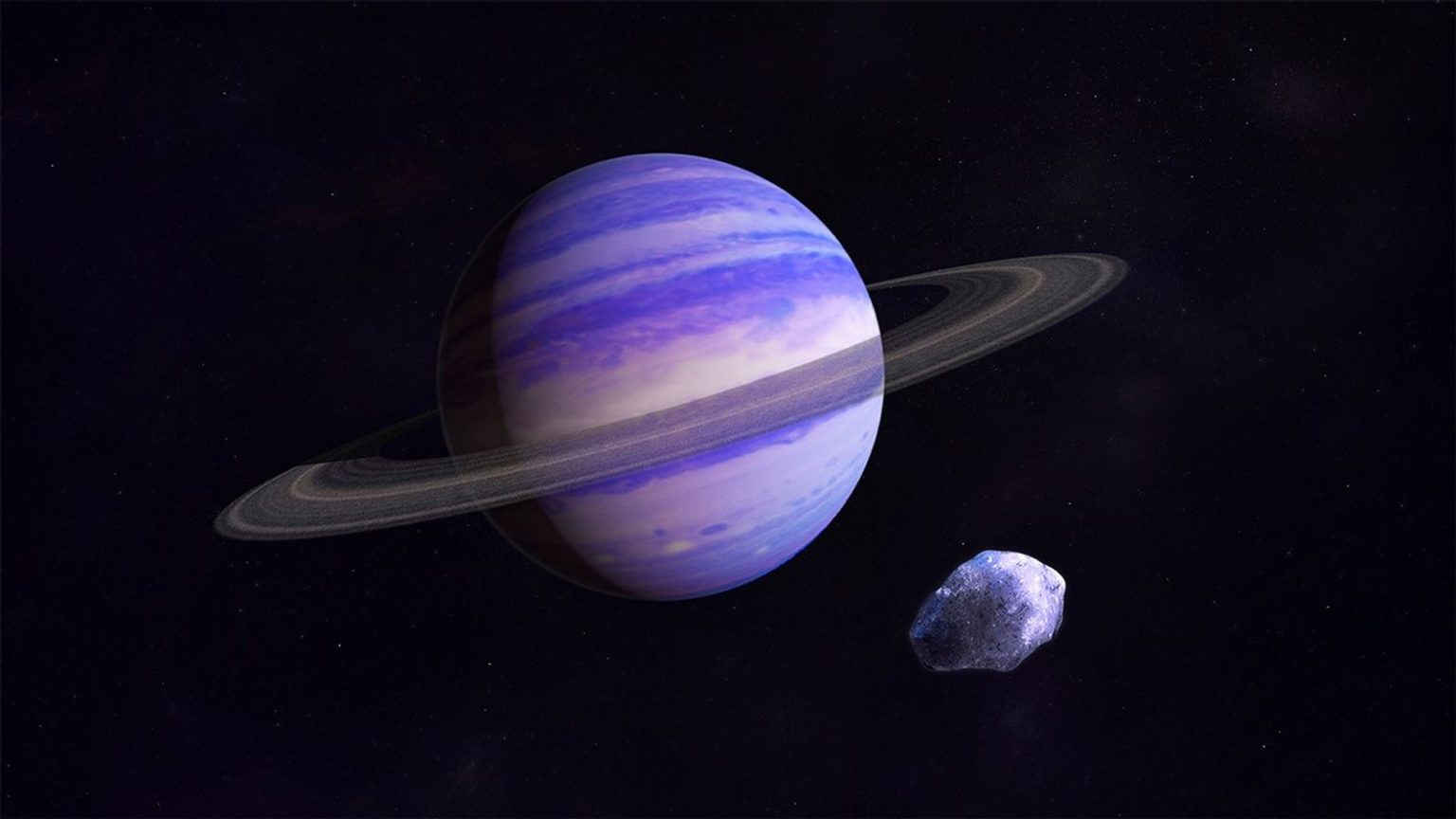
TOI-421 system
An international collaboration of researchers known as ATREIDES recently published a study that looks at the TOI-421 system in the much broader context of why certain types of planets tend to be found in certain places.
TOI-421 is interesting because it has two planets: a Neptune-like gas giant farther from the star and a smaller world closer to it. At the same time, the orbits of both planets are very tilted relative to the star’s equator. This is very different from what we see in the Solar System, where almost all planets revolve in the same plane.
The mystery of “neptunes”
Statistics on the location of planets similar in size to Neptune reveal some surprising findings. They are practically absent in the immediate vicinity of the star, forming something resembling a desert. In more distant regions, they occur much more frequently, and researchers refer to this as the “savannah”.
However, between the desert and the savannah lies a narrow range of distances at which “neptunes” occur with incredible frequency. And this distribution remains the same, no matter how many planets scientists discover. So how can this be explained?
One possibility is the early migration of these worlds, when they have to push through the protoplanetary disk, which has not yet completely dissipated. For other worlds, they may be suddenly thrown into eccentric orbits and then transition to circular orbits, but at a different distance.
This is precisely why researchers are so interested in the TOI-421 system with its skewed planetary orbits. Perhaps they are the result of such interaction. By studying it, they will be able to understand the processes that occur in early planetary systems.
Provided by: phys.org

