

Scientists believe that one of the most effective ways to explore Mars is with robots—tumbleweeds. These vehicles resemble large mesh spheres and do not require very powerful engines. Instead, they are powered by wind energy. Recently, engineers have confirmed the effectiveness of this concept.
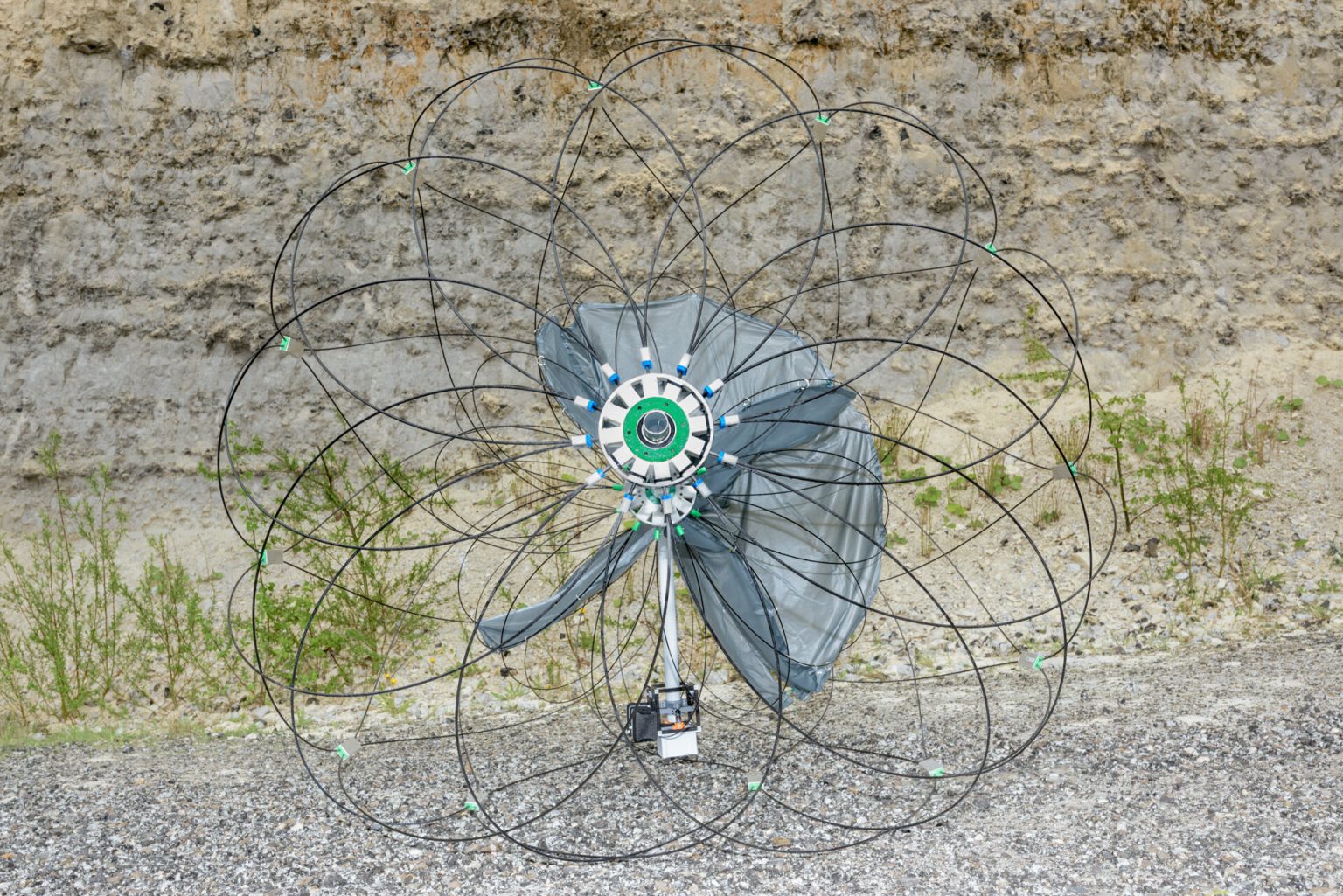
Tumbleweed robot
One of the critical points in the development of Mars rovers is energy sources. They have to ensure the autonomy of the research device for as long as possible, otherwise all attempts to scale automated systems are pointless. Recently, at a meeting of the Europlanet Science Congress and the Department of Planetary Sciences, engineers from Tumbleweed discussed a new way of exploring Mars.
At its core is the idea of a swarm of spherical rovers. Tumbleweed is a special type of shrub that grows in many arid regions of the Earth. When the dry season arrives, their above-ground part, resembling a ball of twigs, dries out and rolls across the desert under the influence of the wind, traveling many kilometers before spilling its seeds.
This is precisely the principle that Tumbleweed decided to use in its robots. They resemble 5-meter balls made of metal mesh, with a core containing equipment in the center. They were first introduced in July this year.
Test results
To be precise, the company has so far presented prototypes with diameters of 30, 40, and 50 cm. However, they have already proven their effectiveness. The fact is that the main advantage of such a design is the absence of a powerful energy source. Instead, it is moved by the wind until the vehicle stops moving and switches to stationary research station mode.
The only problem is the wind itself. On Mars, its speed can reach 9-10 m/s. However, the atmosphere is extremely thin, so its actual strength is significantly lower than on Earth. However, developers have already proven that this is not an obstacle to their work.
They have already confirmed this by testing them in a wind tunnel, which reproduced Martian pressure and the corresponding wind speed. Under these conditions, they were able to overcome a slope corresponding to 30° on Mars.
Test results confirm that they are capable of moving at speeds of up to 10 m/s and covering a distance of 422 km in 100 Martian sol. Overall, the developers expect that under favorable conditions, Tumbleweed could travel 2,800 km across the surface of Mars.
According to phys.org

