

Scientists are studying the sun-like star WISPIT 2. It is about 5 million years old and is surrounded by a gas and dust disk within which planets are forming. Their existence has recently been confirmed by direct observations.
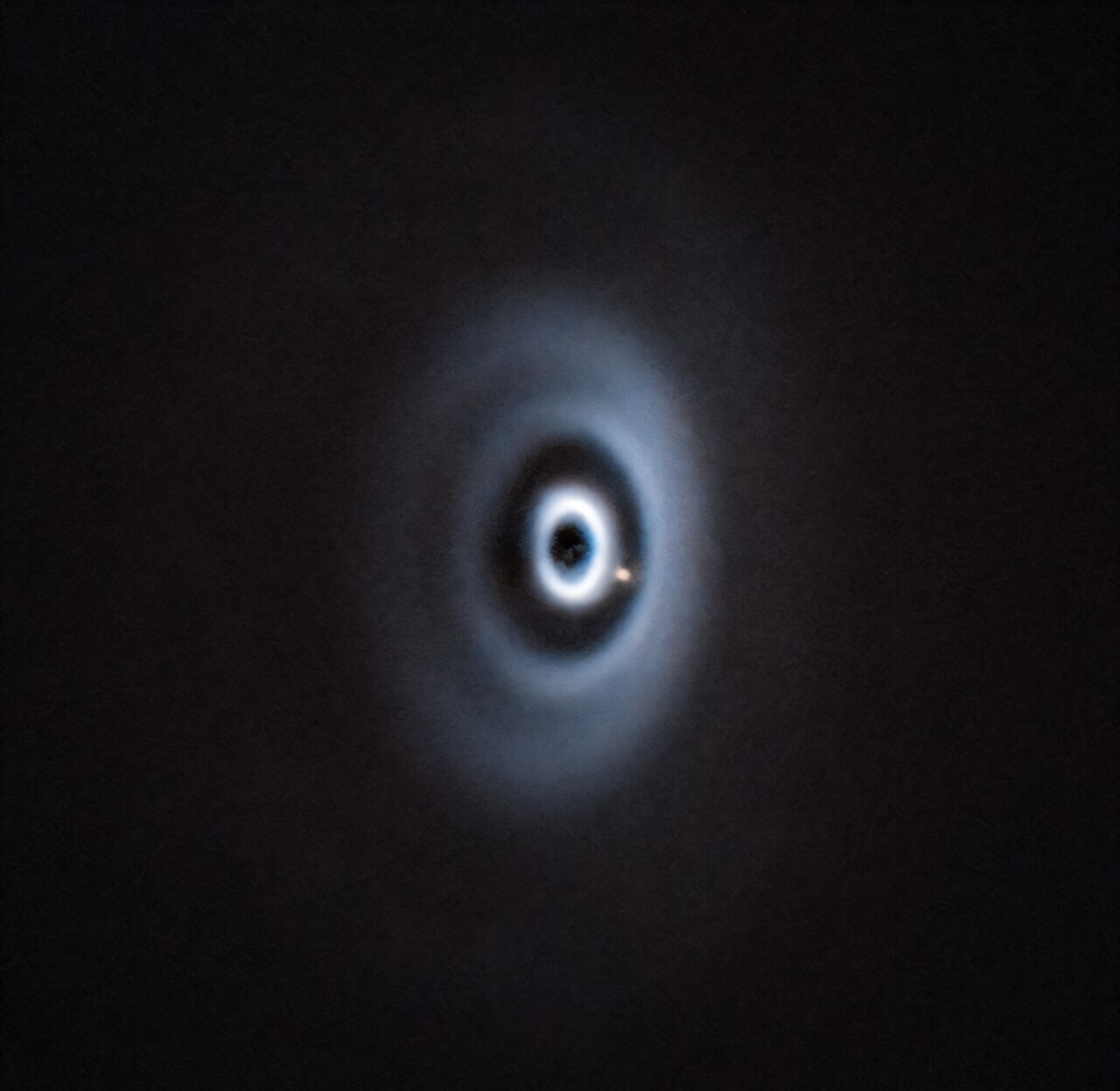
New WISPIT 2 system
With the number of discovered exoplanets now exceeding 6,000 and continuing to grow, scientists are finding a wide variety of solar system architectures. The key to understanding how these structures form lies in identifying young planets forming around very young stars. In 2025, a group of astronomers announced the discovery of a planet with a mass approximately five times that of Jupiter, orbiting a star much younger than our Sun.
The star is called WISPIT 2; it is located about 437 light-years away and has a mass of about 1.08 solar masses. It is very young—only about 5 million years old. It is so young that it has not yet begun its life cycle with nuclear fusion in the main sequence. This also means that it is at a stage where young planets are still forming. Overall, it is a useful analogue of our Solar System.
The exoplanet discovered orbiting this star last year has been given the official designation WISPIT 2-b. The planet was discovered using the Very Large Telescope (VLT) and its spectropolarimetric high-contrast instrument for exoplanet research (SPHERE). The powerful VLT was able to capture an image of the planet, which was named the European Southern Observatory’s (ESO) “Picture of the Week.”
Discovery of a second planet in the system
Now, some of the same astronomers who discovered WISPIT 2b have found another planet in the same young star system, WISPIT 2c. The discovery is described in a new study titled “Direct Spectroscopic Confirmation of the Young Embedded Protoplanet WISPIT 2c.” The lead author is Chloe Lawlor, a PhD student at the Centre for Astronomy and the Ryan Institute at the University of Galway.
WISPIT 2 is a nearby young star with a multi-ringed disk that has recently been confirmed to host a gas giant with a mass of approximately 4.9 times that of Jupiter, located in a large (60 AU) gap at a radial distance of 57 a. from the parent star. WISPIT 2c is likely twice as massive as its “brother” and is also located closer to its parent star, “with a mass in the range of 8–12 Jupiter masses and a radial distance of 14 AU.”
Exoplanets sometimes appear only as minor anomalies in astronomical data, and background stars can mimic exoplanets, which is why direct spectroscopic confirmation is crucial. This type of confirmation can also help narrow down the physical models of exoplanets, provide information about the exoplanet’s composition, and other important data. Direct spectroscopic confirmation is also a technically challenging task, which underscores the significance of this work.
A young replica of the Solar System
WISPIT 2 is also significant because the star is very similar to our Sun, a fact that has always attracted the attention of astronomers. “WISPIT 2 offers the best view to date of our own past,” lead author Lawlor said in a press release.
This system is only the second one in which the formation of two exoplanets around their star has been observed, following PDS 70. PDS 70 is a young Taurus-type star located approximately 370 light-years away, with two confirmed and one unconfirmed exoplanet.
The young Taurus-type star PDS 70 once served as a sort of “beacon in the dark” for early research into planet formation, thanks to its two confirmed planets, PDS 70b. WISPIT 2 now serves as a counterpart to PDS 70, providing a second laboratory for studying the formation and early evolution of a multi-planetary system within a protoplanetary disk.
But the WISPIT 2 has a more extensive and distinct system of rings and gaps. “These structures suggest that new planets are forming right now, which we will eventually discover,” said Lawlor.
New research tools expand possibilities
Until very recently, it was impossible to observe the formation of young planets and the creation of an entire Solar System. All of this has become possible thanks to powerful telescopes and their attached instruments.
“This detection of a new world in formation really showed the amazing potential of our current instrumentation,” said Richelle van Capelleveen, a PhD student at Leiden Observatory in the Netherlands, lead author of the preliminary study and co-author of the new one.
“Critically our study made use of the recent upgrade to GRAVITY+ without which we would not have been able to get such a clear detection of the planet so close to its star,” said study co-author Guillaume Bourdarot. GRAVITY+ allows for the imaging of even fainter astronomical objects at greater distances than the original GRAVITY instrument.
Thanks to these discoveries, as well as others expected from more powerful future telescopes and instruments such as the ELT, our understanding of the formation of the Solar System is poised to take a significant leap forward. The ELT has a massive primary mirror with a diameter of 39 meters and is expected to begin observing the sky in March 2029.
Laboratory for the study of the architecture of Solar Systems
It is possible that another exoplanet discovery awaits us in the WISPIT 2 system. Both of the discovered exoplanets are located in gaps in the star’s protoplanetary disk, and there is evidence of another gap in the disk, located farther from the star. “We suspect there may be a third planet carving out this gap,” says Lawlor, “potentially of Saturn mass owing to the gap’s being much narrower and shallower.” Co-author Ginski noted that “with ESO’s upcoming Extremely Large Telescope, we may be able to directly image such a planet.”
Overall, the WISPIT 2 system offers a rare opportunity to study the formation of Solar System-like structures. The authors suggest that the orbital distances in both PDS 70 and WISPIT 2 indicate the existence of a kind of Goldilocks Zone for the formation of giant planets, although this is far from obvious.
“While the available data remain limited, these results bring us one step closer to making direct connections between the initial conditions of planet formation and the final architectures of planetary systems,” the authors conclude.
According to phys.org

