

Astronomers have studied two ultra-cool red dwarfs that were born relatively recently in the Taurus Molecular Cloud. It turns out that each of them has a component, in one case a planet or brown dwarf, and in the other a star.
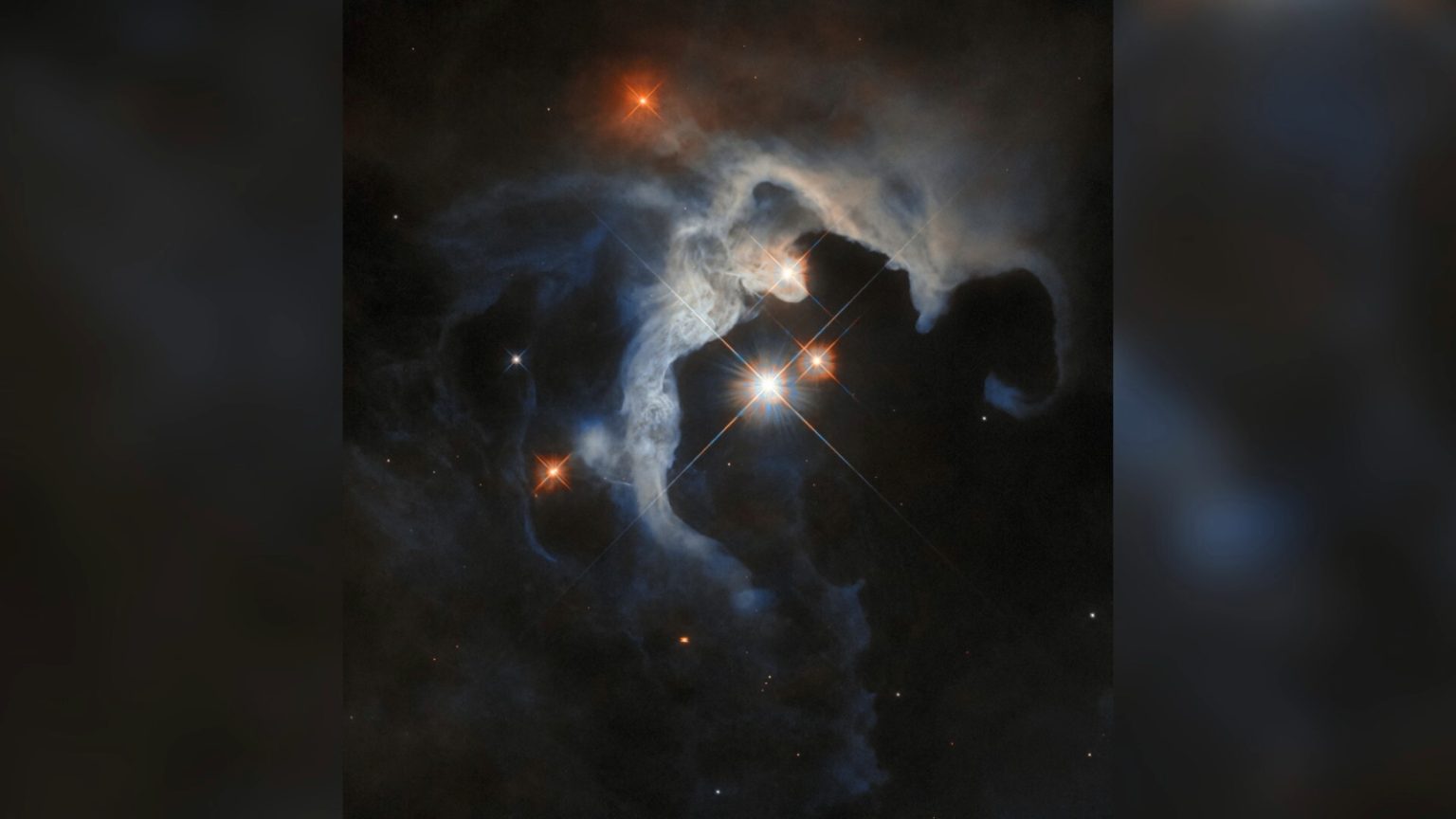
Young red dwarfs
Astronomers like big stars. They shine brightly from birth until death, which, by cosmic standards, comes pretty early for them. But astronomers at the University of Hawaii have recently become interested in the formation of small stars, which, despite their extremely long and inconspicuous lives, also have to be born at some point.
They do this in the same place as large stars—in cold gas and dust clouds—and there is a suspicion that quite often they are not born alone, but in pairs and trios. At least, this is suggested by the number of multiple systems of low-mass stars that we observe around the Sun. In addition, substellar objects — brown dwarfs and orphan planets — should be born along with them.
However, due to their low luminosity, these objects remain poorly studied. An article recently published on the arXiv preprint server discusses observations made using the Keck II and Gemini North telescopes. Their target was the Taurus Molecular Cloud.
What scientists found
The Taurus molecular cloud is one of the closest star-forming regions to us. It is only 430 light-years away. At this distance, even very small objects can be seen. And there are some there. Scientists have already discovered several dwarf stars ranging in age from 1 to 5 million years.
The study focused on two of them: XEST 17-036 and XEST 13-010. It turned out that each of these ultra-cold stars has its own companion. They were named KOINTREAU-1b and KOINTREAU-2b. Each of them is gravitationally bound to its star, but at the same time is located at a great distance from it.
Interestingly, KOINTREAU-1b is an object with a mass of 10.6 Jupiter masses, located at a distance of 690 AU from XEST 17-036. In other words, it is either a large planet or a small brown dwarf. In the case of KOINTREAU-2b, we are talking about an object with a stellar mass, separated from XEST 13-010 by 560 AU.
In the case of the first companion, it was even possible to detect a change in brightness, indicating the presence of clouds or dust rings. In the second case, however, the luminosity is more uniform, but it clearly does not correspond to the mass. Researchers believe that this is a red dwarf that obscures its protoplanetary disk from us.
According to phys.org

