

During its more than decade-long mission on Mars, the Curiosity rover has encountered many surprises. However, the latest discovery surprised even NASA’s most experienced experts. On April 25, 2026, the Mars rover began a routine procedure: it drove its rotary percussion drill into a Martian rock named “Atacama.” The objective was standard: to grind the rock sample into a powder for further chemical analysis. However, when Curiosity tried to pull the tool out, a 13-kilogram boulder came up to the surface along with it. As the agency notes, no such incident has ever occurred in the 13.5 years of the device’s operation.
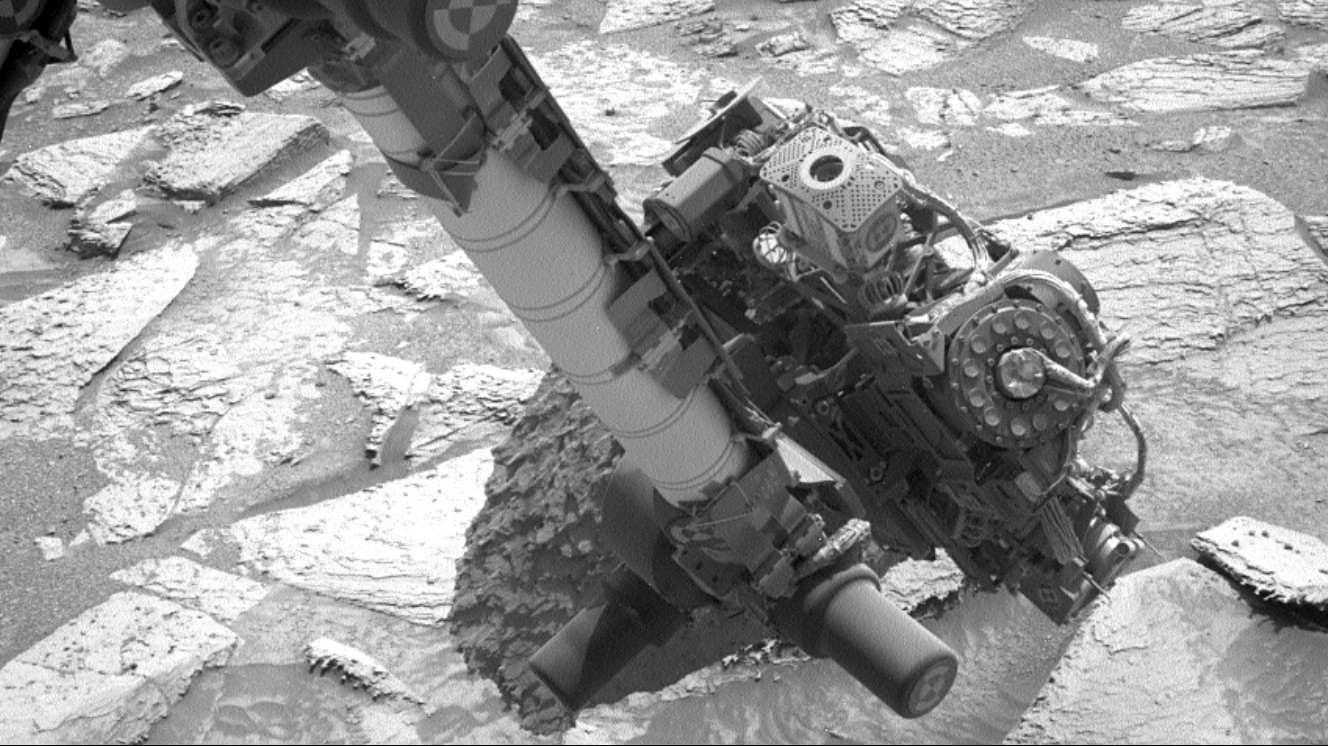
“In the past, the drilling process could have split the rock or chipped away the upper layers, but the rock has never before become lodged on the drill bit,” NASA officials explained.
The main problem is that Martian geology is always a gamble. Engineers on Earth can conduct hundreds of crash tests, but it is impossible to predict how alien soil will behave hundreds of millions of kilometers away. Microcracks, differences in material hardness, or variations in the bonding between rock layers can radically change the stone’s response to physical stress. And these properties can only be determined when the drill bit comes into direct contact with the surface.
Complex history of Curiosity’s drilling
The rover’s relationship with the Martian terrain has always been complicated. The Curiosity instrument combines rotational motion with powerful impact force to effectively grind rock into dust, which is then analyzed by onboard instruments. However, this complex mechanism has malfunctioned on more than one occasion.

As far back as 2015, short circuits and brake system issues were reported due to debris getting into the system. By the end of 2016, the situation had deteriorated to such an extent that drilling operations had to be suspended. Only in 2018, after extensive testing, engineers found an unconventional software workaround that allowed them to resume their research. These efforts were not in vain: subsequently, the drill helped identify long-chain alkanes in the mudstones—complex molecules whose origin is very difficult to explain solely through non-biological processes.
Rescue operation
Fortunately, the massive rock didn’t stay on the robotic arm for long. The ground crew’s initial attempts to simply “shake” the boulder with a light vibration proved futile. On April 29, the procedure was repeated: sand fell away from the “Atacama,” but the rock remained firmly in place.
The peak moment came on May 1. The engineers took a comprehensive approach: they tilted the drill bit further, combined rotation with vibration, and rotated the drill bit. Although the team had prepared to repeat the procedure, the rock broke loose on the very first attempt and crashed loudly onto the Martian surface.
The mission continues, despite the wear and tear
Originally, the Curiosity mission was planned to last only two years. However, during this time, the rover has completely transformed our understanding of Mars: it has investigated the history of water on Mars, climbed Mount Sharp, analyzed the bed of an ancient lake in Gale Crater, and detected preserved organic molecules.
The rover is already showing noticeable signs of wear and tear, but it continues to operate at full capacity. And the main contribution to this belongs to the team of engineers on Earth, who come up with creative solutions every time the Red Planet throws another unexpected challenge their way.
We previously reported on an unexpected “passenger” hitchhiking across Mars.
According to nasa.gov

