

Scientists have studied the chemical processes occurring on Saturn’s moon Titan. There are substances such as methane, ethane, and hydrogen cyanide, and it is now becoming clear that they can form compounds that on Earth are the result of the activity of living organisms.
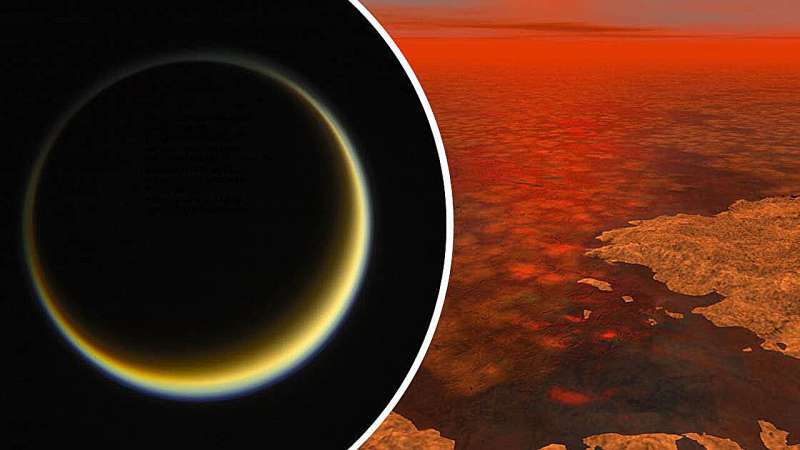
Conditions on Titan
Researchers from Chalmers University of Technology in Sweden and the US space agency NASA have made an unexpected discovery that challenges one of the fundamental rules of chemistry and provides new insights into Saturn’s mysterious moon Titan.
In extremely cold environments, substances that are normally incompatible can be mixed. This discovery expands our understanding of chemistry prior to the emergence of life.
Scientists have long been interested in Saturn’s largest orange moon, as its evolution can tell us more about our own planet and the first chemical stages on the path to the emergence of life. Titan’s cold environment and dense atmosphere, filled with nitrogen and methane, have much in common with the conditions believed to have existed on the young Earth billions of years ago. Therefore, by studying Titan, researchers hope to find clues about the origins of life.
Martin Rahm, associate professor in the Department of Chemistry and Chemical Engineering at Chalmers, has been working for a long time to better understand the situation on Titan. He now hopes that the research team’s surprising discovery that some polar and nonpolar substances can combine will form the basis for future research on Titan.
Hydrogen cyanide and its unexpected chemistry on Titan
A research paper published in the journal PNAS shows that methane, ethane, and hydrogen cyanide, which are present in significant quantities in the atmosphere and on the surface of Titan, can interact with each other in ways previously thought impossible.
The fact that hydrogen cyanide, a molecule with exceptional polarity, can form crystals with completely nonpolar substances such as methane and ethane is surprising, since such substances usually remain strictly separated, like oil and water.
“The discovery of the unexpected interaction between these substances could affect how we understand Titan’s geology and its strange landscapes of lakes, seas and sand dunes,” says Martin Rahm.
“In addition, hydrogen cyanide is likely to play an important role in the abiotic creation of several of life’s building blocks, for example, amino acids, which are used for the construction of proteins, and nucleobases, which are needed for the genetic code. So our work also contributes insights into chemistry before the emergence of life, and how it might proceed in extreme, inhospitable environments.”
Researchers’ collaboration with NASA
The premise of Chalmers’ research is the question about Titan, which remains unanswered: what happens to hydrogen cyanide after it forms in Titan’s atmosphere? Does it accumulate on the surface in meter-thick layers, or does it interact or react with the environment in some way?
To find the answer, a group of scientists from NASA’s Jet Propulsion Laboratory (JPL) in California began conducting experiments in which they mixed hydrogen cyanide with methane and ethane at a temperature of 90 kelvins (about -180 degrees Celsius). At these temperatures, hydrogen cyanide is a crystal, while methane and ethane are liquids.
When they studied these mixtures using laser spectroscopy, a method for examining materials and molecules at the atomic level, they discovered that the molecules were intact, but something had still happened. To understand exactly what, they contacted Martin Rahm’s research group at Chalmers, which had conducted extensive research on hydrogen cyanide.
“This led to an exciting theoretical and experimental collaboration between Chalmers and NASA. The question we asked ourselves was a bit crazy: Can the measurements be explained by a crystal structure in which methane or ethane is mixed with hydrogen cyanide? This contradicts a rule in chemistry, ‘like dissolves like,” which basically means that it should not be possible to combine these polar and nonpolar substances,” says Rahm.
Expanding the boundaries of chemistry
Researchers at Chalmers University used large-scale computer simulations to test thousands of different ways of organizing molecules in a rigid state in search of answers.
In their analysis, they discovered that hydrocarbons had penetrated the crystal lattice of hydrogen cyanide and formed stable new structures known as co-crystals. This can occur at very low temperatures, such as on Titan.
This discovery calls into question one of the most well-known rules of chemistry, but Martin Rahm does not believe that it is time to rewrite chemistry textbooks, as the exception only proves the rule.
In 2034, NASA’s Dragonfly space probe is scheduled to reach Titan with the aim of exploring its surface. By that time, Martin Rahm and his colleagues plan to continue researching the chemistry of hydrogen cyanide, partly in collaboration with NASA.
“Hydrogen cyanide is found in many places in the universe, for example in large dust clouds, in planetary atmospheres and in comets. The findings of our study may help us understand what happens in other cold environments in space. And we may be able to find out if other nonpolar molecules can also enter the hydrogen cyanide crystals and, if so, what this might mean for the chemistry preceding the emergence of life,” he says.
According to phys.org

