

Regardless of the size of a gas giant, its atmosphere is very extensive and turbulent. Recently, scientists have developed a unified model that can predict hurricanes and cloud bands on any similar planet.
Equatorial jets
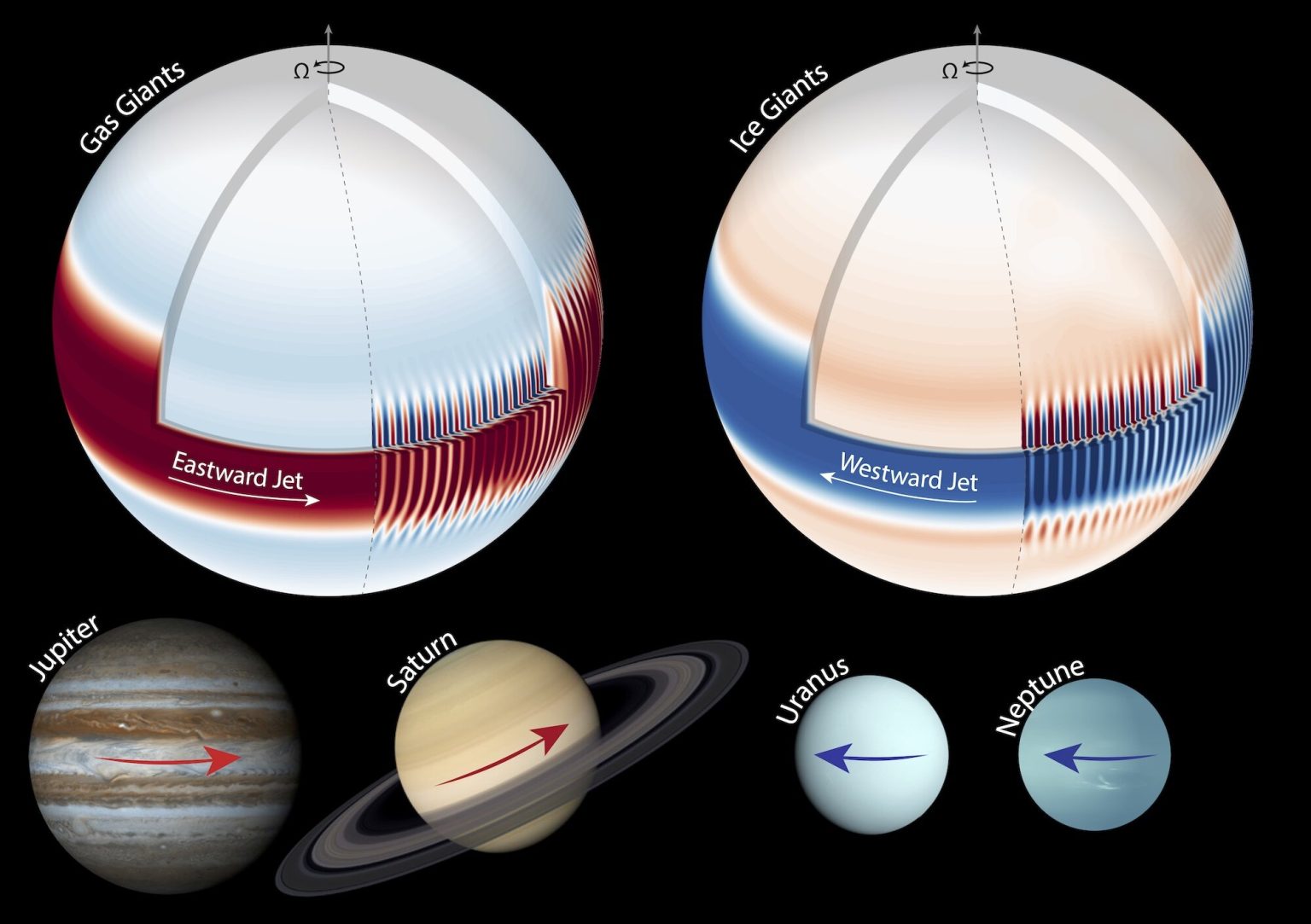
One of the most notable features of the giant planets in our Solar System — Jupiter, Saturn, Uranus, and Neptune — is the extremely strong winds observed around their equators. While on some of these giants the equatorial winds blow eastward, on others there is a westerly jet stream. For the first time, an international team of scientists led by Leiden Observatory and SRON has been able to explain the winds on all giant planets using a single model.
So-called fast-rotating convection in the atmospheres of giant planets may play a key role in the formation of both eastern and western jets. This was discovered by a team of astronomers led by postdoctoral researcher Keren Duer-Milner from Leiden Observatory and SRON.
Using global circulation models, the team determined that differences in atmospheric depth can form eastern jets on Jupiter and Saturn and western jets on Uranus and Neptune. The system demonstrates the so-called bifurcation: under the same conditions, the atmosphere can reach one of two stable states — either eastern or western equatorial currents — establishing a direct link between the direction of the currents and the depth of the atmosphere.
The fastest winds and rotating convection in the atmospheres of giant planets
For decades, scientists have been interested in the mechanism that drives superfast winds on giant planets at speeds ranging from 500 to 2,000 km/h. Air jets are the fastest winds observed in the Solar System and significantly exceed typical wind speeds on Earth.
Especially puzzling was the fact that on Jupiter and Saturn, the winds blow eastward, while on Uranus and Neptune, they blow westward. The main factors that can influence wind streams on these planets are considered to be similar. The planets receive little sunlight, have a moderate internal heat source, and rotate rapidly. There are no known forces that could explain the different wind directions. Until now, it was believed that the different directions of jet winds were caused by different mechanisms that set them in motion.
Now, Duer-Milner and her colleagues have discovered that rapidly rotating convective cells at the equator can act as a “conveyor belt” on the surface, moving wind streams both eastward and westward on different planets. Convection is a process that, thanks to circulation, can transfer heat in the atmosphere or liquids. It is believed that this is the main process by which heat from the interior of gas planets is transferred to their surface.
Unified model
Researchers say their model shows that Uranus and Neptune have the same mechanism for forming equatorial jets as the gas giants Jupiter and Saturn. This single model provides a simple, elegant explanation for a complex phenomenon. Scientists are now using measurements from the Juno spacecraft to find evidence of the proposed mechanism in Jupiter’s atmosphere.
Duer-Milner hopes that their findings can be applied to planets outside our Solar System. “Understanding these winds is crucial because it helps us understand the fundamental processes that govern planetary atmospheres, not only in our solar system but across the galaxy. This discovery gives us a new tool for understanding the diversity of planetary atmospheres and climates throughout the universe,” she says.
According to phys.org

