

Scientists became interested in how asteroids like Dinkinesh—which was found to have not one but two moons—might have formed. They hypothesized that this process might occur in several stages.
Amazing asteroids
A study by a group of researchers from China was recently published in the journal Nature Communications. They suggested that the formation of multiple asteroid systems may be a rather complex process consisting of several independent and repetitive stages.
In general, the fact that asteroids can have moons—and ones that are quite large compared to the asteroids themselves—once came as a huge surprise to scientists. After all, it would seem that an object with a diameter measured in kilometers couldn’t possibly have a moon—isn’t it too small for that?
When it comes to the ability to capture objects with a gravitational field, asteroids are definitely too small for that. However, scientists have long since discovered a mechanism that allows even very large moons to form, transforming ordinary asteroids into binary systems.
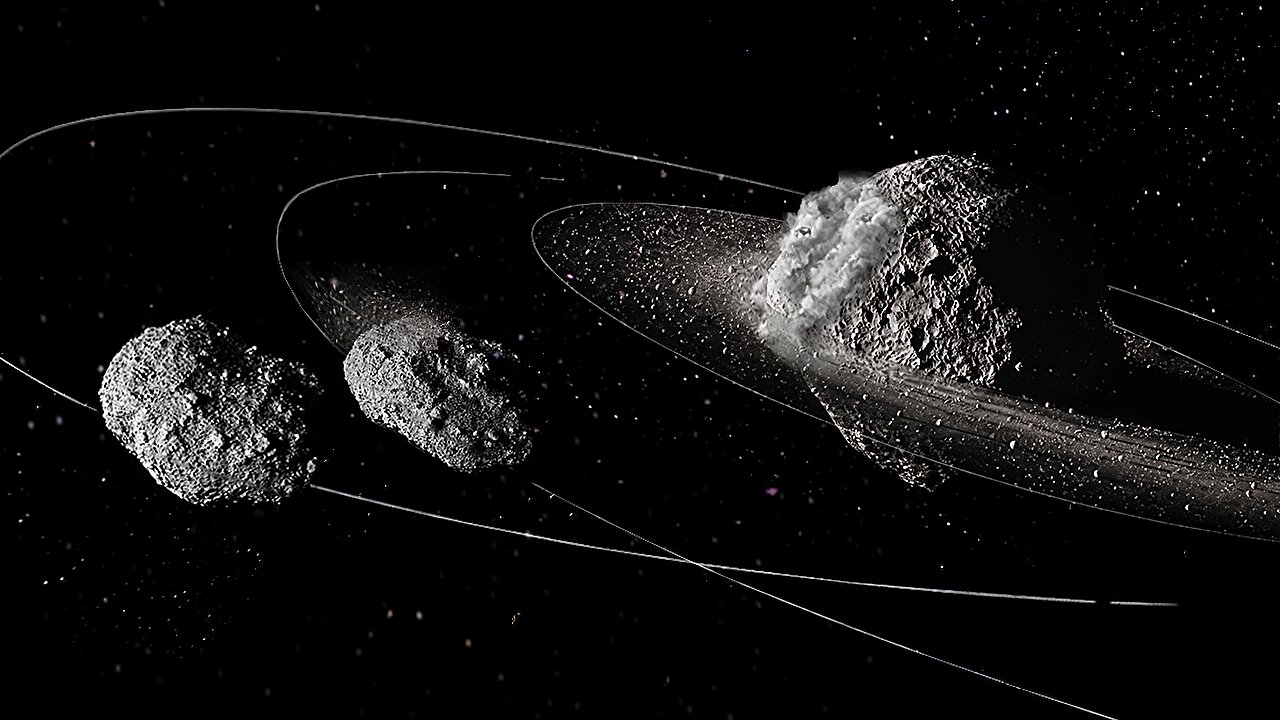
The idea is that, in the early stages of their existence, asteroids that rotate too quickly around their own axis can shed excess angular momentum along with some of their material. At least some of this material is not lost in space but accumulates in the asteroid’s orbit, usually somewhere near the Roche limit.
Dinkinesh and other asteroids
This simple model of binary asteroid formation was widely accepted in the scientific community until NASA’s Lucy mission flew past the asteroid Dinkinesh and discovered that its companion is actually a contact binary. In other words, these are two small asteroids that are almost touching each other while also orbiting the main body.
Dinkinesh is not the only one. There are also at least 2001 SN263 and Balam, which are also multiple systems. Their formation is very difficult to explain using the theory of a single-event ejection of material. Therefore, scientists have proposed a new theory that posits the existence of several processes occurring simultaneously.
The first is not a single event, but rather a series of successive ejections of material from the parent body, occurring at regular intervals. The second involves changes in the orbital parameters of the satellites that have formed over time. And finally, the third involves the complex interaction of these bodies, including the possibility of low-speed approaches resulting in the formation of contact pairs.
The authors of the study tested all of this using multi-component computer models. They showed that 44% of all known multiple asteroids are best explained by this theory. And some of them have existed long enough to have lost fragments of material on several occasions.
According to phys.org

