

Scientists from the University of Washington have published a new study explaining how to recognize the technological origin of interstellar objects (ISO). The reason for this was the discovery of the third known ISO — 3I/ATLAS, which once again sparked a wave of discussion.
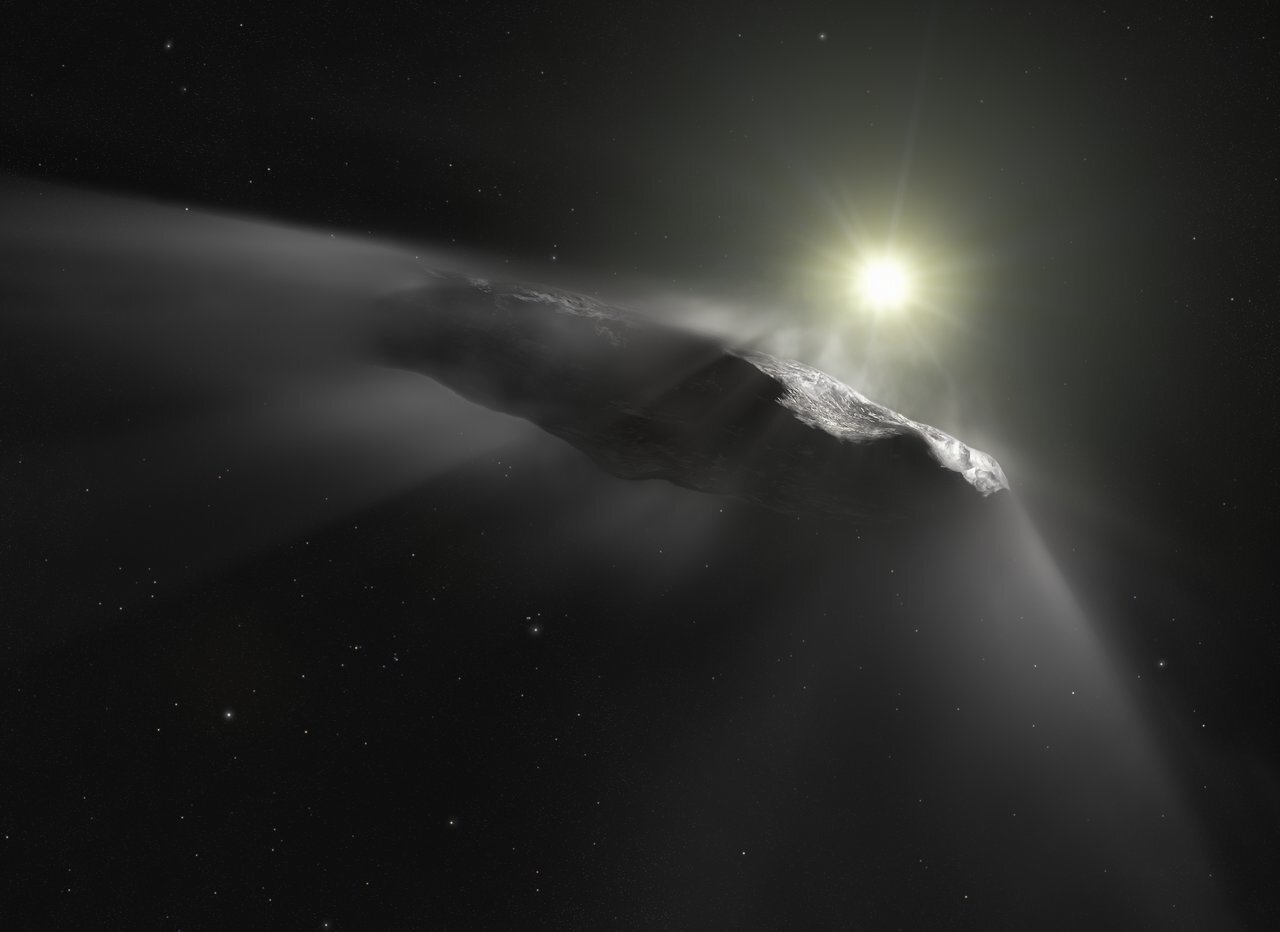
Interstellar objects (ISO) have only become a real astronomical discovery in recent years. The first was the mysterious Oumuamua in 2017. Subsequently, in 2019, Borisov’s comet appeared, and now — 3I/ATLAS. All three objects turned out to be natural, but each of them expanded our understanding of space and the possibilities for its exploration.
Researchers have identified several possible technosignatures — signs that may indicate that an object was created by an intelligent civilization.
- Unusual maneuvers. If a body changes its speed or trajectory in a way that cannot be explained by gravity alone, this may indicate the presence of an engine. This hypothesis was discussed for some time in relation to Oumuamua.
- Spectral features. Artificial materials, coatings, or even window panes on a hypothetical spacecraft may differ from natural rock or ice surfaces. However, all known ISOs have shown normal spectra without anomalies.
- Unusual shape. Artificially designed interstellar probes often have large solar sails or other atypical structures. It is difficult to determine the shape of an object directly, but it can be deduced from the nature of its rotation.
- Signals. Radio waves or lasers from such an object at close range are easily distinguishable from natural noise.
Among them, the latter would be the most reliable evidence. However, so far, all three known interstellar objects have shown nothing “alien.” They behave in ways that can be explained by natural processes, such as gas evaporation or the effects of solar radiation. But the very fact of their existence opens up new horizons for exploration.
Scientists note that no special instruments are needed to detect such technosignatures, because the necessary data is already collected during standard observations. In the future, there may even be special missions to ISO that will resemble science fiction scenarios.
The Vera Rubin Observatory, which is expected to launch in the near future, will play a special role in further research. According to forecasts, it will be able to detect dozens, and possibly hundreds, of new interstellar objects over the next few decades.
Although all three known ISOs have natural explanations, developing criteria for searching for technosignatures helps science be prepared for the unexpected. The more interstellar travelers we discover, the closer we will get to answering the question that has long preoccupied humanity: are we alone in the Universe?

