

In January, the James Webb Space Telescope (JWST) conducted a 17-hour observation of the ice giant Uranus to unravel the mysteries of its turbulent upper atmosphere. Thanks to the NIRSpec instrument (near-infrared spectrograph), astronomers were able to create a detailed three-dimensional map of this region at an altitude of almost 5,000 km above the planet’s cloud layer for the first time. A study published in the journal Geophysical Research Letters sheds light on how Uranus’ eccentric magnetic field interacts with the solar wind, generating unique auroras.

Uranus is one of the most mysterious planets in the Solar System. It rotates “on its side” due to the extreme tilt of its axis of more than 90°. But its magnetic field turned out to be even more bizarre: it is tilted relative to the axis of rotation by almost 60° and is also shifted from the center of the planet. This “curved” configuration creates an asymmetrical magnetosphere that is constantly changing, causing the auroras to “wander” across the surface.
James Webb’s observations confirmed this theory by showing two bright arcs of light rotating around the magnetic poles. Between these bands, scientists recorded a sharp drop in ion concentration. This is direct evidence that the magnetic field acts like a giant funnel, directing streams of charged particles from the solar wind into the atmosphere. Although Hubble first observed auroras on Uranus in 2012, astronomers have only now been able to track how far these energetic processes penetrate the atmosphere.
Temperature record
Voyager 2, which flew past Uranus in 1986, recorded incredible cold there — the temperature of the upper layers reached -214°C. New data from James Webb shows that this region continues to cool.
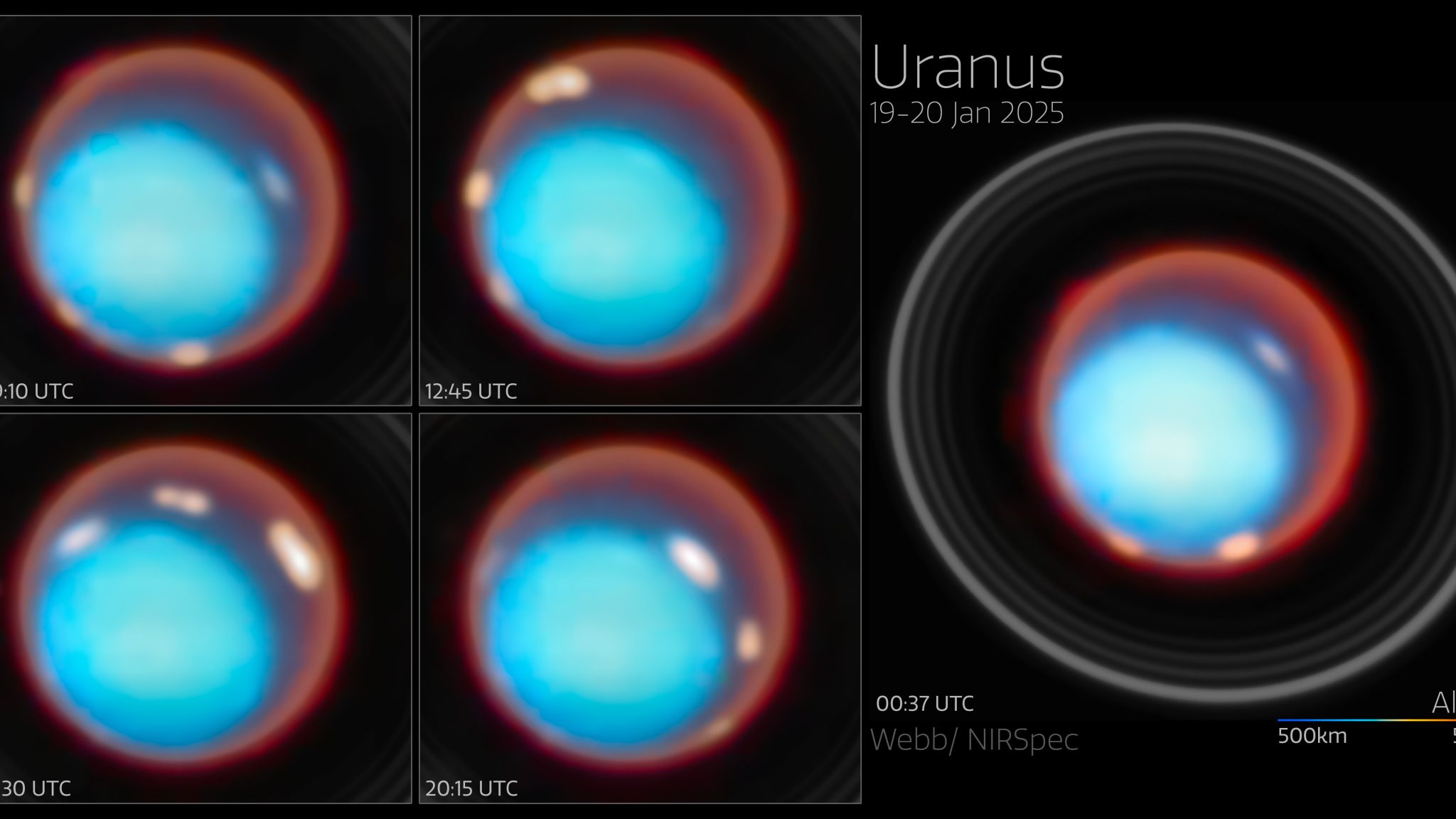
By observing the glow of molecules in different layers of the atmosphere, the telescope was able to measure not only the temperature but also the density of particles at different altitudes. This made it possible for the first time to track how energy moves through the planet’s gas envelope.
“Building a vertical structure of Uranus’ atmosphere with such precision helps us understand the energy balance of all ice giants,” the scientists explain. “This is an important step in studying similar planets that we are discovering beyond the Solar System.”
Earlier, we reported on the top 12 surprising facts about Uranus.
According to ESA

