

Uranus is warmer than previously thought. This conclusion was reached by a team of researchers from NASA and Oxford University thanks to computer simulations and reanalysis of old data.

Uranus is unlike any other planet in our Solar System. It rotates on its side. This means that for 42 years, one of its poles is constantly illuminated by the Sun and enjoys continuous summer, while the other pole is in darkness and experiences a 42-year winter.
Throughout its history, Uranus has been visited by only one spacecraft: Voyager 2 in 1986. Its measurements presented scientists with a new mystery. The other giant planets in the Solar System (Saturn, Jupiter, and Neptune) emit much more heat than they receive from the Sun. The reason for this excess heat emission is most likely due to residual heat remaining after their formation, as well as gravitational compression and differentiation processes. The amount of heat emitted by a planet can also be an indicator of its age: the less heat it emits compared to the heat it absorbs from the Sun, the older the planet is.
However, this is not the case with Uranus. Data from Voyager 2 shows that the planet emits approximately the same amount of energy as it receives from the Sun, and it has no internal heat source. This puzzled scientists. Some hypothesized that Uranus might be much older than all the other planets and had completely cooled down. Others have suggested that it is the result of a giant collision that once knocked the planet on its side. However, none of these hypotheses fully satisfied the scientific community. The problem was further exacerbated by the fact that all hypotheses were based on a single measurement made by Voyager 2.

To uncover the mystery of cold Uranus, a team of researchers from NASA and Oxford University decided to determine the planet’s total energy balance: how much energy it receives from the Sun compared to how much it reflects as sunlight and how much it emits as heat. For this, the researchers needed to estimate the total amount of light reflected from Uranus at all angles.
Scientists have developed a computer model that combines all known data about Uranus’ atmosphere obtained over decades of observations from ground-based and space telescopes, including Hubble. It included information about haze, clouds, and seasonal changes that affect sunlight reflection and heat loss.
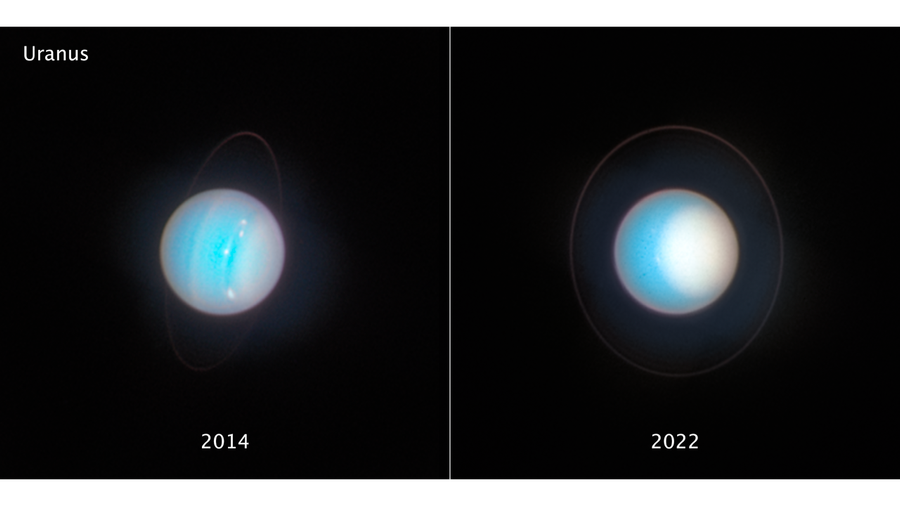
Researchers have discovered that Uranus emits approximately 15% more energy than it receives from the Sun. This figure is consistent with estimates from another study, the results of which were recently published in Geophysical Research Letters. Thus, Uranus does have an internal heat source, although it is significantly weaker than that of Neptune, which is similar in size. By comparison, the eighth planet emits more than twice as much energy as it receives.
According to scientists, uncovering Uranus’ past is not only useful for compiling a chronology of the formation of the planets in the Solar System and their migration to their current orbits, but will also help scientists better understand the nature of exoplanets, most of which are of comparable size.
According to NASA

