

Scientists used data from several astronomical instruments to determine the chemical composition of Uranus’s two outer rings—μ and ν. Studies show that they have different origins.
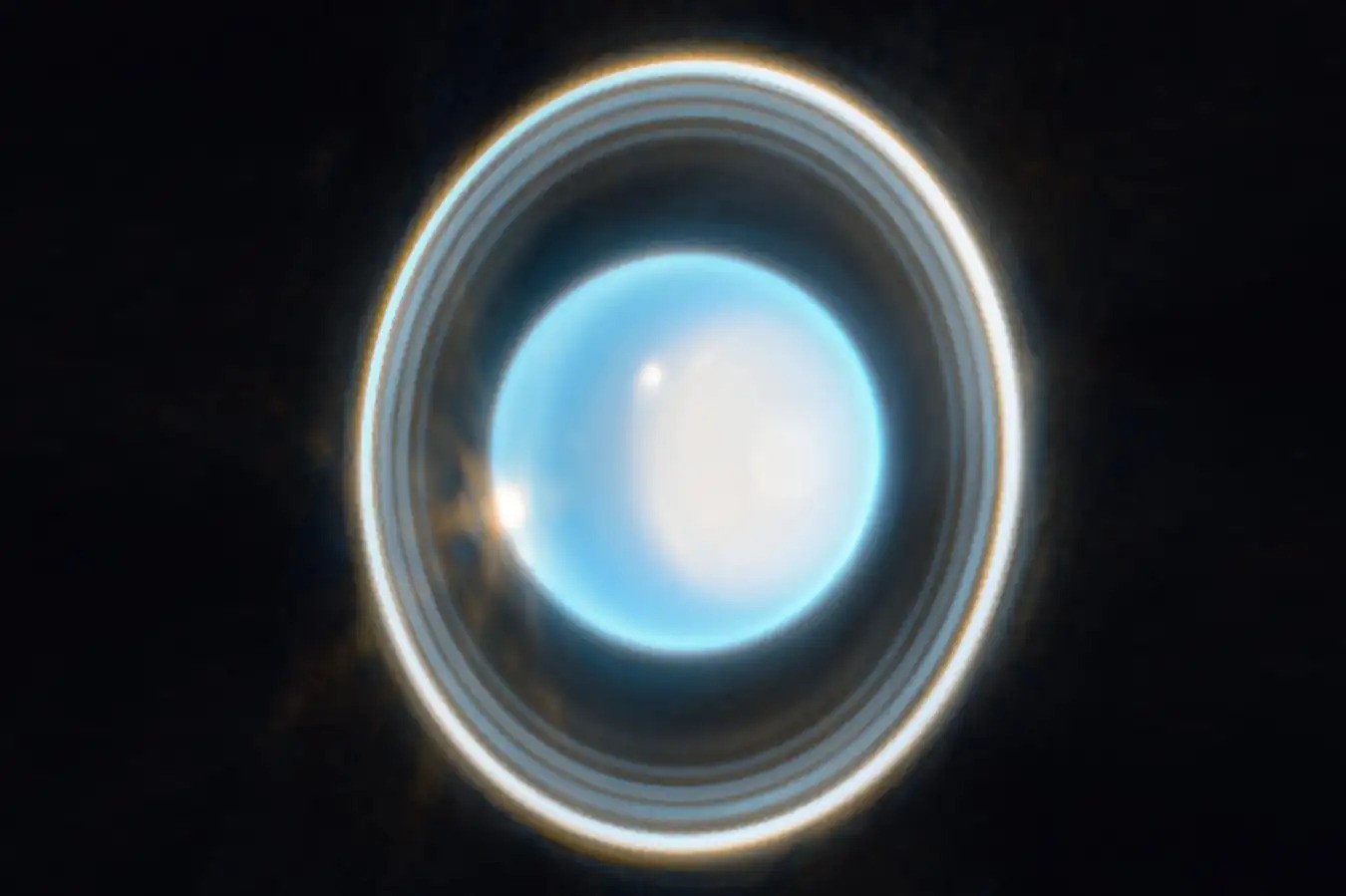
Uranus’ outer rings
Astronomers working at the W. M. Keck Observatory in Hawaii recently published a study on the origin of Uranus’s two outer rings. For this purpose, they used observational data from their research institution, as well as from the Hubble and James Webb space telescopes.
In fact, Uranus was the second planet to be found to have a ring system. This happened in 1977, and at the time, few people noticed just how unusual it was. However, scientists have known for many years that something is amiss with its two outer components—μ and ν.
Both are fairly faint and are located within Uranus’s satellite system. Ring μ appears blue and consists of tiny ice particles. Ring ν, on the other hand, resembles other components of the system and consists of larger dust grains.
At the same time, when researchers attempted to reproduce their full spectrum, both rings exhibited significant absorption at a wavelength of about 3 micrometers. This raised the question of whether they share a common origin or evolved independently of one another.
Different origins
Recent studies show that these rings have different origins. The μ ring really consists mainly of pure ice, whereas the ν ring consists mainly of silicates and organic compounds. This has led scientists to wonder where it might have come from.
Researchers speculate that the μ ring formed from material originating from a small (12-km-wide) icy moon of Mab. At the same time, it remains unclear where the micrometeorites might have dislodged the material for the ν ring.
However, the μ ring is of much greater interest to scientists, since the only known structure in the Solar System that resembles it is Saturn’s E ring. It was formed as a result of geyser activity on Saturn’s moon Enceladus. However, compared to it, Mab is extremely small and cannot sustain volcanic activity. Therefore, scientists are still at a loss as to why this moon and its associated ring are so strange.
According to phys.org

