

Scientists studied the orphan planet SIMP-0136 using the James Webb Space Telescope. It does not have its own star, but processes involving the absorption of high-energy particles, similar to polar auroras, occur in its atmosphere.
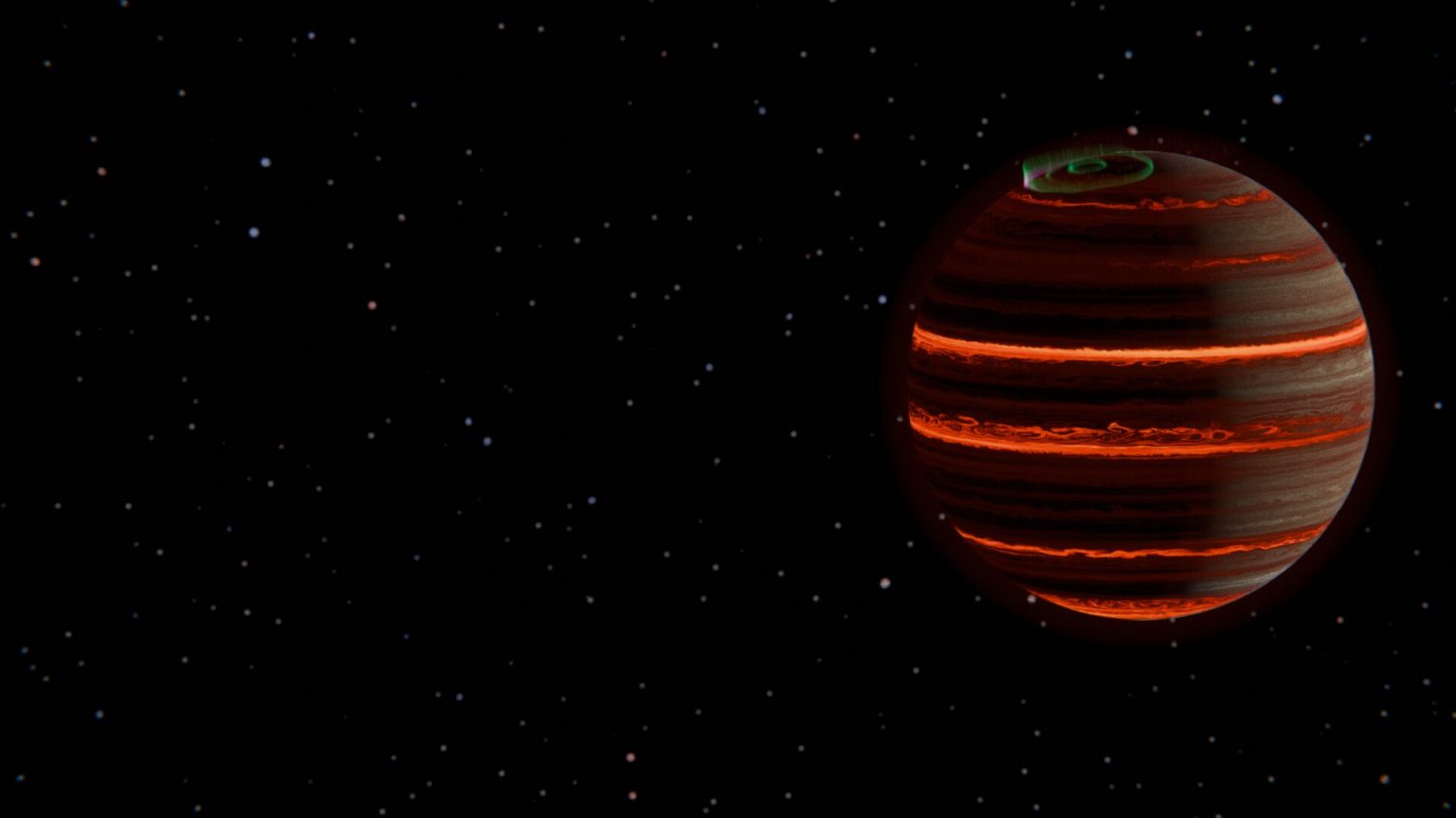
Auroras on a distant planet
Strong activity, similar to the Northern Lights, is a striking feature of today’s weather forecast, which is brought to you from the amazing world beyond the sun, rather than from a standard television studio. This was made possible by astronomers at Trinity College Dublin, who used NASA’s James Webb Space Telescope to study the weather on the warm neighboring wandering planet SIMP-0136 in detail.
The fine sensitivity of the instruments aboard the space telescope allowed the team to observe slight changes in the planet’s brightness as it rotated, which was used to track changes in temperature, cloud cover, and chemical composition. Surprisingly, these observations also revealed strong auroral activity in SIMP-0136, similar to the Northern Lights on Earth or the powerful auroras on Jupiter, which heat its upper atmosphere.
“These are some of the most accurate measurements of the atmosphere of any extrasolar object to date and the first time that changes in atmospheric properties have been measured directly,” said Dr. Evert Nasedkin, a postdoctoral fellow at Trinity College Dublin’s School of Physics.
Atmospheric properties and temperature measurements on SIMP-0136
Precise observations made by astronomers allowed them to accurately record temperature fluctuations of less than 5 °C. These temperature changes were associated with minor changes in the chemical composition of this free-floating planet, indicating a storm — similar to Jupiter’s Great Red Spot — rotating in the field of view.
Another unexpected discovery was the absence of cloud changeability on SIMP-0136. It can be expected that changes in cloud cover will lead to changes in the atmosphere, just as we observe areas of clouds and blue skies here on Earth. Instead, the team found that the cloud cover on the surface of SIMP-0136 remains constant. At the temperatures prevailing in these conditions, the clouds on SIMP-0136 differ from those on Earth; they consist of silicate grains similar to sand on a beach.
Scientists conducted additional analysis, revealing more details about the atmosphere of planet SIMP-0136.
It turns out that different wavelengths of light are associated with different atmospheric characteristics, meaning that changes in the color of a planet indicate changes in atmospheric properties. Because of this, we can figure out the temperature of the atmosphere, the chemical composition, and the position of clouds.
Researching weather in other worlds
The work of astronomers is very exciting because it shows that by applying our advanced modeling techniques to modern data sets from James Webb, we can begin to form an understanding of the processes that influence weather in worlds beyond our Solar System.
Understanding these weather processes will be very important as we continue to discover and characterize exoplanets in the future. Although such studies are currently very limited, scientists are confident that future observations using the Extremely Large Telescope and the Habitable Worlds Observatory will allow them to investigate the atmospheric dynamics of exoplanets, from Jupiter-like gas giants to rocky worlds.
According to phys.org

