

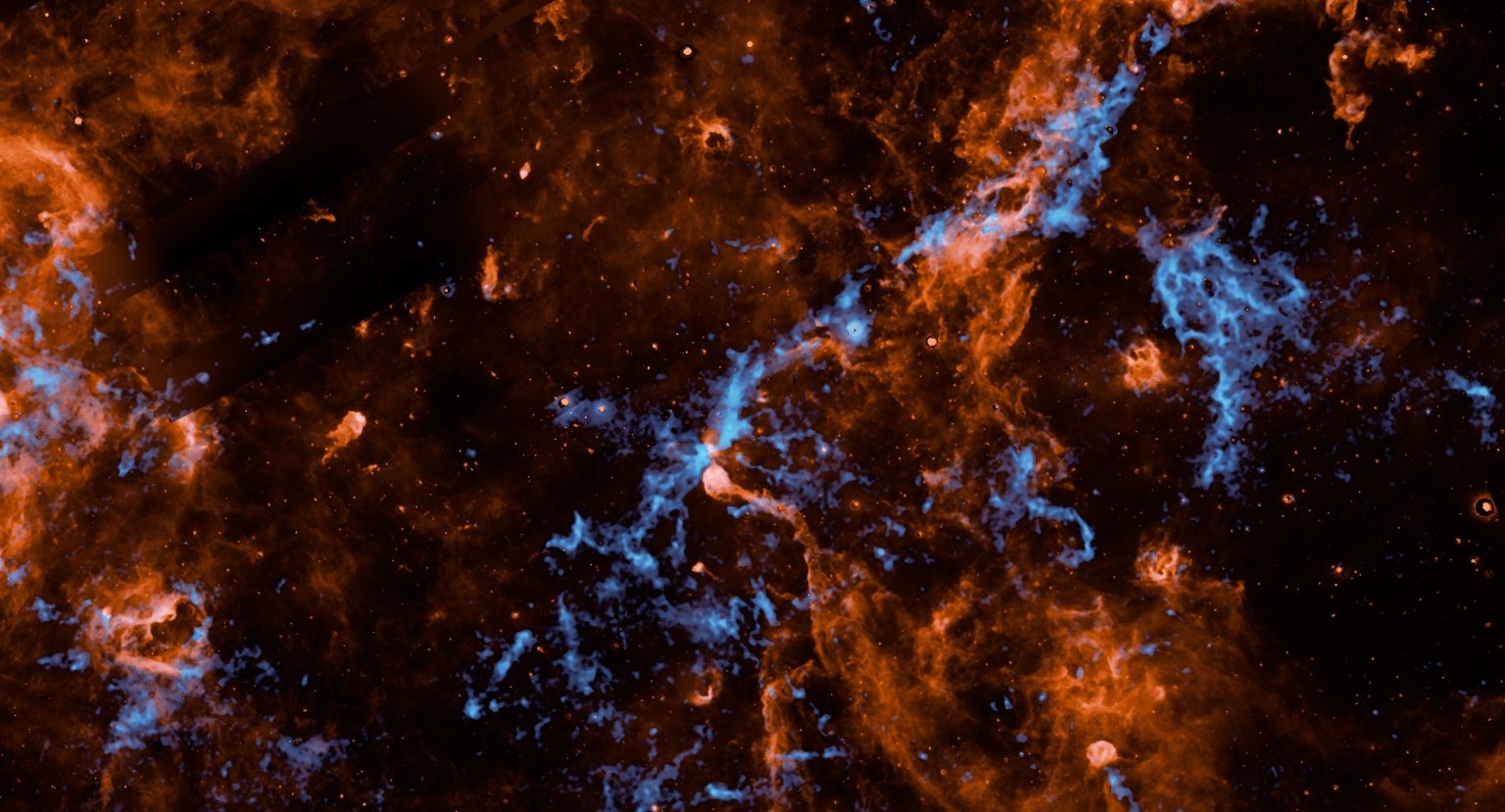
Using NASA’s SPHEREx space telescope, researchers have mapped interstellar ice across a region spanning more than 600 light-years for the first time, uncovering vast reserves of water for future star systems. The findings were published in The Astrophysical Journal.
What is interstellar ice?
We’re not talking about the usual ice floes, but rather molecules of water, carbon dioxide, and carbon monoxide that settle on the surface of microscopic dust particles—no larger than the smoke particles from a candle.
These molecular clouds—where gas and dust are compressed by gravity and give rise to new stars—are where most of the water in the universe is formed. According to scientists, the water in Earth’s oceans and the ice on comets and other bodies in our galaxy originate from these clouds.
Scale and accuracy of observations
SPHEREx observes the sky simultaneously in 102 infrared wavelengths, each of which provides distinct information about the composition of celestial objects. This allowed scientists to map the spatial distribution of ice in the clouds of Cygnus X and the North America Nebula—with a level of detail unmatched by any previous survey.
“When we look along the galactic plane, where most of our galaxy’s stars, gas, and dust are concentrated, scattered background light shines through entire clouds, and SPHEREx can see the distribution of ice within them in incredible detail,” explains study lead author Joseph Hora of the Harvard-Smithsonian Center for Astrophysics.
Observations confirm that ice forms on dust grains, and dense clouds shield it from the intense ultraviolet radiation emitted by young stars. At the same time, water and carbon dioxide react differently to environmental conditions—and SPHEREx makes it possible for the first time to track these differences across large regions of space. Ground-based telescopes are unable to conduct such studies because water vapor in Earth’s atmosphere absorbs the very infrared light emitted by cosmic ice.
“Glaciers” for new planets
“These massive ice structures are like interstellar glaciers capable of supplying enormous amounts of water to the new star systems forming in these regions,” notes study co-author Phil Korngut of the California Institute of Technology. In other words, this very ice could one day fall as rain on newly formed planets and potentially create the conditions necessary for life to emerge.
SPHEREx was launched on March 11, 2025. By the end of that year, the spacecraft had completed the first of four full infrared maps of the sky. The mission data is available to all scientists and the general public. SPHEREx will study the physics of the interstellar medium and the chemistry of space to understand how the building blocks of life become part of newly formed worlds.
According to nasa.gov

