

Scientists observed the interstellar comet 3I/ATLAS using the Swift ultraviolet space telescope. With the help of this instrument, they found hydroxyl ions, indicating the presence of water on the comet. This allows us to compare it to the “cosmic icebergs” that are constantly present in our Solar System.
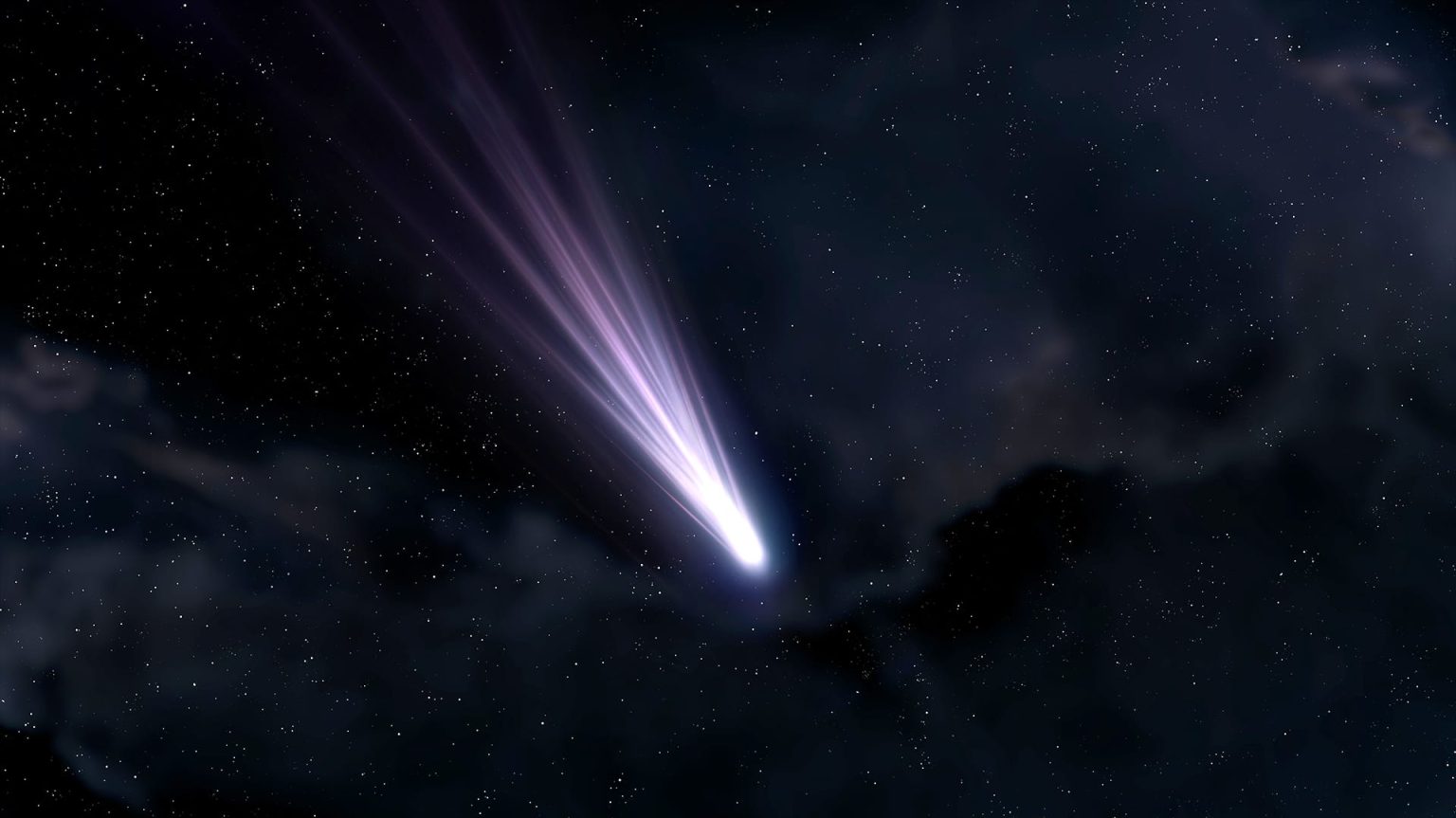
Water on comet 3I/ATLAS
Scientists have published a study of the interstellar comet 3I/ATLAS using NASA’s Swift space telescope. This orbital observatory operates in ultraviolet light and is capable of performing spectral analysis for this wavelength range. As a result, scientists learned something interesting about its chemical composition.
In particular, water was found on it. More precisely, the telescope captured ultraviolet light from the hydroxyl ion OH, but it cannot be anything other than the decay product of a water molecule. Thus, a safe assumption is that it is present there.
But the really important thing was that this discovery was made when 3I/ATLAS was three times farther from the Sun than Earth. At this distance, comets in the Solar System do not show any activity. But for some reason, up to 40 kg of water evaporated from the interstellar space every second.
Origin of comets
Nevertheless, scientists believe that ultraviolet research has enabled them to compare 3I/ATLAS with comets in the Solar System. Its abnormal activity can be easily explained by the existence of complex layers of ice on the surface of its core. Similar ones were observed in several objects that formed far from the Sun.
3I/ATLAS is only the third interstellar object that scientists have been able to study in detail. And they are all completely different. Oumuamua was completely dry, while Borisov’s comet was rich in carbon monoxide. And now 3I/ATLAS shows a large amount of water.
All this indicates their formation under different conditions. This means that the systems from which they originate have to be really different from each other. Although this conclusion is based on a small sample size, future interstellar visitors will be able to provide more information.
According to phys.org

