

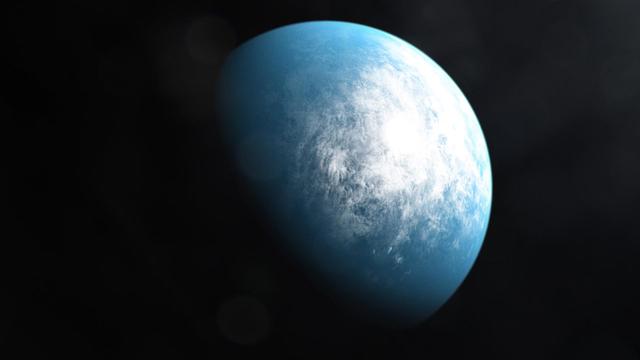
Water is traditionally considered essential for life, but research by a team at the Massachusetts Institute of Technology (MIT) led by Rachana Agrawal challenges this assumption. Scientists have discovered that even planets without water can form other liquids capable of supporting life.
These are so-called ionic liquids — stable salt solutions that appear when sulfuric acid is mixed with certain organic substances containing nitrogen. Such substances are likely to exist on many rocky planets.
“We usually think in terms of ‘water = life’. But in reality, it is not water itself that is important, but the presence of an environment in which metabolism is possible,” explains Rachana Agrawal.
The impetus for the study was an attempt to understand whether Venus’ clouds, which consist mainly of sulfuric acid, could contain signs of life. During experiments with glycine (a simple organic compound), scientists noticed that after most of the acid had evaporated, a thin layer of liquid remained. The analysis showed that the acid and glycine reacted to form an ionic liquid that did not break down even at high temperatures and low pressures.
This discovery led researchers to believe that similar reactions could occur on other planets, particularly those that are significantly warmer than Earth and do not have water.
“If we imagine a hot, rocky planet with volcanoes spewing sulfuric acid and a surface rich in organic matter, we get potential oases of liquids that could exist for years or millennia,” notes Sara Seager, co-author of the study.
Thus, the researchers tested more than 30 different organic compounds in combination with sulfuric acid. They worked in conditions of up to 180 °C and pressure much lower than on Earth. It turned out that ionic liquids form almost always, even when acid is applied to basalt rock, similar to that found on many planets.
“We were surprised that these liquids formed so easily and persisted even under harsh conditions,” says Sara Seager. “It’s like finding a puddle that doesn’t dry up even under the scorching sun.”
This discovery means that life can arise even in environments without water. For example, on hot, rocky exoplanets with volcanoes or even in the clouds of gas giants. Thus, the “habitable zone” in the Universe may be much wider than previously thought.
The study was published in the Proceedings of the National Academy of Sciences.

