
Researchers have developed a new virtual model to simulate how astronauts might interact with each other and their environment during future operations at a lunar base, with previous simulations indicating potential opportunities to increase the chances of mission success. Raymond Vera and his colleagues at George Mason University in Virginia, USA, present these findings in the scientific journal PLOS One.
The need to simulate astronauts’ behavior on the Moon
The primary goal of NASA’s Artemis program is to establish a permanent base on the Moon for astronaut missions. The success of future operations at the lunar base will depend on how astronauts interact with one another and with the lunar environment.
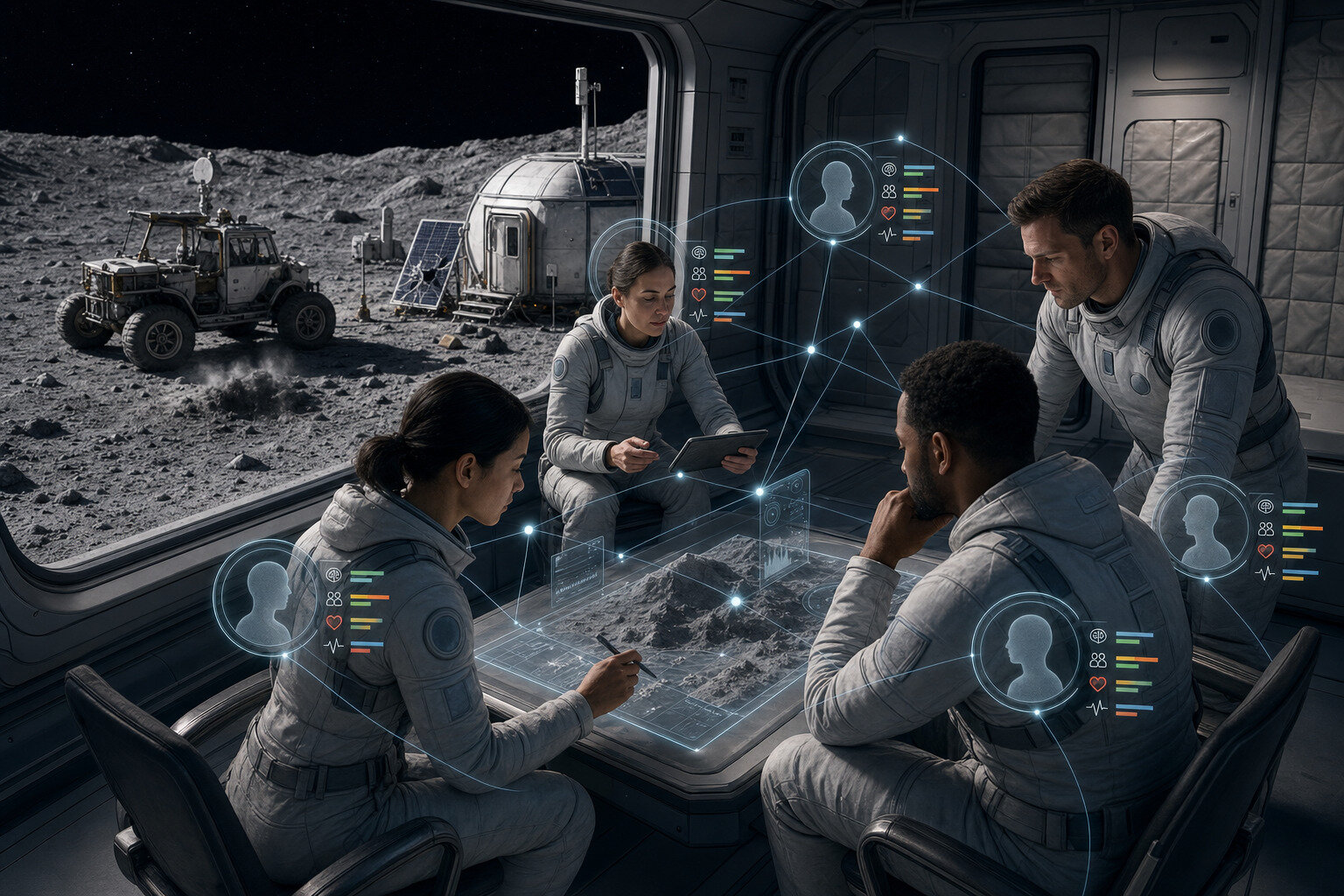
To assist in planning and assessing the risks of such missions, Vera and her colleagues developed a new model that simulates the interaction of cognitive, social, emotional, and environmental factors during operations at a lunar base. The model takes into account the known characteristics and challenges of the Moon, as well as preliminary findings from studies on team dynamics and psychological well-being from past crewed space missions and research on teams operating in extreme conditions on Earth.
How does the new virtual model work?
In the simulations, virtual astronauts are randomly assigned various professional skills, personality traits, physical health, and other characteristics. Over time, they adapt in response to interpersonal dynamics and environmental conditions, becoming more efficient at performing routine tasks and improving their proficiency. In addition to the expected mission-related tasks, they sometimes face unpredictable challenges, such as equipment malfunctions, moonquakes, and intense radiation events. The simulations also include interactions between the astronauts and the lunar rovers.
The researchers ran tens of thousands of such simulations and analyzed the results. They found that increasing the size of the crew helped optimize the development of professional skills and improved the chances of personality compatibility, which fosters teamwork. Meanwhile, factors such as the length of the mission and the lack of astronaut relief caused psychological stress, which reduced the effectiveness of mission operations.
Help with planning future lunar missions
Based on their findings, the researchers conclude that modeling the dynamics of a space mission crew could aid in planning to optimize mission success in future lunar exploration. Further research could improve these simulations, for example, by incorporating the physiological effects of long-duration space missions and communication delays with Earth.
The authors note: “As humanity prepares to establish a permanent presence on the moon, understanding human behavior becomes just as important as understanding engineering systems. This research demonstrates how agent-based modeling can simulate the complex interactions between astronauts, teams, and the extreme conditions of space to improve the effectiveness and sustainability of future lunar missions.”
According to phys.org

