

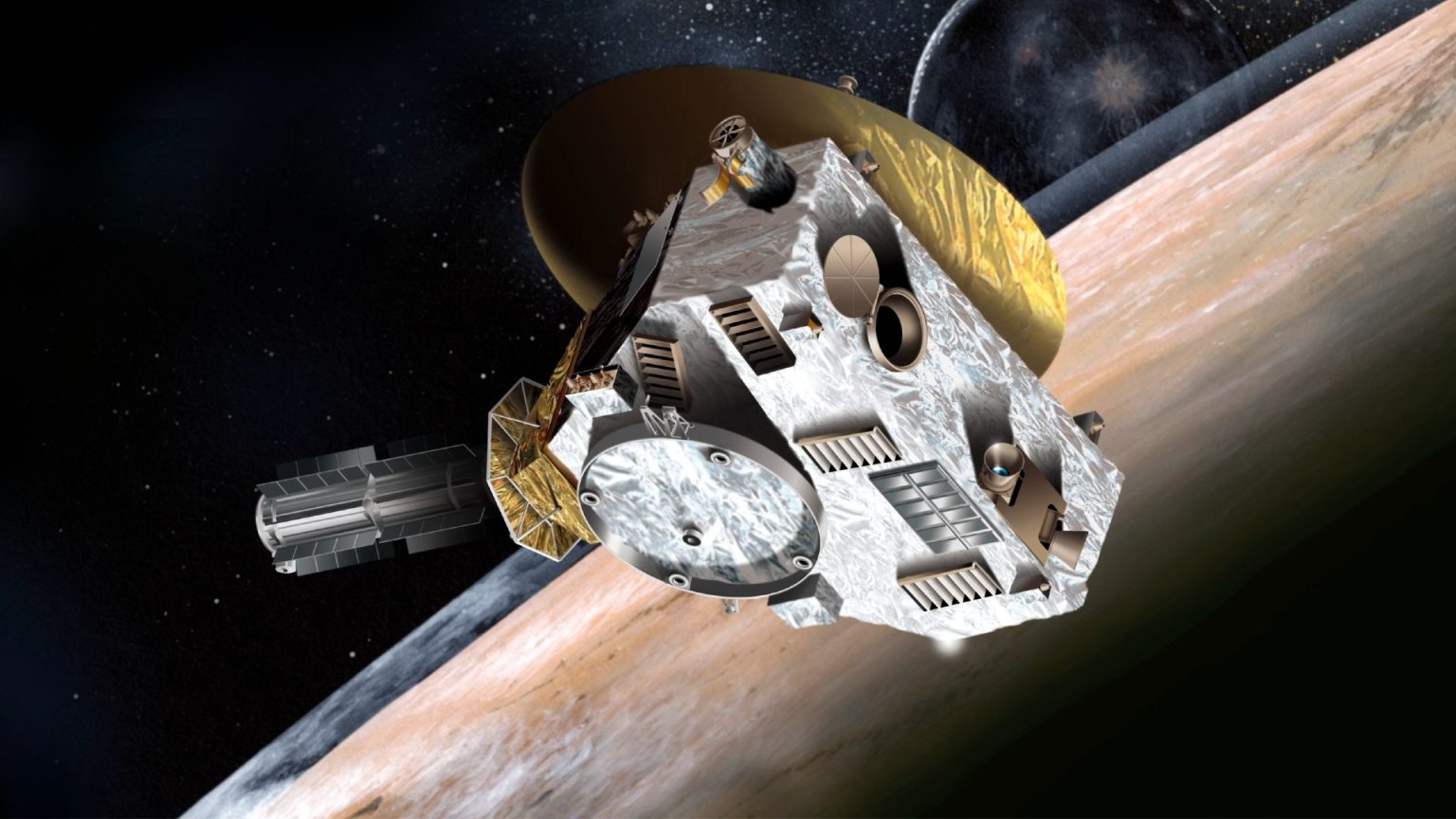
Twenty years ago, the New Horizons spacecraft launched from Cape Canaveral. Eight and a half years later, the whole world was talking about it when it transmitted the first-ever close-up images of Pluto’s surface back to Earth. However, its adventures actually began much earlier.
Who is interested in Pluto?
January 19 marks the 20th anniversary of the launch of the Atlas 5 rocket from the US Space Force base, which carried the New Horizons spacecraft beyond Earth’s gravitational sphere. Nowadays, it is mainly talked about in connection with the discoveries it made during its brief flyby of Pluto.
However, in reality, the interesting adventures of the probe designed to explore Pluto began long before the summer of 2015 and even long before its launch, although these adventures were a little unusual.
First, it should be noted that the first spacecraft could have reached Pluto several decades earlier. Voyager 1 could well have been that spacecraft. At least in the 1970s, during the mission planning stage, there was an idea to perform a gravitational maneuver during the flyby of Saturn, which would allow the probe to be directed towards the object that was then considered the ninth planet of the Solar System in a few years.
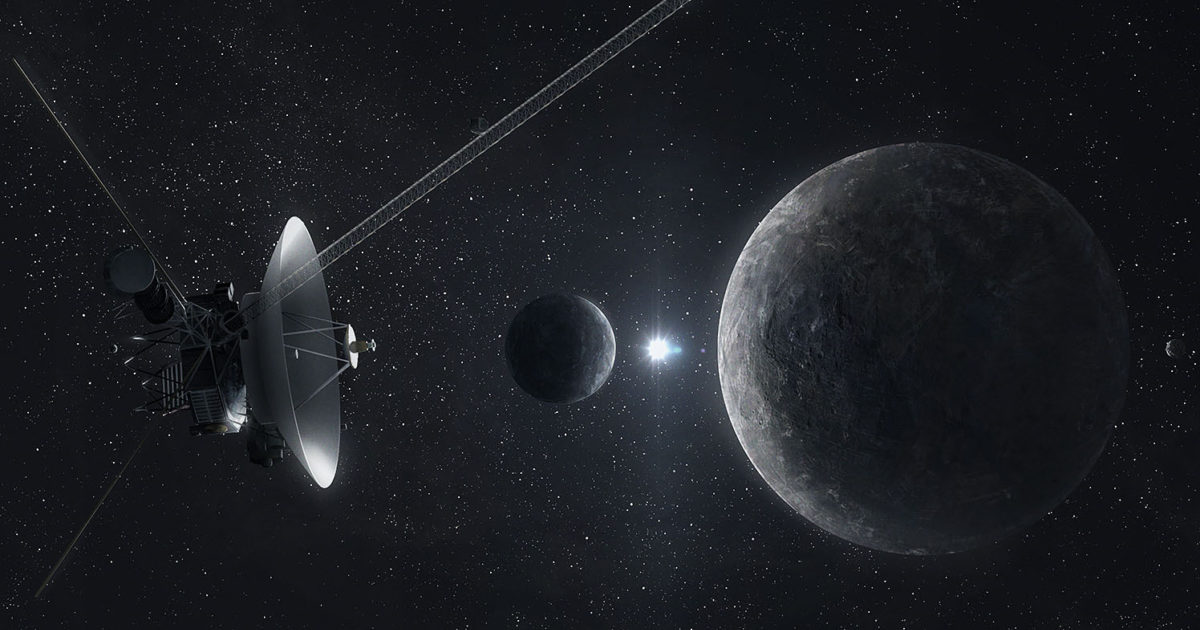
However, at that time, Pluto was considered too distant and uninteresting, so preference was given to a trajectory that allowed for better exploration of Saturn’s largest moon, Titan. However, over the next 15 years, everything changed dramatically. In 1978, Pluto’s moon Charon was discovered, unusually large and close to the planet, and in 1985, its atmosphere was discovered. All this was already worth launching a spacecraft to what seemed at the time to be the most distant body in the Solar System.
In 1989-90, NASA established a working group that developed a project called Pluto 350. It was supposed to be a truly epic mission, designed to last 15 years. Initially, the spacecraft was to head for Venus and Mercury to gain speed, then perform another gravitational maneuver near Jupiter, and only then head for Pluto.
Such a cunning plan was necessary because the speed that can be achieved by the spacecraft during launch is quite limited, and the entire time it flies to Pluto, the Sun’s gravitational pull will slow it down. It will reach its destination, but it will take several decades.
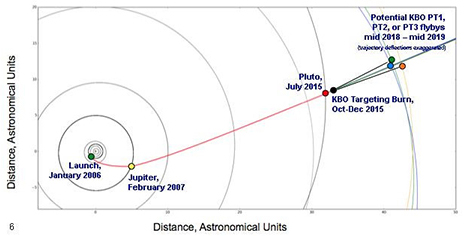
That is why, without an intermediate point in the form of Jupiter, which, with the right calculations, can be turned into acceleration, it is impossible to do without. But 15 years was still too long, so NASA’s Jet Propulsion Laboratory developed another plan called Pluto Fast Flyby. It involved flying two small spacecraft for a total of seven years and performing a gravitational maneuver near Jupiter. In fact, this plan was later implemented during the New Horizons mission.
Is the flight to Pluto justified?
However, at that very moment, in 1993, after the loss of Mars Observer, the number of people willing to pay $1 billion – the estimated cost of the mission to Pluto at the time – dropped sharply. Instead, scientists’ interest only grew. The fact is that in 1987, the planet passed its equinox, and in 1989, it passed its perihelion, i.e., the point in its orbit closest to the Sun.
In addition, Pluto’s orbit is not only highly elongated but also significantly inclined to the ecliptic. This means that the most favorable moment for launching a spacecraft from Earth was in the second half of the 1980s. This crazy celestial body completes a full revolution around the Sun in 247 years.
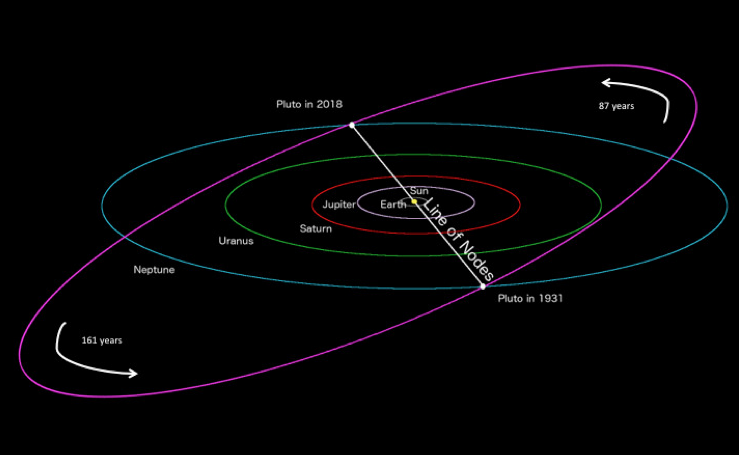
This means that with each passing year, the spacecraft’s flight path would become longer and higher above the plane in which the rest of the planets in the Solar System revolve. This would mean higher costs and less equipment that could be delivered to the target.
In an attempt to save the mission, a desperate option was proposed: it would be launched by a Russian rocket, and Germany would provide funding in exchange for the opportunity to place its own sub-probe on board. The plan was to drop it onto one of Jupiter’s moons as the spacecraft flew through the gas giant’s system.
So, in discussions about the flight to Pluto, the topic arose that on its way there, the spacecraft should not only “sleep” but also explore something interesting as it flew past. But the plan did not work out, and in the mid-1990s, the project was abandoned.
But not for long, because at that very moment, more and more new objects began to be discovered beyond Neptune’s orbit. The flight plan to Pluto was taken out of the drawer again and supplemented with a section in which, after exploring the planet, the probe was to fly further and take a closer look at one of the newly discovered asteroids.
The mission was renamed Pluto Kuiper Express, and only one of the two previously planned spacecraft remained, but this did not help the project. In 1999, it was rejected again. But this time, the public was on the side of the scientists, and soon NASA had to announce a new competition, which the New Horizons won: the Shedding Light on Frontier Worlds project from the Johns Hopkins University Applied Physics Laboratory. It was this project that was implemented.
New Horizons design
Ready for launch, the spacecraft weighed 478 kg, of which 77 kg was fuel, and was about the size of a small car. It was propelled by four main rocket engines and 12 orientation engines. All of them ran on hydrazine as a single fuel.
The payload consisted of a whole set of scientific instruments. The Alice camera provided observation of objects and spectroscopy in the ultraviolet range, Ralph performed similar studies in the infrared part of the spectrum, and the main LORRI telescope was responsible for the visible range.
Also on board were the SWAP solar wind analyzer and PEPSSI. These two instruments captured all the high-energy particles that New Horizons encountered during its flight. They were designed to answer the question of how strongly solar radiation affects objects at such a distance from the sun.
The VBSDC device was responsible for studying much larger particles that the spacecraft might encounter. Also on board was the REX radio spectrometer, designed to study Pluto’s atmosphere by measuring the signal from Earth as it passed through it.
All of this was controlled by the onboard computer. Signals were sent to it from Earth via a communication system. Inside New Horizons, the temperature was maintained between 10 and 30°C.
All this required a lot of energy. Solar batteries could not be used due to Pluto’s considerable distance from the Sun. Therefore, a radioisotope thermoelectric generator with 72 plutonium “pills” was used to power New Horizons. It provided 245 watts of power.
Flight to Pluto
When New Horizons finally launched into space on January 19, 2006, it was launched using the most powerful modification of Atlas 5, called 551. It has five solid-fuel boosters. Thanks to this, the spacecraft was able to accelerate to 12.4 km/s. Then the acceleration unit kicked in, bringing the speed up to 16.207 km/s.
New Horizons headed for Jupiter, but only reached it a year later, in February 2007. A lot happened during that time. Back in February 2006, engineers tested the spacecraft’s cameras and used them to photograph an asteroid that at the time was known only by its number, 132524. The distance to it was then 102,000 km. Thus, at the beginning of its mission, the spacecraft enriched our collection of celestial bodies photographed from close range.
However, on August 24 of the same year, an event occurred that was significantly less pleasant for the spacecraft team. The 26th General Assembly of the International Astronomical Union adopted a new classification of bodies in the Solar System. The reason for this was the discovery of new bodies beyond Neptune’s orbit, which gave new impetus to the study of Pluto.

Ironically, under the new classification, Pluto was classified not as a large planet but as a dwarf planet. Eris’s discoverer, Michael Brown, was openly delighted about this. However, New Horizons team leader Alan Stern called the new classification complete nonsense.
This assessment is not surprising. If the new classification had been adopted a few years earlier, it would have been difficult for the New Horizons team to prove the importance of the project. However, the spacecraft was already flying in space and in September 2007 even began observing Jupiter.
The flyby itself, with its gravitational maneuver, took place in February 2007, and it was an extremely successful moment in terms of raising the mission’s prestige. Some spacecraft had already completed their exploration of the largest planet in the Solar System at that time, while others were still on their way to it. New Horizons turned out to be its main explorer.

The probe took numerous photographs of the planet itself and its moons. The images of the four largest moons were particularly interesting, as it photographed a lava fountain on Io shooting hundreds of kilometers into space. Jupiter’s atmosphere and magnetosphere were also studied.
The mission continues
After flying past Jupiter, New Horizons went into “sleep” mode. Every two to three months, engineers would wake it up and check the systems. This continued until it approached Pluto. Then the whole world started talking about the probe, and this lasted for several weeks. And then, like any sensation, it disappeared from the public eye again.
But the spacecraft’s scientific mission did not end there. It continued to explore trans-Neptunian objects and on January 1, 2019, flew past the asteroid Arrokoth, photographing and studying it. This is the first study of such a body, and it is thanks to it that we know what the outskirts of the Solar System look like.
And the New Horizons mission continues. The radioisotope generator is expected to operate until at least 2035. We can expect that it will make many more discoveries before then.

