

There is clay on Mars, just like on Earth. These sedimentary rocks are formed by wind and flowing water. Therefore, by studying them, it is possible to learn a lot of interesting things about the times when the red planet still had flowing rivers and a dense atmosphere, but geological activity had already begun to slow down.
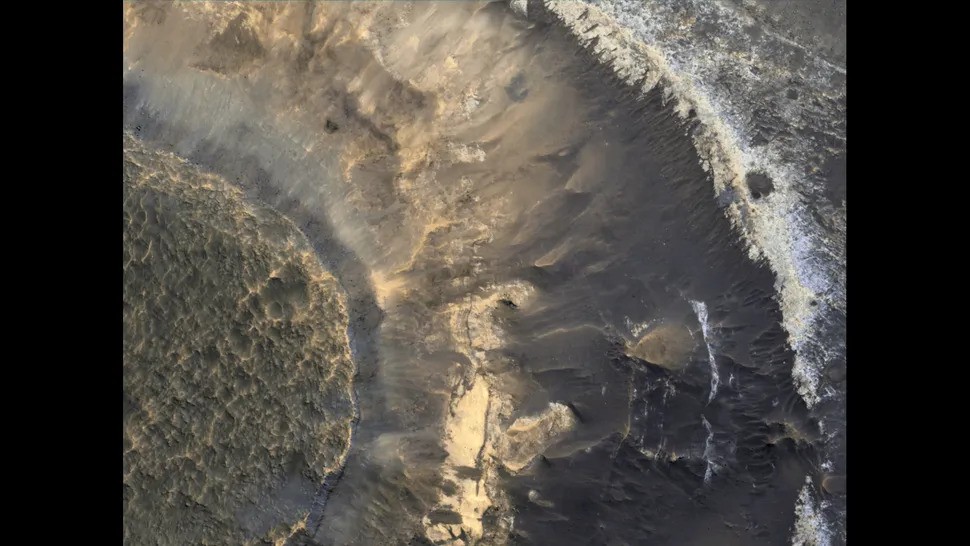
Conditions for clay formation on Mars
New research shows that thick, mineral-rich layers of clay discovered on Mars indicate that conditions favorable to life existed on the Red Planet for a long time in the distant past.
Liquid water is necessary for the formation of clay. These layers are hundreds of meters thick and are believed to have formed approximately 3.7 billion years ago, when conditions were warmer and wetter than present-day ones on Mars.
“These areas have a lot of water, but they don’t have significant topographic elevation, so they are very stable,” said study co-author Rhianna Moore, who conducted the research as a graduate student at the University of Texas at Jackson School of Geosciences, in a statement.
These deposits form on our planet under certain landscape and climate conditions.
“On Earth, the places where we tend to see the thickest clay mineral sequences are in humid environments, and those with minimal physical erosion that can strip away newly created weathering products,” said co-author Tim Goudg, associate professor of Earth and Planetary Sciences at the Jackson School.
However, it remains unclear how the local and global topography of Mars, as well as its past climatic activity, influenced the weathering of the surface and the formation of clay layers.
Study of clay deposits
Using data and images from NASA’s Mars Reconnaissance Orbiter, Moore, Goudge, and their colleagues studied 150 clay deposits, examining their shape and location, as well as how close they are to other features such as ancient lakes or rivers.
They discovered that the clays are mainly located in low-lying areas near ancient lakes, but not near valleys where water once flowed intensely. This combination of mild chemical changes and less intense physical erosion has helped clays to survive over time.
Stratigraphies containing clay minerals are usually found in areas where chemical weathering has prevailed over physical erosion, further away from valley networks and closer to standing water bodies. The results of the study indicate that intense chemical weathering on Mars may have disrupted the normal balance between weathering and climate.
Role of CO2 in clay formation
On Earth, where tectonic activity constantly releases fresh rock into the atmosphere, carbonate minerals such as limestone are formed when rock reacts with water and carbon dioxide (CO2). This process helps remove CO2 from the air, keeping it in a solid state and helping to regulate the climate over long periods of time.
There is no tectonic activity on Mars, which leads to a lack of carbonate minerals and minimal removal of CO2 from the planet’s thin atmosphere. As a result, CO2 released by Martian volcanoes long ago probably remained in the atmosphere longer, making the planet warmer and wetter in the past — conditions that, according to the team, could have contributed to the formation of clay.
Researchers also suggest that clay could absorb water and retain chemical by-products such as cations, preventing them from spreading and reacting with the surrounding rock to form carbonates, which remain trapped and cannot seep into the environment.
According to www.space.com

