

Physicists have created a new model of neutron star mergers. It is based on observations of gravitational waves and can explain what is inside these objects.
Neutron stars and the mystery of gravitational waves
Neutron stars are among the most extreme environments in the Universe: their density is several times greater than that of atomic nuclei, and their gravitational field is one of the strongest among all known objects, second only to black holes.
They were discovered in the 1960s, but neutron stars remain a mystery because their internal composition is still unknown. Scientists are beginning to consider gravitational waves emitted by binary neutron stars orbiting each other as a possible source of information about their internal structure.
Physicists from the University of Illinois at Urbana-Champaign, together with colleagues from the University of California, Santa Barbara, Montana State University, and the Tata Institute of Fundamental Research in India, have made an important theoretical breakthrough in understanding how spiral-bound binary neutron stars respond to tidal forces, a key step in elucidating the structure of neutron stars. The team demonstrated that the time-dependent tidal responses of such objects can be described in terms of their oscillatory behavior or modes, extending a similar result from Newtonian gravity to a relativistic setting.
Neutron stars: a natural laboratory for studying extreme states of matter
As the name suggests, neutron stars are partly made up of neutrons, which can form when protons and electrons are compressed to such high pressures that they effectively “merge” together. But neutrons are not everything. Leading theories suggest that heavy elements, free electrons, and free protons are also essential components. Some even suggest that quantum superfluid and superconducting phases arise at greater depths. However, these hypotheses are difficult to verify, and much of the internal composition, especially within the core, remains a big question mark.
But neutron stars are not only interesting in themselves. Scientists believe that they can tell us about extreme physics in general. Theorists suggest that neutron stars are one example of a more general type of matter known as quark-gluon plasma — an extremely dense, hot state of matter consisting of quarks, the elementary building blocks of protons and neutrons. Such a substance exists only in the most extreme conditions, such as the early Universe in the first microseconds after the Big Bang.
The only way to study quark-gluon plasma on Earth is to collide high-energy particles in colliders that explore such plasma at extremely high temperatures. However, there are no laboratory methods for lower temperatures.
Nicolás Yunes, a physics professor from Illinois, said: “It’s very hard to study the physics of matter at such high densities and, relatively speaking, low temperatures. But the universe provides a natural lab to study this kind of matter through neutron stars.”
Given that neutron stars cannot be studied on Earth, physicists have to draw conclusions about their properties based on astrophysical observations, which have traditionally been limited to electromagnetic observations. However, with the advent of gravitational wave astronomy, physicists have gained a powerful alternative that may allow them to peer into the very heart of a neutron star.
“Fingerprints” in gravitational waves
Sometimes neutron stars form binary systems in which two stars orbit around a common center of mass. Once they enter each other’s orbit, they begin to spiral closer together, losing energy to gravitational waves — vibrations in space-time that propagate outward at the speed of light. During a spiral approach, each star pulls on its partner through gravity, creating tidal forces similar to those created by the Moon on Earth, before finally merging in a violent collision.
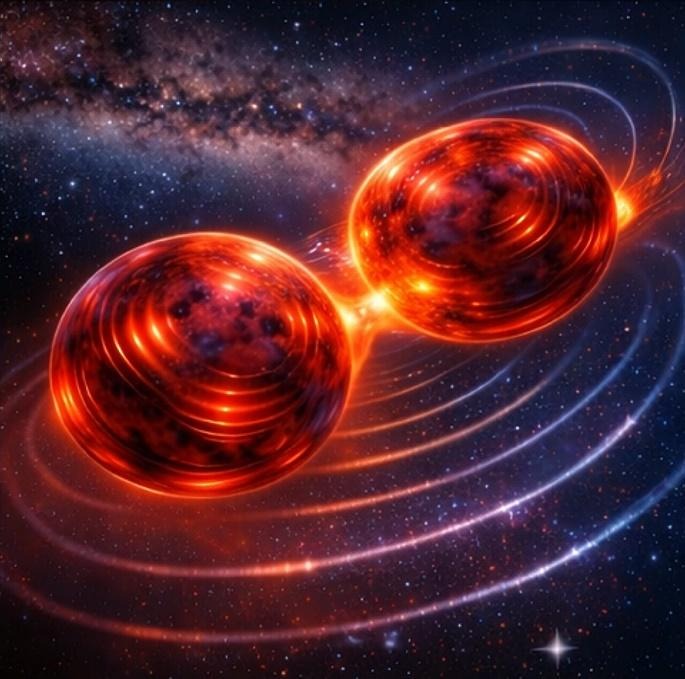
Image of a pair of neutron stars approaching each other. Each star exerts tidal forces on its neighbor, deforming and exciting frequency patterns within, leaving imprints on the emitted gravitational waves. Researchers can analyze these gravitational waves to “hear” what is happening inside stars.
Abhishek Hegade, a former graduate student at the University of Illinois Department of Physics and current postdoctoral fellow at Princeton University, shared: “As they get closer, tidal forces from one star begin to deform the other and vice versa. The amount of deformation depends on what’s inside of the stars.”
These deformations excite oscillatory patterns called modes within stars, just as a hammer excites a bell when it strikes it. These modes leave imprints on emitted gravitational waves, which can be detected by sensitive sensors on Earth. By “listening” to these imprints, scientists can draw conclusions about what is happening inside.
Correct determination of the reaction to inflow forces
To decipher the mode prints, scientists first need to understand how neutron stars respond to tidal forces, which is a challenging task because these forces, and therefore the response to them, are dynamic and change rapidly over time, especially in the late stages of the merger.
For dynamic tidal reactions of non-relativistic Newtonian bodies, the solutions to Newton’s gravitational equations are modes that behave like dampened springs or, as physicists say, damped harmonic oscillators. Moreover, the tidal response of an object can be expressed entirely in terms of these modes — and nothing else — forming what is known as a “complete” set.
Without a complete set of modes, you may miss part of the inflow reaction during simulation, as there may be other elements that you omit from the mathematical description of the reaction required to represent all physical processes.
Scientists around the world have hoped that a complete set of modes for binary neutron stars in Einstein’s theory of general relativity also exists. But neutron stars orbiting each other are highly relativistic: they are extremely dense and can approach speeds of around 40% of the speed of light before merging, greatly distorting the space-time around them. This complex picture and the complexity of Einstein’s equations hindered physicists’ attempts to determine whether neutron star modes form a complete set of harmonic oscillators.
Search for modes
To overcome these difficulties, Yunes’s team broke the problem down into simpler parts, focusing on a single star and treating it as a source of tides. If they can apply the boundary conditions in exactly the right way, they could find the complete set of modes. Starting with Einstein-Euler’s set of linearized equations describing how matter creates gravitational fields and evolves in space-time, they divided the inner and outer parts of the star into separate regions: a strong gravity zone and a weak gravity zone.
Decomposing the system in this way and carefully stitching together solutions for areas with strong and weak gravity allowed researchers to apply the appropriate boundary conditions in stages. It is crucial that the inclusion of the low-gravity zone successfully eliminated radiation in the team’s analysis.
“Our near‐zone decomposition ensured that we accounted for the tidal field,” noted Hegade. “By restricting to the near zone, we took care of radiation by subtracting it out and treating it as a small correction. This allowed us to obtain a complete set of modes.”
Researchers have also developed a method for determining the tidal field inside a star. By manipulating Einstein-Euler equations appropriately, they discovered that they could consider the internal tidal field as a factor in the oscillations. In particular, they found that as long as the tidal field changes without sudden jumps or sharp angles, the equations generate modes of a harmonic oscillator — just as in Newtonian theory.
Real data on internal structure
With a complete set of harmonious neutron star oscillation modes now at their disposal, the researchers achieved exactly what they had planned.
First, scientists managed to detect the radiation, discovering that the modes of the neutron star actually form a complete set. Secondly, they found that if we solve a certain set of equations sequentially using a tidal field that is sufficiently “smooth,” this solution applies to the interior of the star, and we can do all the same things in general relativity as we do in Newtonian gravity. Researchers are now eagerly awaiting to see what their new concept might reveal.
Yunes said: “One hope is that we’ll be able to get some information about the neutron‐star equation of state at densities found in the inner core of a neutron star. Is there really a quark core, as some have recently claimed? Are there phase transitions occurring inside that we don’t know about yet?”
There’s a need for more sensitive gravitational wave detectors
Yunes noted, “The signal-to-noise ratios obtained by the LIGO collaboration in their most recent data from 2017 aren’t large enough for us to see the features we’ve captured in our model. In addition, current detectors aren’t that sensitive to sufficiently high frequencies, where most of the information about the neutron‐star oscillation modes sit.”
Many hope that new generations of detectors, expected to be launched in the next few years, together with discoveries of nearby merger events, will improve the signal-to-noise ratio and sensitivity needed to see more detail in the data.
By that time, physicists will still have plenty of opportunity to prepare for the anticipated detectors. Yunes’s team already has some proposed directions: their current model only applies to non-rotating stars, so they hope to extend it to include rotation, since most neutron stars rotate rapidly. They also plan to repeat the analysis for nonlinear tidal forces and include non-gravitational fields, such as magnetic fields. As for their new generalized model, they overcame the most difficult obstacle — they solved the most difficult part of the model — gravity.
According to phys.org

