

Scientists have analyzed the temperature at which the Earth’s core can remain in the state in which we observe it. They made a number of new assumptions about the chemicals it might consist of.
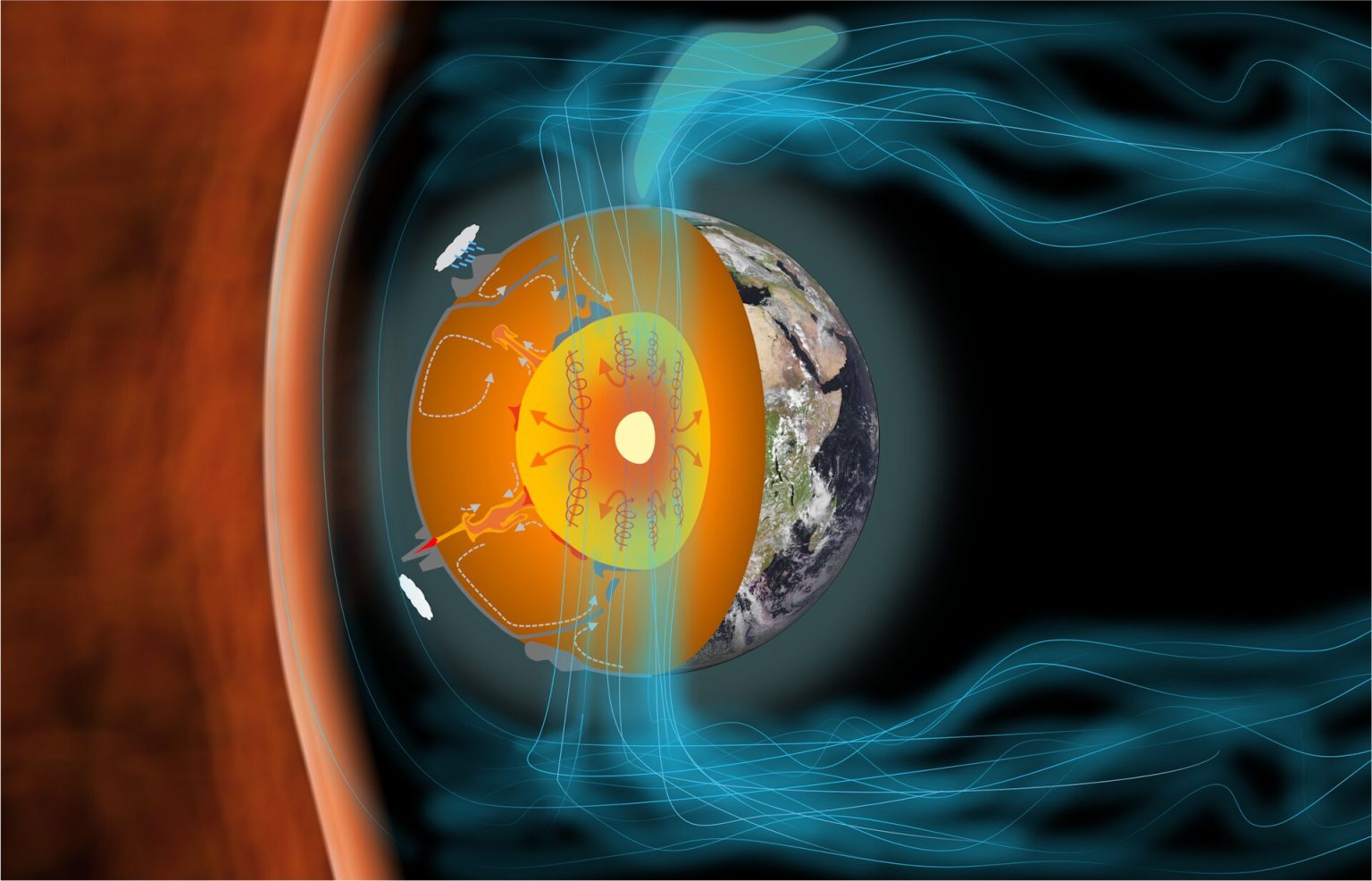
Earth’s core
At the center of the Earth is its hottest and densest part — the core. No one has ever seen it, but thanks to some indirect methods, it is possible to determine its condition and chemical composition. Scientists have recently made progress in this case.
At the very beginning of its cooling, the Earth’s core was rarefied and hot. But then the temperature dropped and crystallization began in the center of the planet. Gradually, the liquid part became the outer core, and the solid part became the inner core. Charged currents began to form at their boundary.
The latter are the source of our planet’s magnetic field. In fact, its source is the temperature of the solid inner core. It cools down, transfers energy to the outer layers, and the movement of those layers generates currents and magnetic fields.
Seismic waves
All this is fine, but in reality no one has ever seen a sample of the material, either from the outer or inner core. All scientists know about them is the results of research on meteorites, which have remained unchanged since the formation of the Solar System, and observations of the propagation of seismic waves through our planet.
The latter method was used to establish the modern boundaries of the outer and inner cores. And this is precisely where the new study focused its efforts. Knowing the sizes of these two spheres, their cooling times, and information about the outer layers of the Earth, it is possible to calculate what their temperatures are now and in the past.
This is a way to determine chemical composition, because different substances transition to a solid state at different temperatures. Studies have shown that the Earth’s core has to be 10% less dense than pure iron, while the outer layer, despite being liquid, has to be a bit denser, and only certain chemical compositions can make this happen.
Most likely, the core contains sulfur and carbon. It was formed due to the process of supercooling, when, due to certain factors, a substance remains in a liquid state even though the temperature is already below the crystallization point. It is quite possible that in the case of the Earth’s core, this value was 420°C lower. This leaves a very wide range for the carbon content values in it.
According to phys.org

