

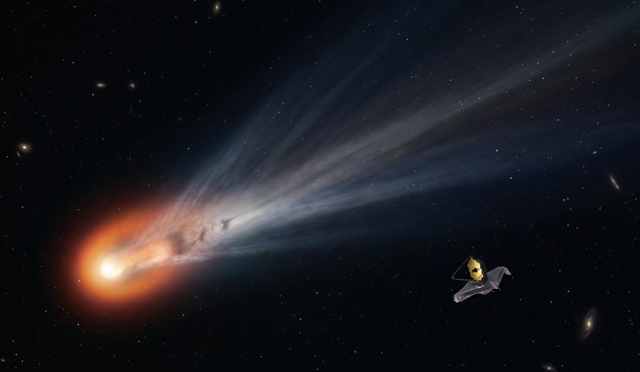
As the interstellar comet 3I/ATLAS leaves the Solar System for good, it has revealed its true internal composition to researchers. Using the James Webb Space Telescope (JWST), a team from the California Institute of Technology observed that in December 2025, the comet began emitting methane at an increasingly rapid rate. The results have been published in The Astrophysical Journal Letters.
Stranger from the depths of the galaxy
3I/ATLAS is only the third object in the history of astronomy to be discovered beyond our Solar System. The comet is over a kilometer in diameter and consists of dust and ice from the distant planetary system where it formed. According to Matthew Belyakov, a Caltech graduate student and the study’s lead author, the comet has been traveling through the Milky Way for at least a billion years. The high speed of movement left scientists with a very narrow window of opportunity for observations.
The fact is that during its long journey, the surface of 3I/ATLAS was exposed to cosmic radiation—its most volatile substances, including methane, were barely released as it approached Earth. But when, after its October close approach to the Sun at a distance of 1.5 astronomical units, the comet began to move away and warm up, its ancient outer layers began to sublimate—turning directly into gas—and the JWST detected an increasingly active release of methane, indicating that the inner layers were being exposed.
Different chemistry
This is of fundamental importance: observations taken after the object’s close approach to the Sun reveal not the surface chemistry—which has been altered by billions of years of radiation—but the object’s true internal composition. And it differs from what we see in comets in our Solar System—it has different ratios and concentrations of chemical compounds, characteristic of the environment in which 3I/ATLAS formed.
The JWST is scheduled to conduct another observation session of the comet this spring, but the window of opportunity is rapidly closing—3I/ATLAS is already beyond Jupiter’s orbit. Separately, the team studied the comet’s dust composition. According to the researchers, these results will be published at a later date.
According to phys.org

