

Of the four gas giants in the Solar System, Neptune is the farthest from the Sun and has the fewest moons – 16. Therefore, they are usually mentioned only in passing. In this article, we will break this trend and explore what these celestial bodies are all about.
Neptune was discovered at the tip of the pen
The largest moons of Jupiter and Saturn – Ganymede and Titan – are almost always in the news. But the moons of Uranus, and especially those of Neptune, are not mentioned as often. And this is a shame, because there is plenty to say about them as well. For example, they are all named after heroes from ancient myths associated with the sea and water.
Did you know that Neptune’s largest moon was discovered just 17 days after the planet itself was discovered? The story of this icy giant’s discovery is, in fact, a triumph of scientific foresight. As is well known, it all began when, following the discovery of Uranus in 1781, scientists determined its mass and orbit and concluded that Uranus alone could not explain the anomalies in the motion of all the other planets.
Based on this, it was concluded that there must be another planet farther from the Sun, one that no one had yet seen. Scientists even calculated the point in the sky where it should be sought. Interestingly, this was done independently by John Adams in Great Britain and Urbain Le Verrier in France.

Both of them asked the observers to look for it at the specified location. However, the royal astronomer George Airy, although he observed Neptune twice, postponed the analysis of these observations and thus deprived himself of the glory of being the discoverer of the eighth planet. Johann Galle, on the other hand, got to work immediately and confirmed Le Verrier’s calculations on the very first night of observations.
That is why people say that Neptune was discovered at the tip of a pen – referring to the pen used to write down the results of the calculations on paper.
The British were initially disappointed that they had been beaten to it, but John Herschel (son of the discoverer of Uranus) quickly realized that the new planet might have moons, so he asked William Lassell to look for them, and Lassell very quickly discovered the largest of them.
Triton
At first, scientists simply referred to this celestial body as “Neptune’s moon.” In 1880, a renowned astronomer and science popularizer proposed naming it Triton after the son of Poseidon from ancient Greek mythology, who loved to transform into a fish. However, the name did not become definitively established for this moon until the mid-20th century.
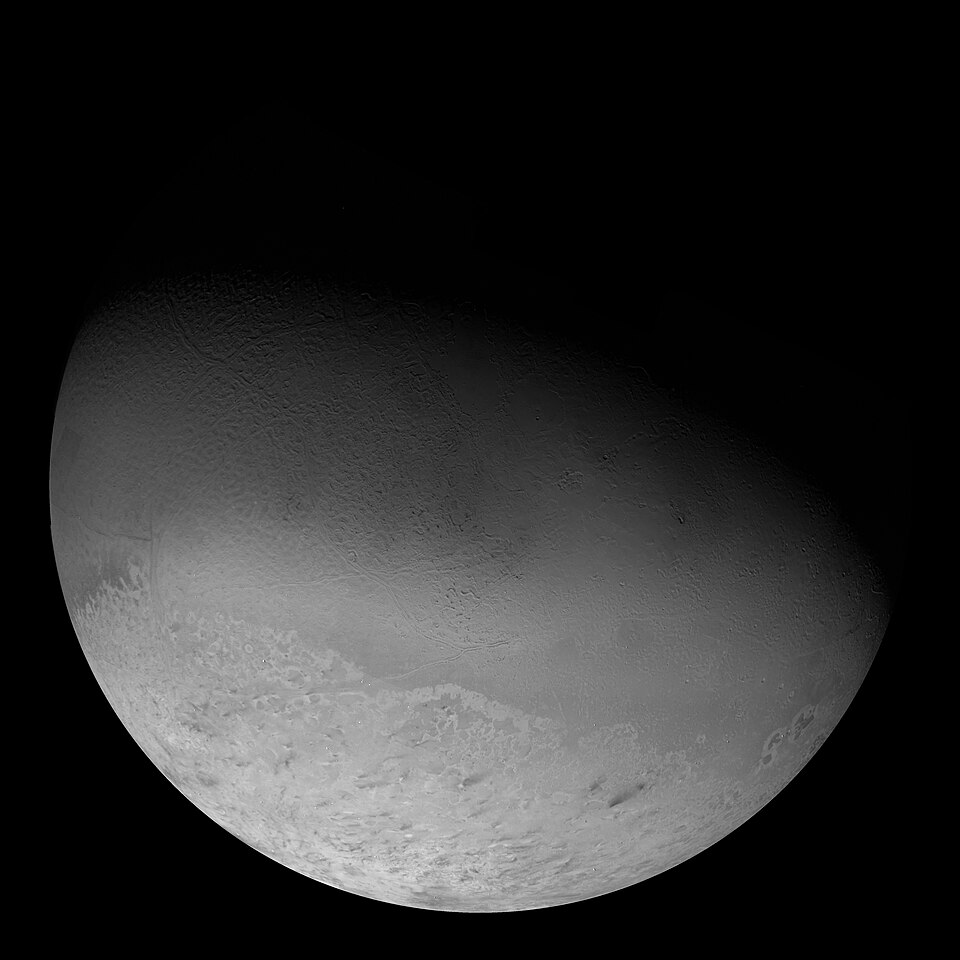
With a radius of 1,353.4 km, Triton is the seventh-largest moon in the Solar System. Its density is 2.061 g/cm³. This suggests that silicate rocks must be hidden somewhere inside it, although frozen volatile substances also occupy a significant volume.
As for the surface, 55% of it consists of frozen nitrogen and 35% of water ice. The remainder consists of solid carbon dioxide and organic compounds. At the same time, the elevation variations on Triton are less than 1 km. In other words, it is practically a flat, smooth ice ball.
Despite its small size, Triton has its own atmosphere, with a pressure 70,000 times lower than that at sea level on Earth. It consists mainly of nitrogen, with small amounts of methane and carbon monoxide.
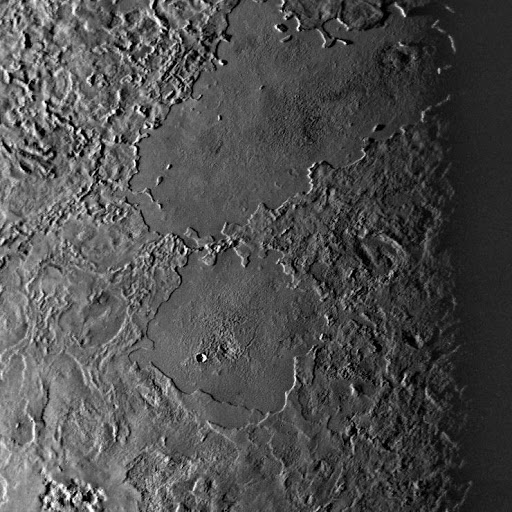
Long streaks can be seen on Triton’s flat surface, as well as two regions resembling frozen lakes. Both of these features can only be explained by the influx of liquid material, which suggests the possible presence of geysers. Thus, Triton is one of the few geologically active bodies in the Solar System.
Triton’s average distance from Neptune is 354,759 km in a nearly circular orbit. In other words, it is about as far from the planet as the Moon is from Earth. It completes one orbit in 5.88 days, and its rotation is retrograde, meaning it moves in the opposite direction to the planet’s rotation.
This final feature, along with the similarity of the surface’s chemical composition to that of Pluto, leads scientists to speculate that Triton was once part of the Kuiper Belt but was later captured by Neptune’s gravity and became its moon.
Nereid
77 years ago, on May 1, 1949, Neptune’s second moon was discovered. It was named Nereid after the sea nymphs of Greek mythology. So, in a way, it could be called a mermaid.
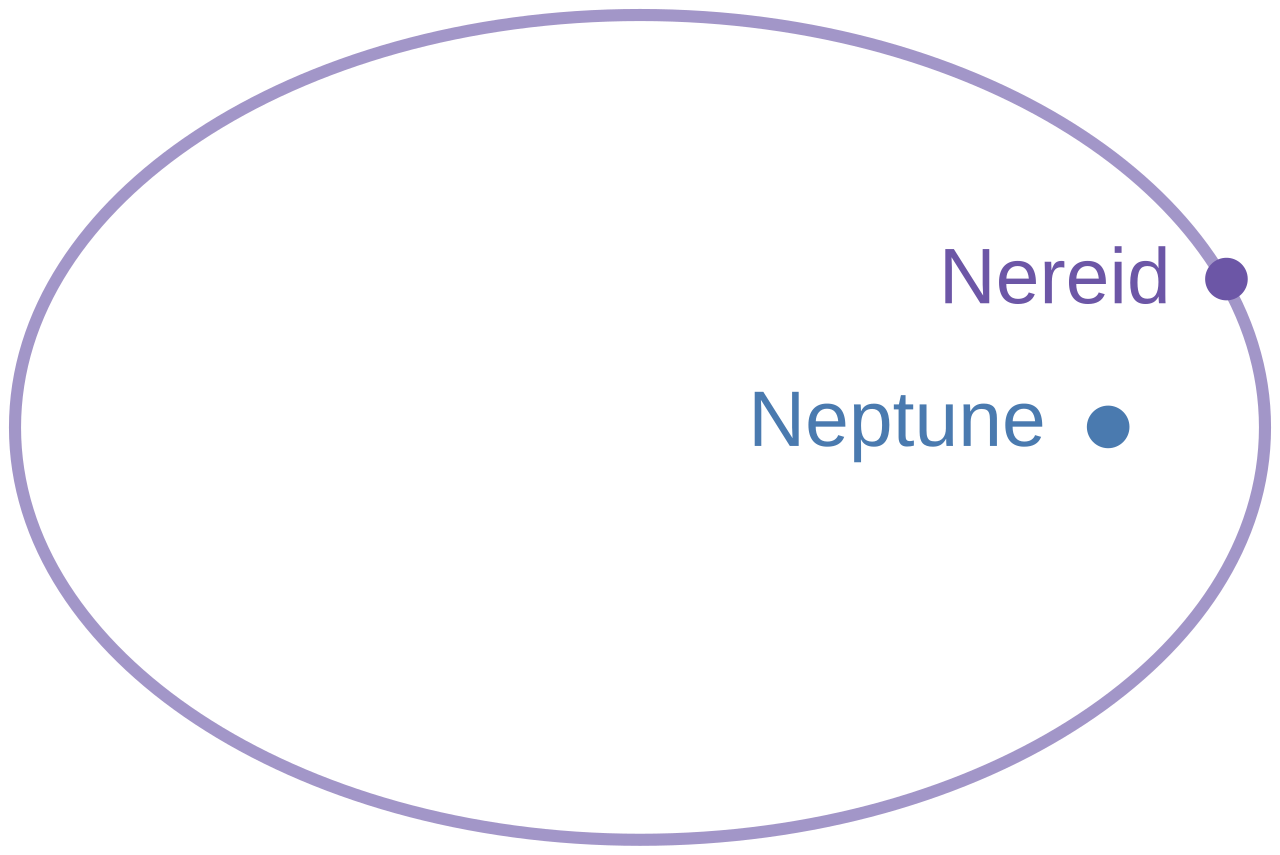
For a long time, almost nothing was known about Nereid, except that, among all planetary moons (except for the smallest ones), it has the highest orbital eccentricity – 0.75. It completes one orbit around the planet in approximately 360 Earth days, sometimes coming as close as 1.4 million km and sometimes as far as 9.7 million km.
In 1999, the Voyager 2 spacecraft flew past Neptune. It was able to determine that Nereid’s diameter is 340 km. However, the moon was at the point in its orbit farthest from the planet at the time, so it was not possible to get a clear view of it. In fact, Nereid remains the most mysterious of all the moons in the Solar System. We know it is a fairly large body, but we still do not have a single map of its surface.
Other large satellites
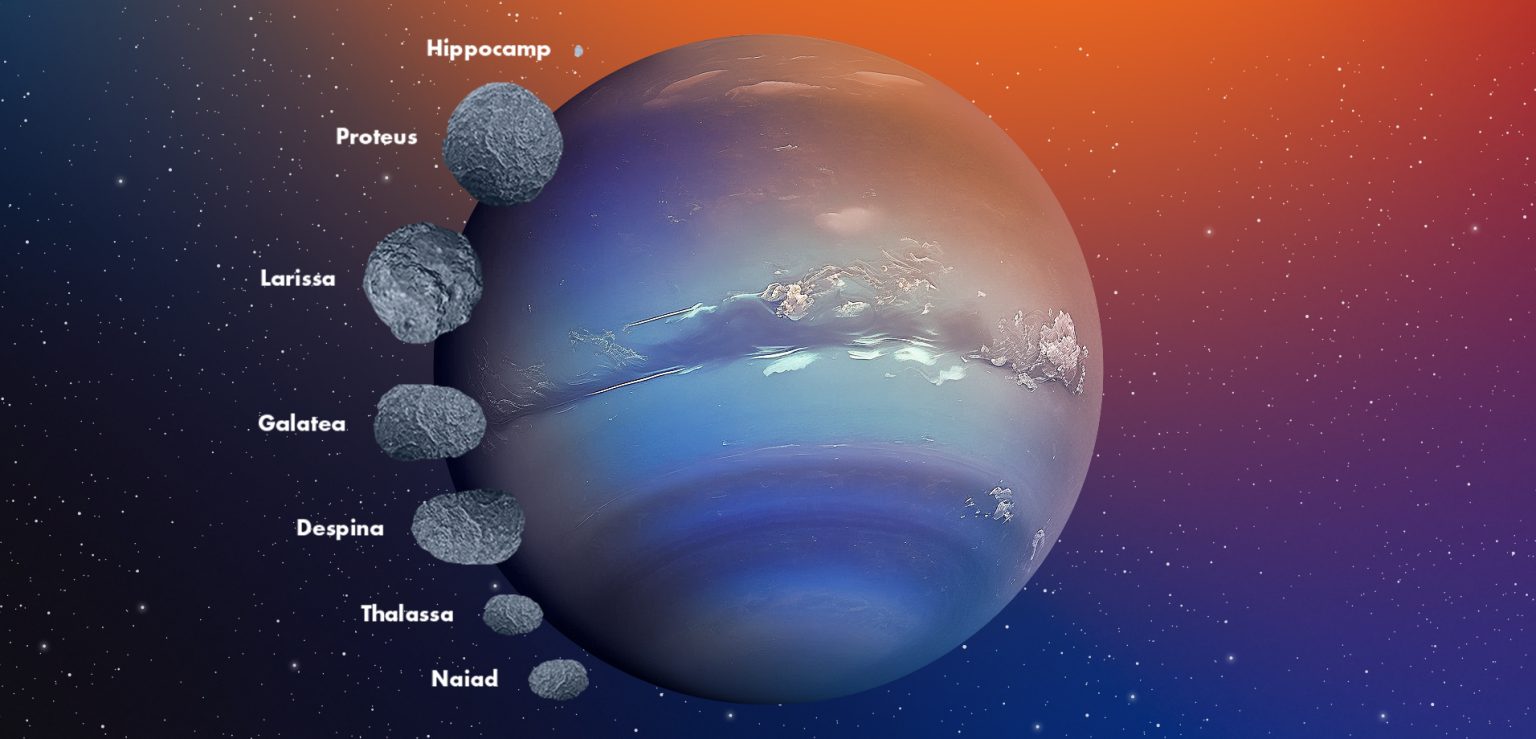
However, when Voyager 2 flew past Neptune in 1989, it discovered many other interesting things. For example, six new moons. One of them, later named Proteus (after the sea giant from ancient Greek mythology), turned out to be even larger than a Nereid. It has an irregular shape, but its average diameter is as much as 420 km.
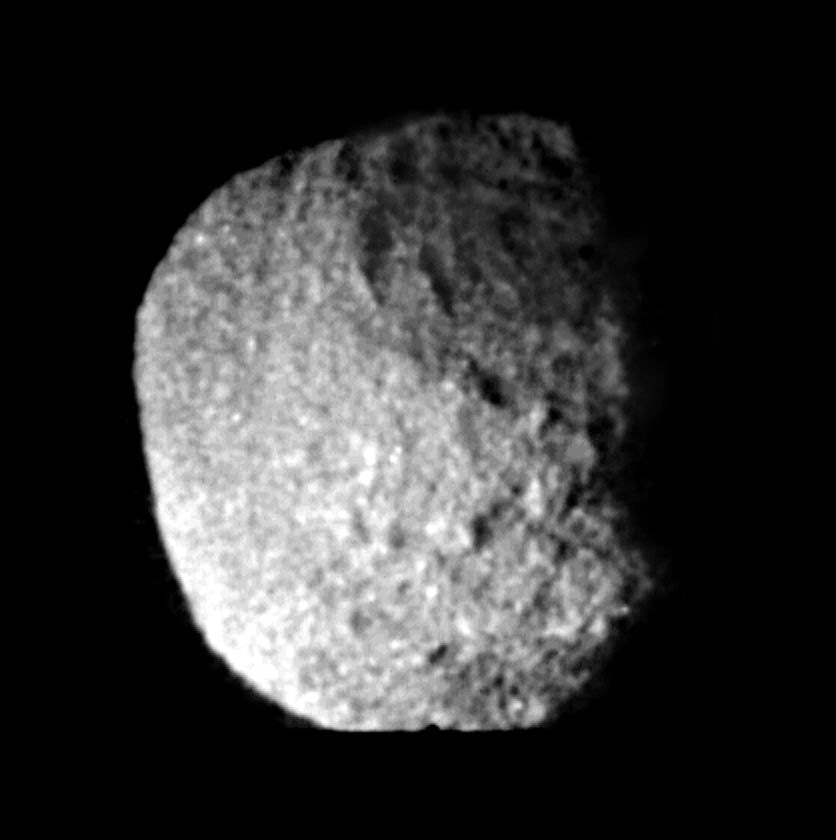
The reason Proteus was not seen earlier is that it is extremely dark. Its surface reflects only 6% of sunlight, so it is difficult to see it from Earth, even with very powerful telescopes.
The surface of Proteus features the Pharos crater, which is about 250 km in diameter, and overall, it appears to have undergone a major impact relatively recently. Scientists believe that over time, this celestial body may take on a more spherical shape under the influence of its own gravity.
Three more moons from the group discovered by Voyager 2 have diameters exceeding 100 km. These are Larissa, Galatea, and Despina. All three are named after nymphs from ancient Greek mythology. Larissa is particularly interesting. In fact, this moon was first discovered back in 1981, and in 1989 it was “rediscovered.”
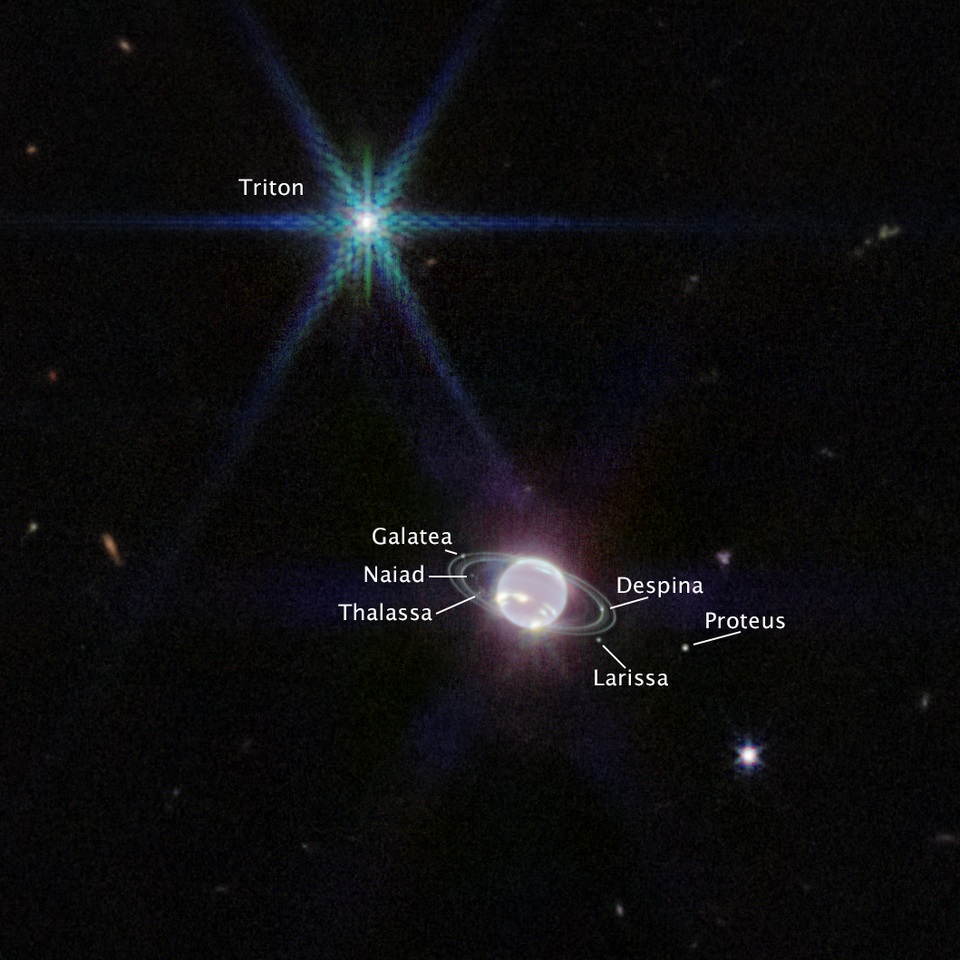
All three moons have orbits below geostationary altitude, and tidal forces are gradually causing them to spiral inward. Eventually, they will either break apart, forming new rings, or be swallowed up by the planet.
Two more moons discovered in 1989 have diameters of less than 100 km. These are Nayaida, measuring 96 × 60 × 52 km, and Thalassa, measuring 104 × 100 × 52 km. Both are small icy bodies.
Smaller satellites
When discussing Neptune’s moons, one cannot fail to mention its rings. As with the other gas giants, they consist of a vast number of tiny particles. They may be the result of the breakup of some large body – perhaps a moon – that no longer exists.
Nor did the story of the discovery of new moons around Neptune end with the Voyager 2 flyby. In 2002, scientists announced the discovery of five more objects around the planet: Galimede, Nessa, Sao, Laomedeia, and Psamathe. All of them are small icy bodies with diameters not exceeding a few dozen kilometers.
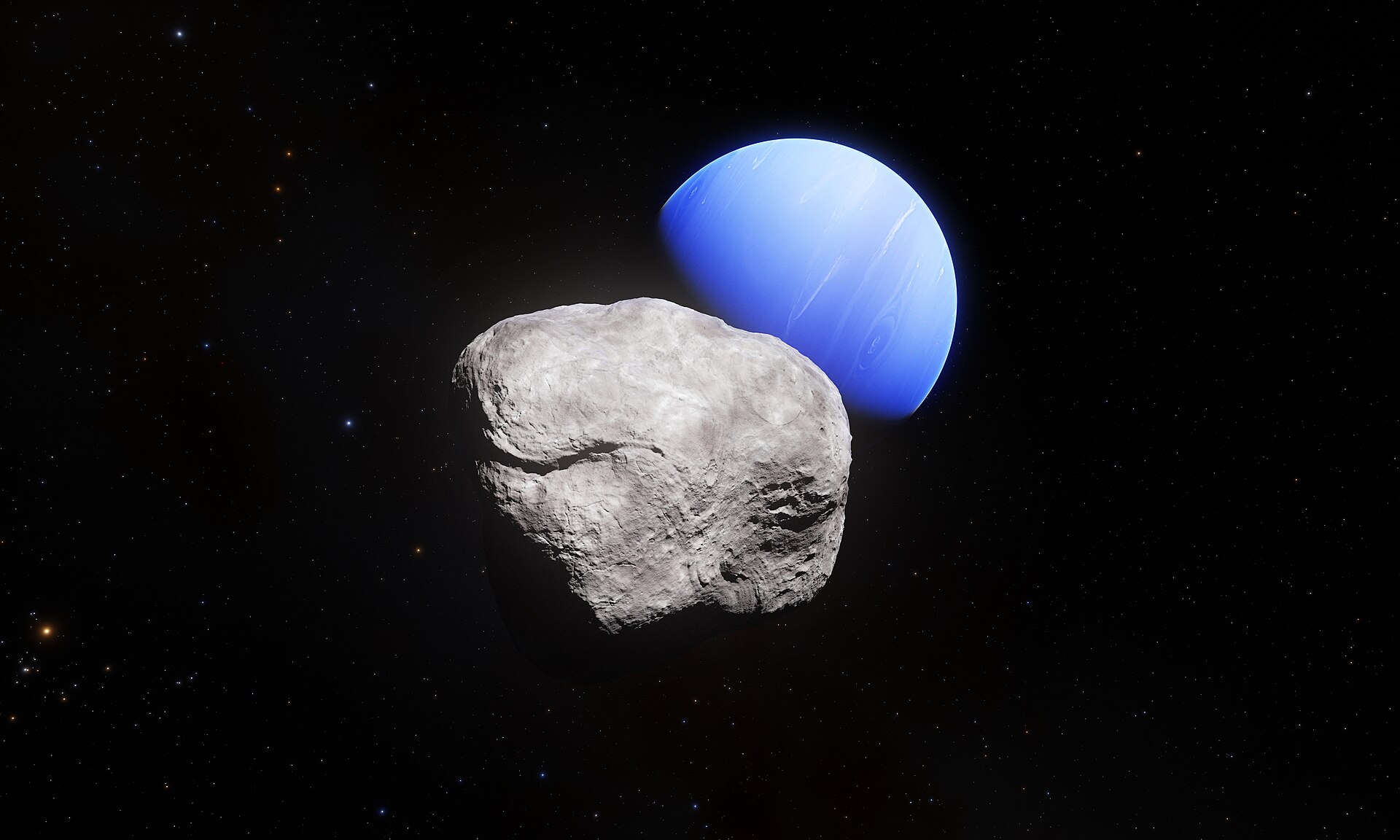
In 2013, astronomers discovered Hippocamp. This moon has a diameter of just 35 km. It orbits incredibly close to Neptune, at a distance of only 105,000 km from its surface. Scientists believe it may be a fragment of the moon Proteus, which broke off from it during a collision that formed the Pharos crater.
In 2024, astronomers discovered two more moons of Neptune, which do not yet have official names, only designations. But this is likely only temporary. And perhaps these are not the last moons to be discovered around this planet.

