

Libra is a small zodiacal constellation in which the Sun is located in October and November. The stars there, although not very bright, are very interesting. This is where the planet is located from which a mysterious radio signal was allegedly received in 2010.

Constellation Libra
Libra is an amazing zodiac constellation. Astrologers believe that the Sun enters it on September 24 and leaves it on October 24. Astronomers know that our sun is in it from October 31 to November 21. Thus, there is not a single day in the year when both sides would agree that our sun is actually there.
There are several reasons for this situation, which you can read about in this article. In short, over thousands of years, the point of the spring equinox has shifted, and the boundaries of the constellations were not strictly defined in the past. But astrologers still use statements outdated by many centuries.
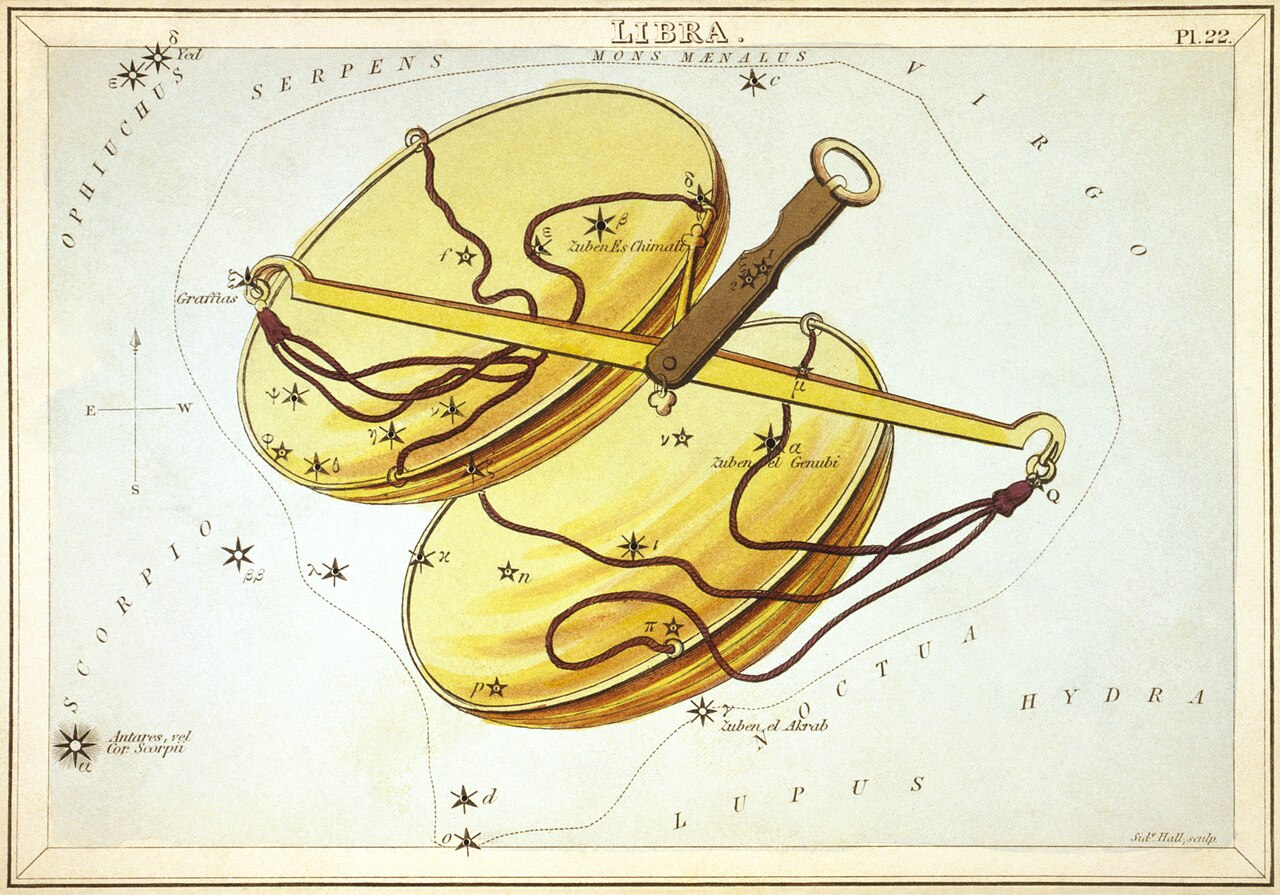
In general, Libra is one of the youngest zodiacal constellations. Back in the 3rd century BC, this group of stars was considered part of the constellation Scorpio — its claws. Memories of those times have been preserved in the names of some of the brightest stars in the constellation. They came to us from Arab astronomers, who used ancient Greek records. Alpha, Beta, and Gamma of the constellation contain the word “zuban” — claw — in their names.
The brightest stars
There are no stars in Libra that are impossible to miss in the sky. The brightest star in Libra is β Librae, also known as Zubeneschamali, Kiffa Borealis, the “northern claw” or “northern bowl of the scales.”
Its apparent magnitude is 2.61. In reality, it is a hot blue star located 185 light-years away from us. Its luminosity exceeds that of the Sun by 413 times, and its mass by 3.5 times. The star is only 200 million years old.
Much more interesting is the second brightest star in Libra, their α — Zubenelgenubi, which means “southern claw.” It is a multi-component system located 77 light-years away from us.
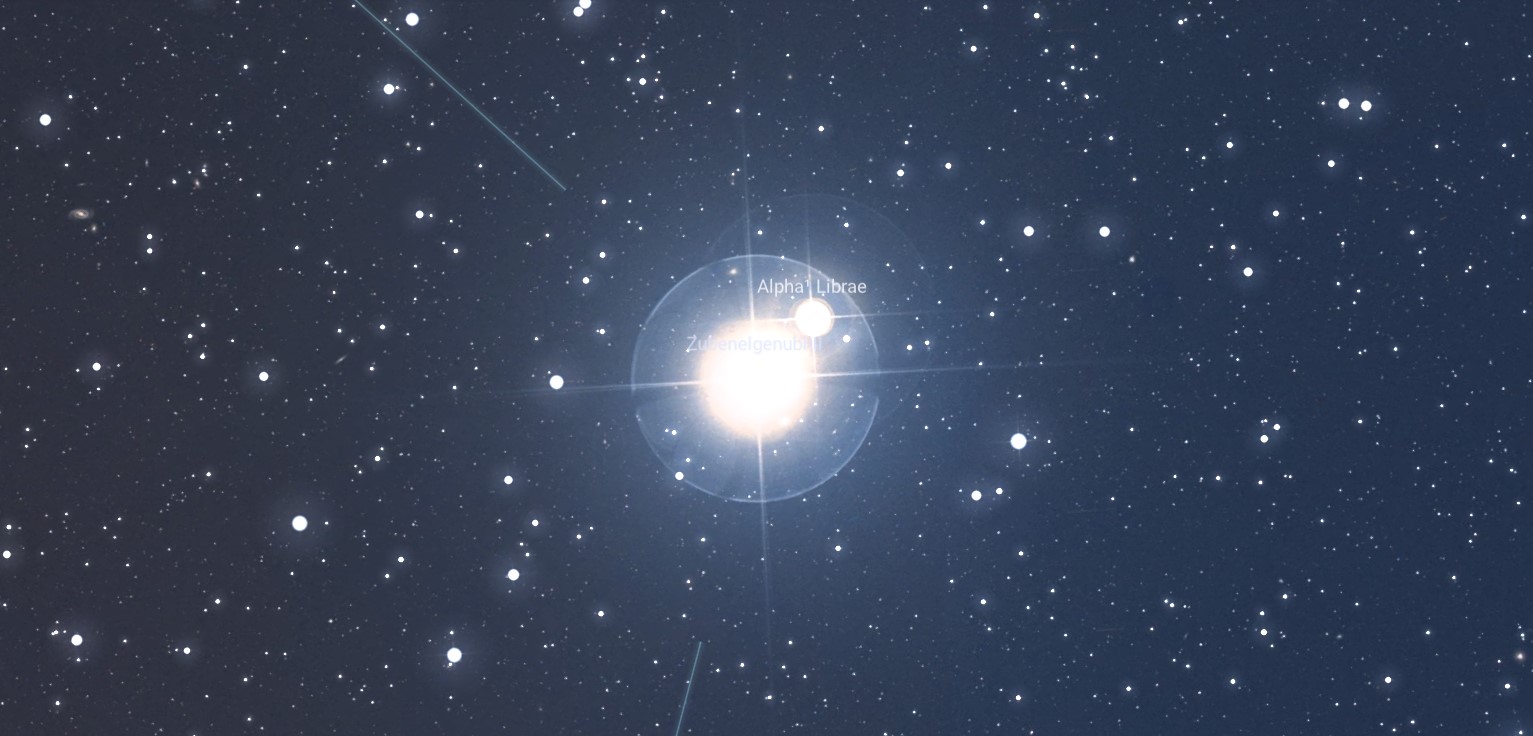
The main component, α2, is itself a pair of white stars. The mass of one exceeds that of the Sun by 95%, and the other by 79%. They complete one rotation around their common center of mass in 70 Earth days.
Another pair, called α1, orbits around this pair at a distance of 5,400 AU. It consists of a large yellowish-white star of spectral class F, whose mass is 36% greater than the Sun’s, and an orange dwarf with a mass of 50-60% of the Sun’s, which orbits the larger star with a period of 5,870 Earth days.
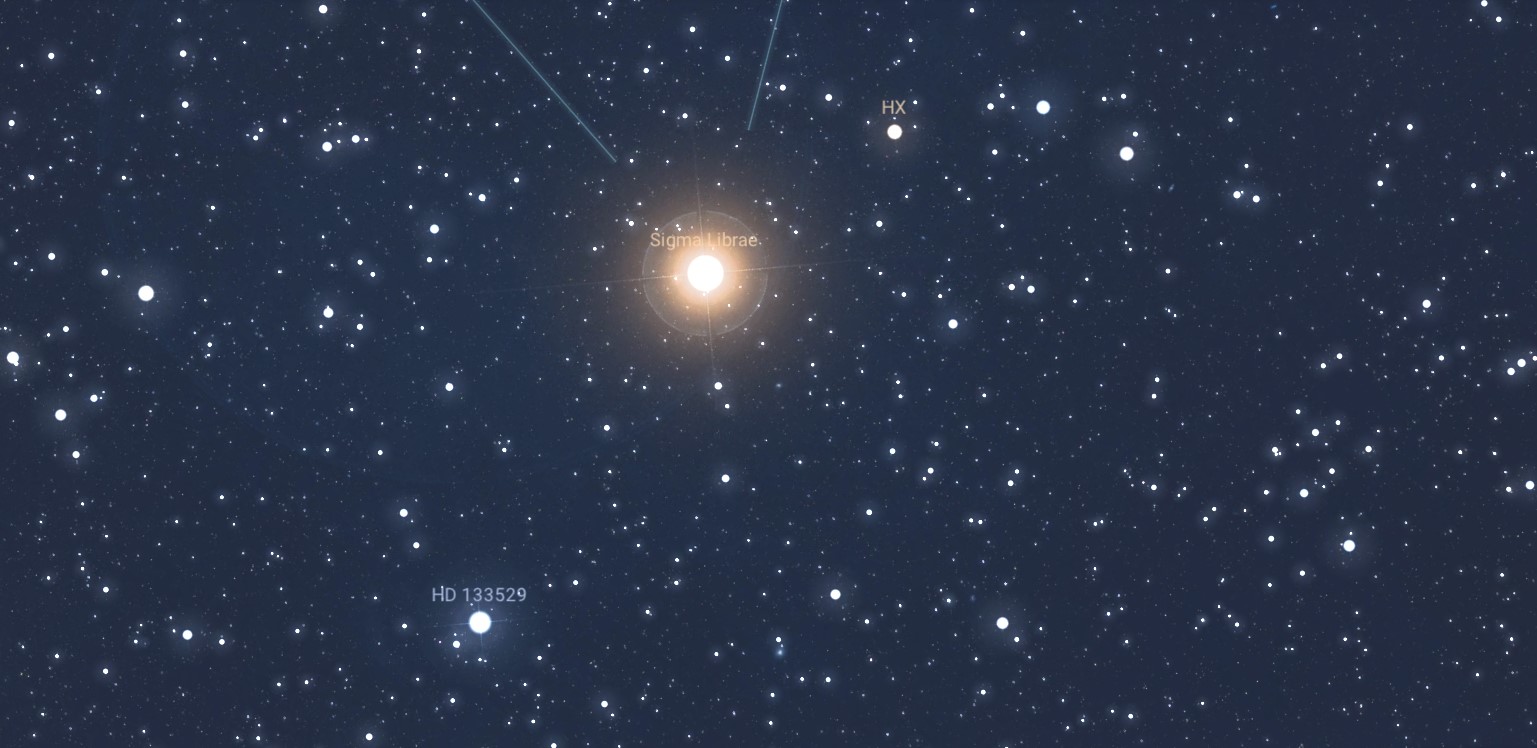
The third brightest star in the constellation Libra is σ Librae, known as Brachium. It is a red giant located 261 light-years away from us. Its mass exceeds that of the Sun by 1.9 times, its radius by 108 times, and its luminosity by 1,800 times.
σ Librae is in the final stage of its evolution. It has already largely “used up” not only hydrogen, but also helium. Now an oxygen-carbon core has formed inside it, and it is slowly pulsating.
Gliese 581
However, the interesting stars in the constellation Libra do not end there. For example, there is a star that you have most likely heard of, but you did not know that it is located in this zodiacal constellation. We are talking about Gliese 581 with one of the planets, from which a signal from another civilization was allegedly received in 2010.
In reality, the story is as follows. Until the beginning of the 21st century, the red dwarf Gliese 581 was little known. And no wonder, since it cannot even be seen with the naked eye or even with binoculars, despite the fact that the distance to it is only 20 light-years, so small and dim is it.
But in 2005, a planet was discovered in Gliese 581. Two more were discovered two years later, then another in 2009, and two more in 2010. Half of these objects are now considered unconfirmed. However, at that time, these discoveries caused a great deal of excitement. Discoveries of worlds outside the Solar System were not as common then as they are now. Very few planets similar in mass to Earth had been discovered. And here we have an entire system in which at least one planet is a super-Earth in the habitable zone.
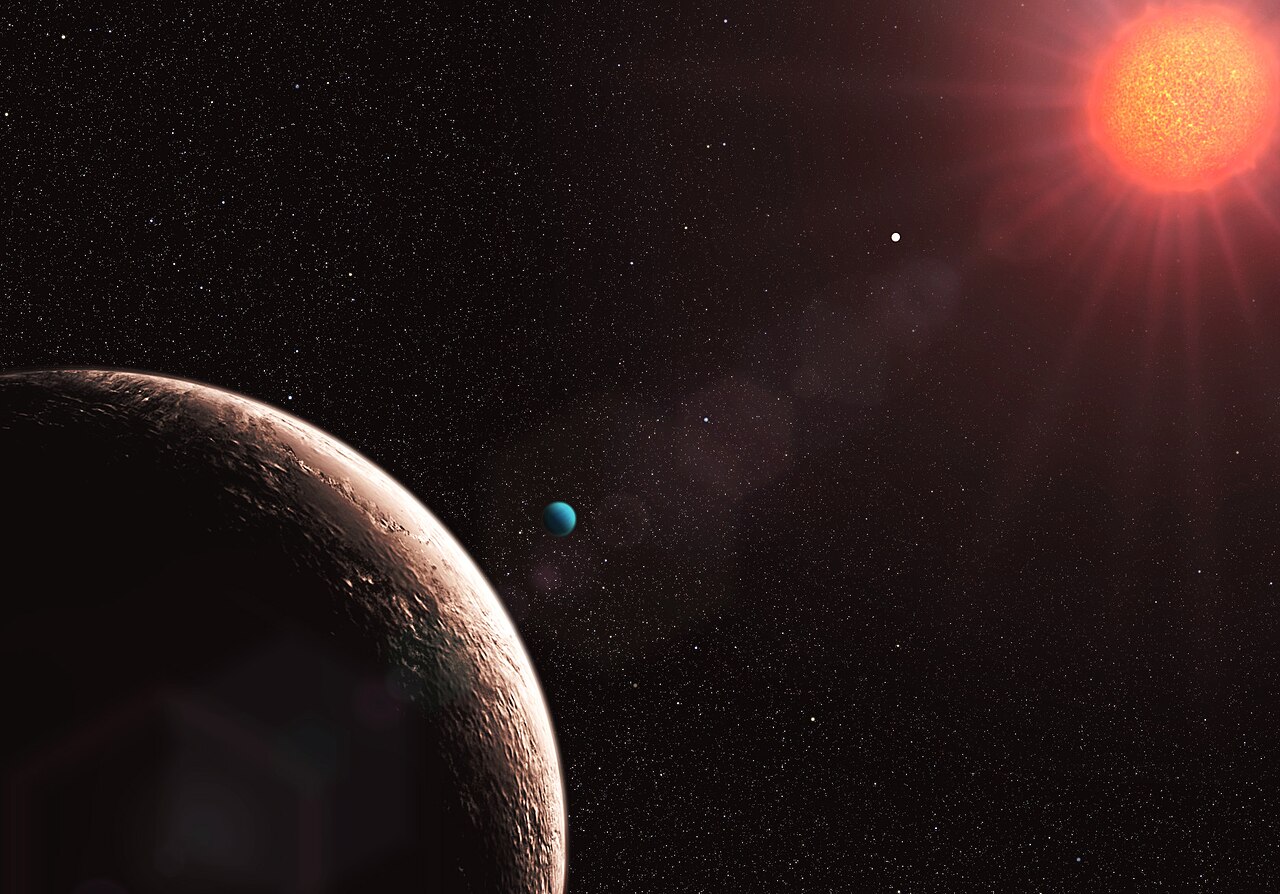
There was a lot of hype surrounding the system. And at its peak in 2010, many media outlets reported that scientists had received an incomprehensible signal from the planet Gliese 581d, orbiting a red dwarf. And, of course, they attributed it to extraterrestrial civilization.
Scientists quickly determined that this was all fiction, but stories about the signal from Gliese 581d continued to circulate in the media for several years, and the system gained a reputation as the most likely place to search for extraterrestrial life. It is not surprising that it was here that a message from Earth was sent even before the peak of the hysteria in 2008. And it was organized not just anywhere, but at the National Space Agency of Ukraine using the RT-70 radio telescope in Crimea.
Scientists now believe that three planets exist in the Gliese 581 system. The first of these, planet e, is a super-Earth, approximately 2.5 times the mass of our planet. It completes one orbit every 3.15 days and is closer to the star than the inner limit of the habitable zone. This means that it has to be hot as hell.
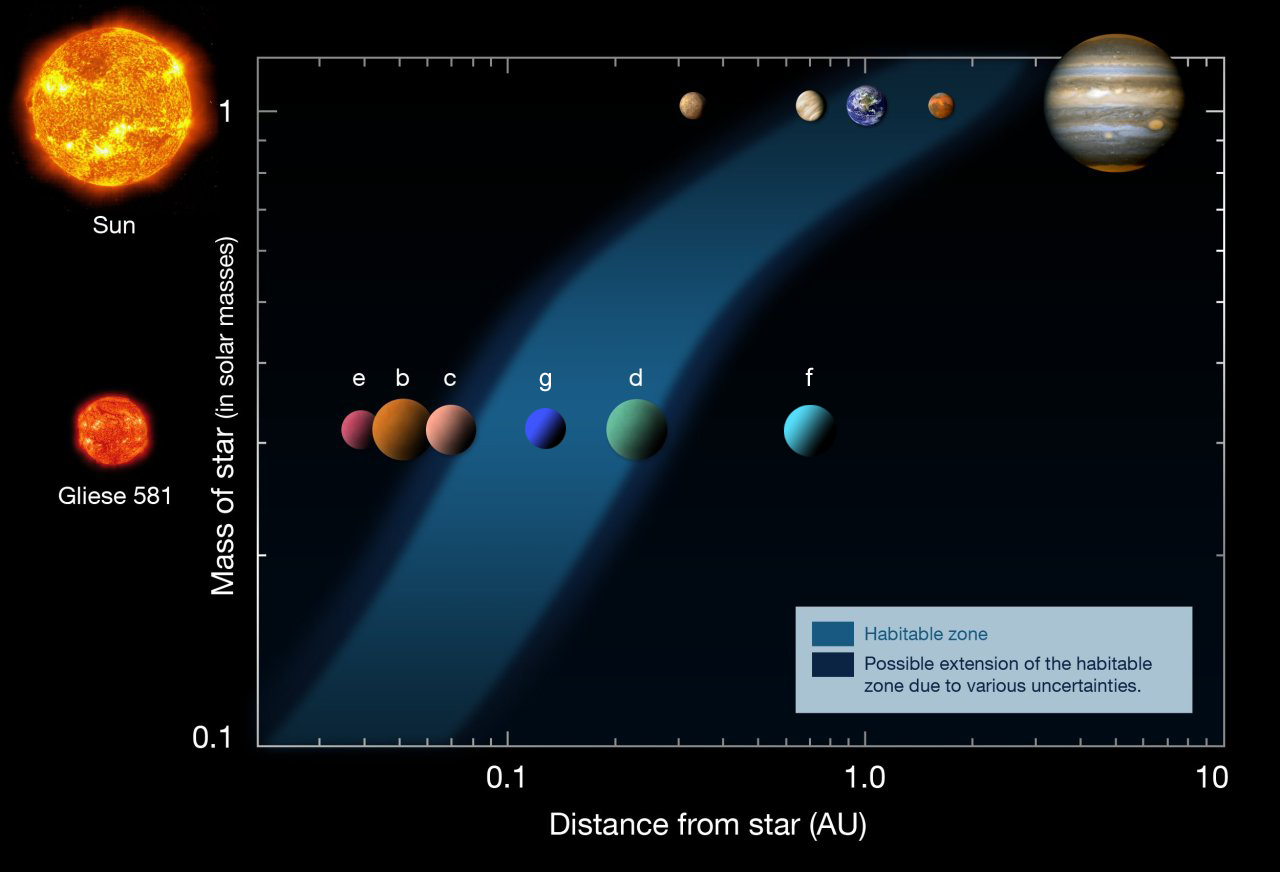
The second planet, Gliese 581b, has a mass approximately 20 times greater than Earth’s. It can be called a small ice giant, or more precisely, a water giant, because it is very close to its star and completes one orbit in 5.39 days.
The third planet in the Gliese 581c system is of greatest interest because it is located within the star’s habitable zone. Its average surface temperature ranges from -4 to +30°C according to various estimates, but it is most likely higher than the greenhouse effect. Nevertheless, this world is still considered a possible candidate for extraterrestrial life.
Other interesting stars
Another interesting star is one of Gliese 581’s closest neighbors, the Gliese 570 system. This is the closest quadruple system to Earth. It consists of an orange dwarf, two red dwarfs, and one brown dwarf. It is only 19 light-years away.
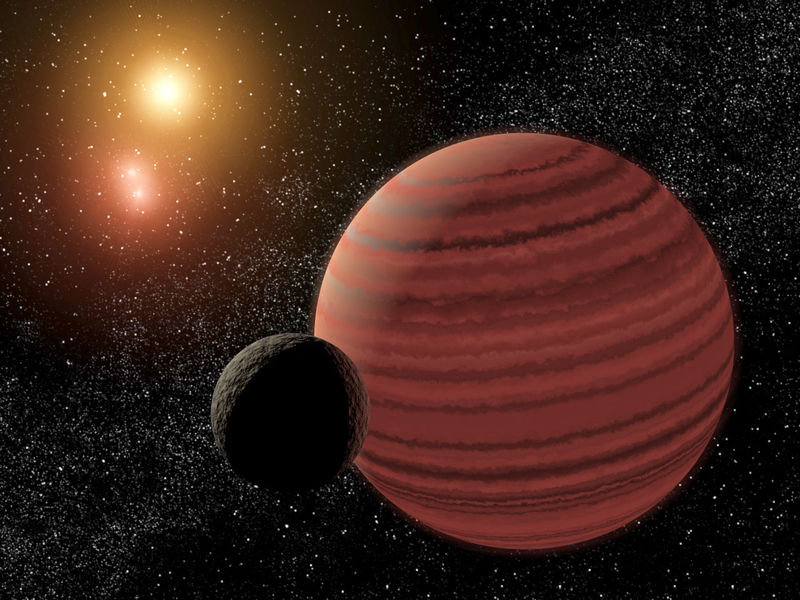
The main star of the system has a mass and diameter of 77% of the Sun’s. Around it, at a distance of 190 AU, there’s a pair of red dwarfs with masses of 55% and 35% of the Sun’s. They orbit around a common center of mass in 302 Earth days. And around all three of these stars, at a distance of 1,500 AU, there’s a brown dwarf with a mass 50 times greater than Jupiter’s.
Another interesting star is Methuselah, or officially HD 140283. It is a subgiant with a mass of 80% of the Sun’s and a radius twice that of our star. It is located 190 light-years away from us.
What makes it interesting is its very low content of heavy elements, which, together with its high speed and mass and radius values, indicate that it is very old. It is actually named Methuselah because it is considered the oldest known star in existence. It was born 13.46±0.8 billion years ago, and its life has been long and turbulent. The dwarf galaxy of which it was originally a part was captured by the Milky Way about 12 billion years ago, and it has been part of it ever since. Methuselah has completed its existence on the main sequence and is gradually leaving it. However, it is still a long way from burning helium and turning into a red giant.
Deep space objects
The constellation Libra does not contain many bright deep-sky objects. In particular, it does not contain a single galaxy from the Messier catalog. However, there is still plenty to see there.
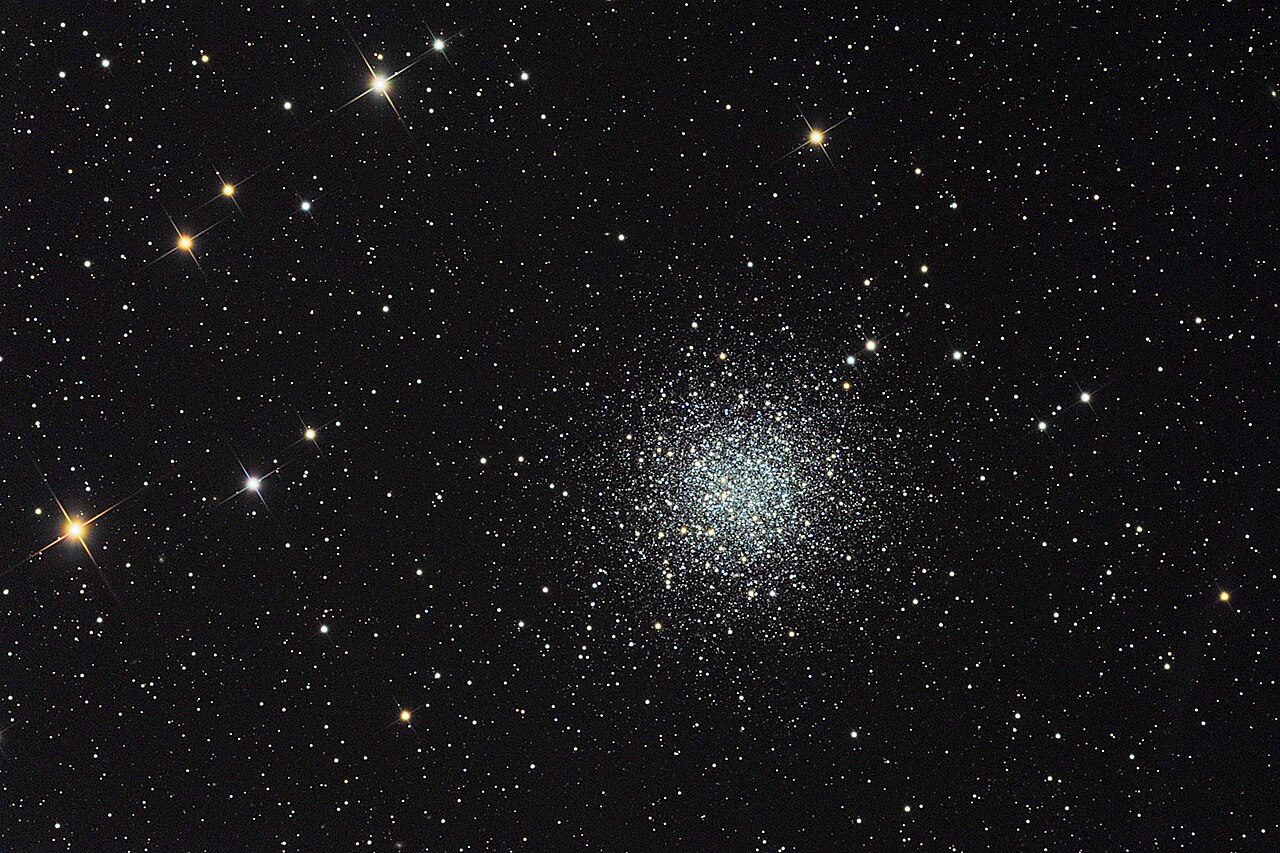
First of all, there is the globular cluster NGC 5897. Located at a distance of 40,800 light-years from us, it has an apparent magnitude of 8.52 and an angular size of 12.6 minutes. This means that it can be seen even with a small telescope.
There are also several barred spiral galaxies in Libra: NGC 5885, NGC 5792, and NGC 5728. These spiral systems are similar to the Milky Way, which we cannot see from the side.
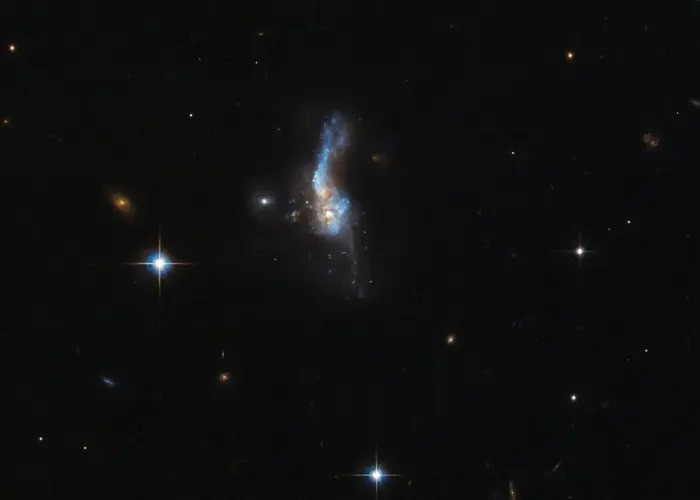
Also in Libra is IRAS 14348-1447. This is a pair of galaxies located 1 billion light-years away from us. These star systems are in the process of merging and both have beautiful long tails consisting of stars.

