

If you are interested in astronomy, you have likely dedicated the entire month of May to observing Venus and Jupiter as they gradually converge in the evening sky. The observing conditions for the first planet are improving, whereas the observational season for the second is concluding. It is in June that these planets will appear in close proximity within the constellation Gemini, reaching their nearest approach of the entire year 2026. Among the numerous celestial events of the summer of 2026, the conjunction of Venus and Jupiter will undoubtedly be one of the most spectacular.
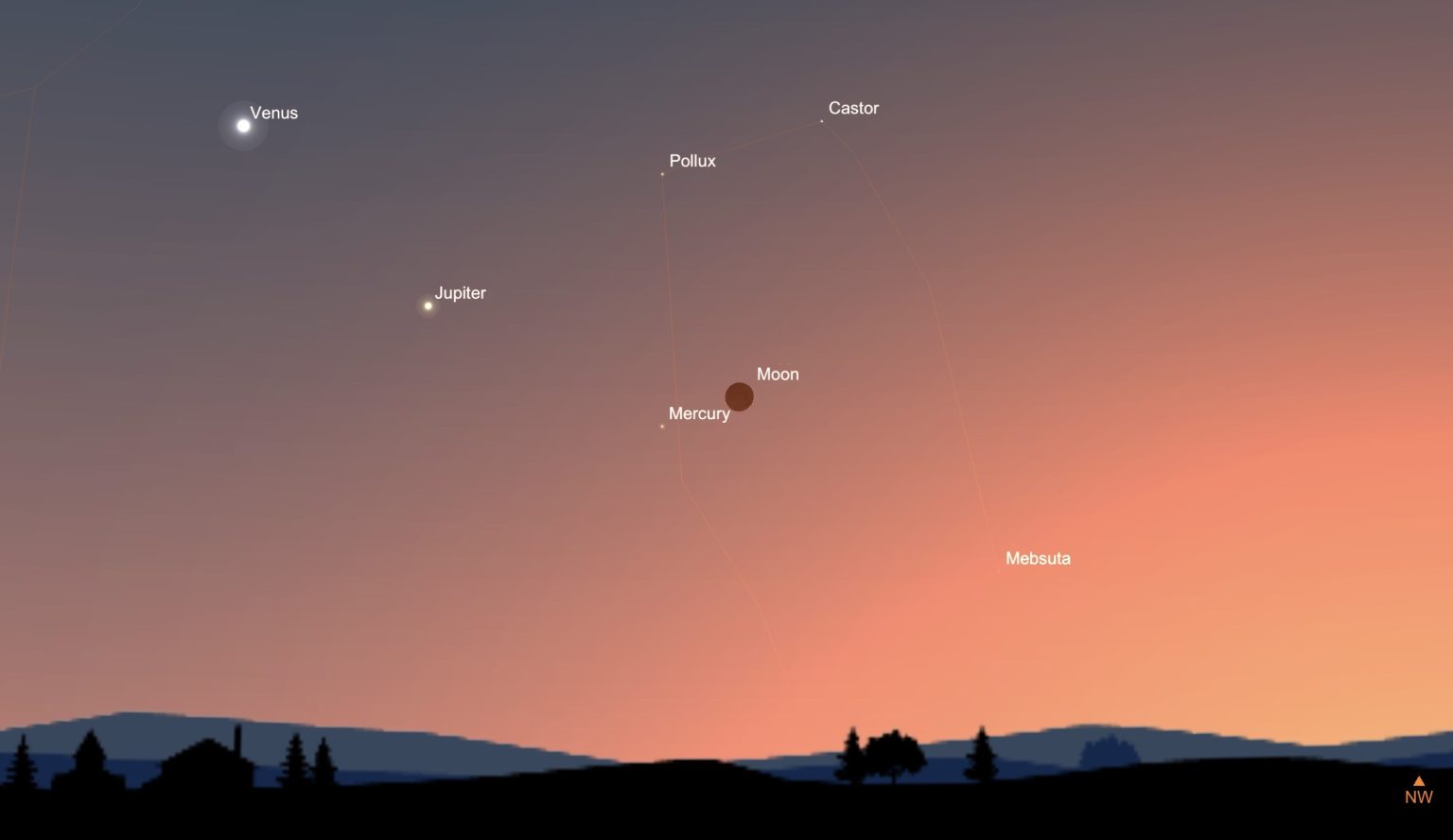
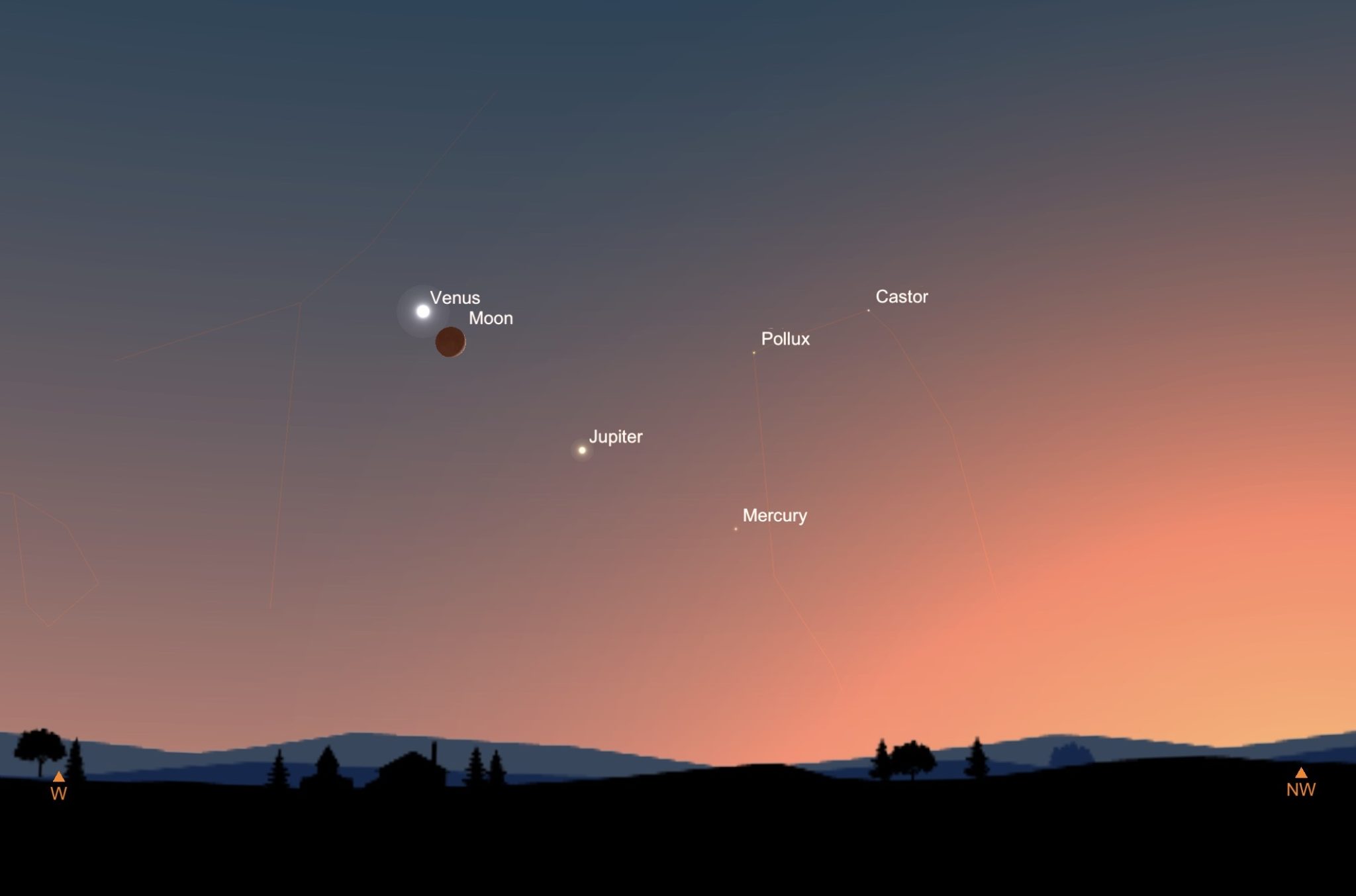
Mid-June will afford us the opportunity to observe another planet in the evening hours — Mercury — which will approach quite closely to Venus and Jupiter, providing a unique “mini-parade.” Nevertheless, it will be necessary to secure an observation location with an unobstructed view toward the northwest in advance. June 16 will be of particular interest to amateur astronomers, as Mercury will attain its greatest eastern elongation, accompanied by a slender crescent Moon in close proximity.
What will captivate the observer’s eye during the second half of the night? Although June nights are the shortest, and stargazing is hindered by persistent efforts against mosquitoes and other insects, this period offers an exceptional opportunity to observe the densest region of the Milky Way’s faint band. For optimal viewing conditions, an unobstructed view of the southern sky is essential. Near the direction of the Galactic center, numerous star clusters and nebulae can be observed. Additionally, it is important to note that in the weeks surrounding the summer solstice (June 21), true darkness does not occur in northern Ukraine, as the Sun remains above 18° below the horizon. Observations may be more comfortable in the southern regions of the country.
At the beginning of the month, shortly before dawn, one may attempt to observe Saturn. Toward the end of June, Neptune may also be visible. Regarding Mars, it is likely necessary to await a more suitable time. Nevertheless, this presents an engaging challenge — endeavor to observe the Red Planet at the earliest opportunity.
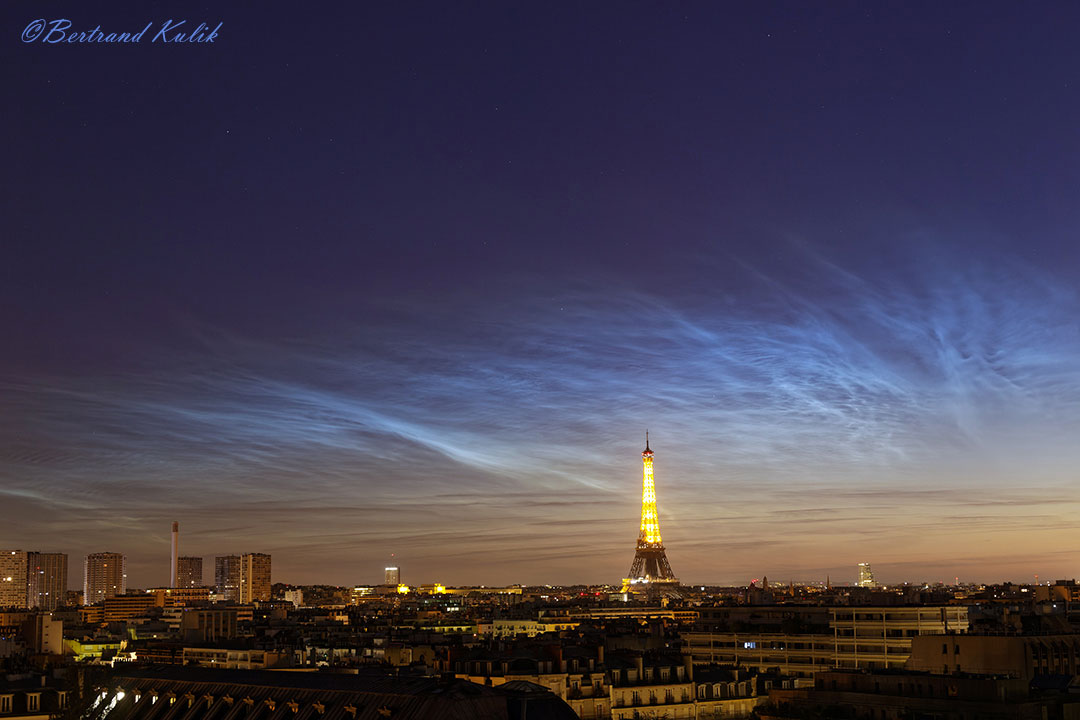
The commencement of the noctilucent clouds season occurs in early June, typically extending until the conclusion of August. These phenomena are observable only when both the observer and the lower atmospheric layers are concealed within Earth’s shadow. The high-altitude, slender clouds — composed of minuscule ice crystals approximately 80 kilometers above the Earth’s surface — reflect sunlight, thereby producing the visual impression of luminous silk ripples across the sky. Optimal observation latitudes range from 50° to 70°, a zone that Ukraine partially encompasses. When selecting an appropriate observation time, it is essential to consider the Sun’s altitude, which should be between 6° and 16° below the horizon.
General astronomical circumstances
June 7 — maximum of the Arietids meteor shower. The shower lasts from May 14 to June 24, and at its peak, the ZHR reaches, according to various sources, from 30 to 60. But the radiant, located in the Aries, rises just two hours before sunrise. Therefore, it is usually possible to see no more than 1 – 3 meteors per hour shortly before dawn.
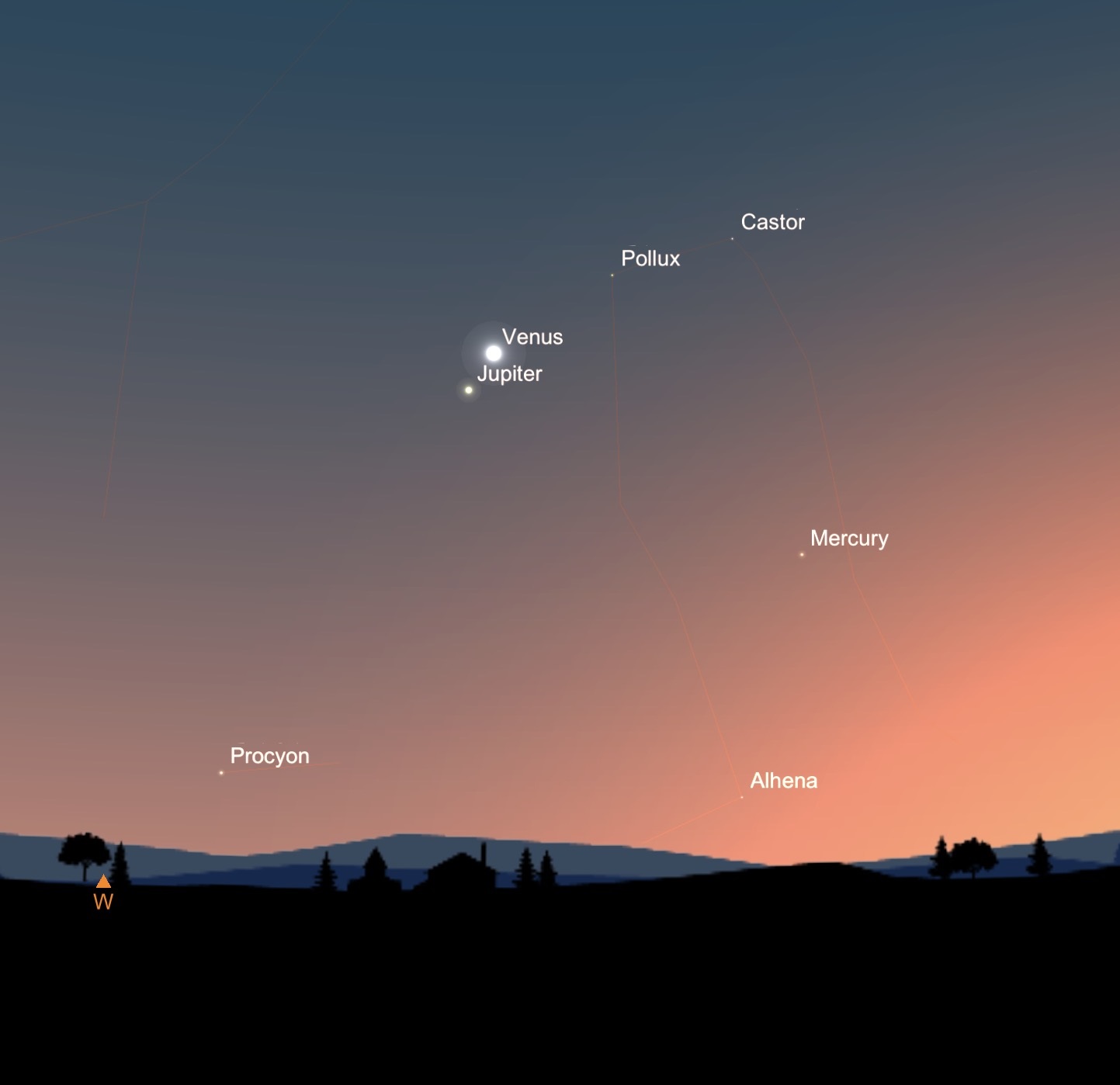
June 9 — Venus (-4.0m) and Jupiter (-1.9m) will be in conjunction, separated by merely one and a half degrees.
June 13 — before dawn, the Moon (6%) is situated near Mars (+1.3m) and the Pleiades. Both celestial entities are approximately 6° distant from the Moon.
June 15 — new moon, with the precise timing at 5:54 a.m. Kyiv time (2:54 a.m. UTC).
June 15 —Mercury (+0.4m) will reach its greatest eastern elongation and can be observed in the western sky shortly after sunset. Its maximum angular distance from the Sun will be 24.5°. Please be advised that the planet will be positioned quite low above the horizon, necessitating a clear view of the western and northwestern skies for optimal observation.
June 17–18 — a “mini-parade”: at dusk, Mercury (+0.6m), Jupiter (-1.8m), the Moon (10–18%), and Venus (-4.0m) will be observable in a closely grouped assemblage in the western sky.
June 21 — the summer solstice, which will occur at 11:25 a.m. (08:25 UTC).
June 22 — the peak of the June Boötids meteor shower is anticipated. This meteor shower is generated by the short-period comet 7P/Pons–Winnecke, which approaches the Sun approximately every 6.2 years. Nonetheless, the shower remains highly unpredictable. Typically, it yields no more than a few slow-moving meteors per hour, traveling at approximately 14 km/s. However, in certain years, a notable increase in activity has been documented.
June 25 —the conjunction of Mercury (+1.5m) and Jupiter (-1.8m); at 2:00 p.m., the separation between the two planets will be 3.8°, and observers may attempt to observe them shortly after sunset. However, it is important to note that both planets will be situated very low on the horizon.
June 30 — a full moon; the precise time is 2:56 a.m. Kyiv time (June 29, 11:56 p.m. UTC).
A detailed overview of the most interesting circumstances
June 9: The “kiss” of Venus and Jupiter
Since all the planets in the Solar System orbit within approximately the same plane, they occasionally seem proximal in the sky when observed from Earth. The close encounters of the luminous planets are especially remarkable. In this context, Venus and Jupiter are undeniably the most prominent.
The previous occurrence of these planets in close conjunction took place on August 12, 2025, with a separation of 0.9°. During the upcoming conjunction on June 9, this summer, the minimum distance between the planets will be marginally greater, at 1.6°, occurring at 10:48 p.m. Kyiv time (7:48 p.m. UTC). For residents of Ukraine, the planets will already be positioned too low above the horizon at that time, and in the eastern region of the country, they will have already set. Consequently, it is advised to commence observation approximately 20–30 minutes subsequent to sunset.
Please ensure you reserve an observation spot with an unobstructed view of the sunset in advance. Against the backdrop of the gradient colors in the western sky, the conjunction of the two planets will appear remarkably stunning. To maximize the experience, it is advisable to observe the planets through a telescope or binoculars. Both celestial bodies will be visible within the field of view of a small optical instrument. With a mid-range or high-end amateur telescope, observers will be able to discern Venus’s phase at 77% and conduct a closer examination of Jupiter’s largest moons. On the evening of June 9, all these phenomena will occur in close proximity to the planet concurrently. Furthermore, residents of western Ukraine and Europe will have the opportunity to witness Callisto’s transit across Jupiter’s disk, which is scheduled to last from 8:22 to 10:30 p.m. UTC.
The most skilled observers, or those possessing autoguided telescopes, may attempt to identify Venus and Jupiter in the daytime sky during the day of the conjunction. This opportunity offers a clearer view of Venus’s phase, as it is already approaching excessive brightness in the evening sky.
June 15: New Moon and brief nights suitable for observing faint objects
So, the shortest nights of the year occur in June. That is why this month is not considered the best time for observing deep-sky objects. In particular, in the northern regions of Ukraine, the Sun does not dip low enough below the horizon — astronomical twilight persists and never gives way to a truly dark night.
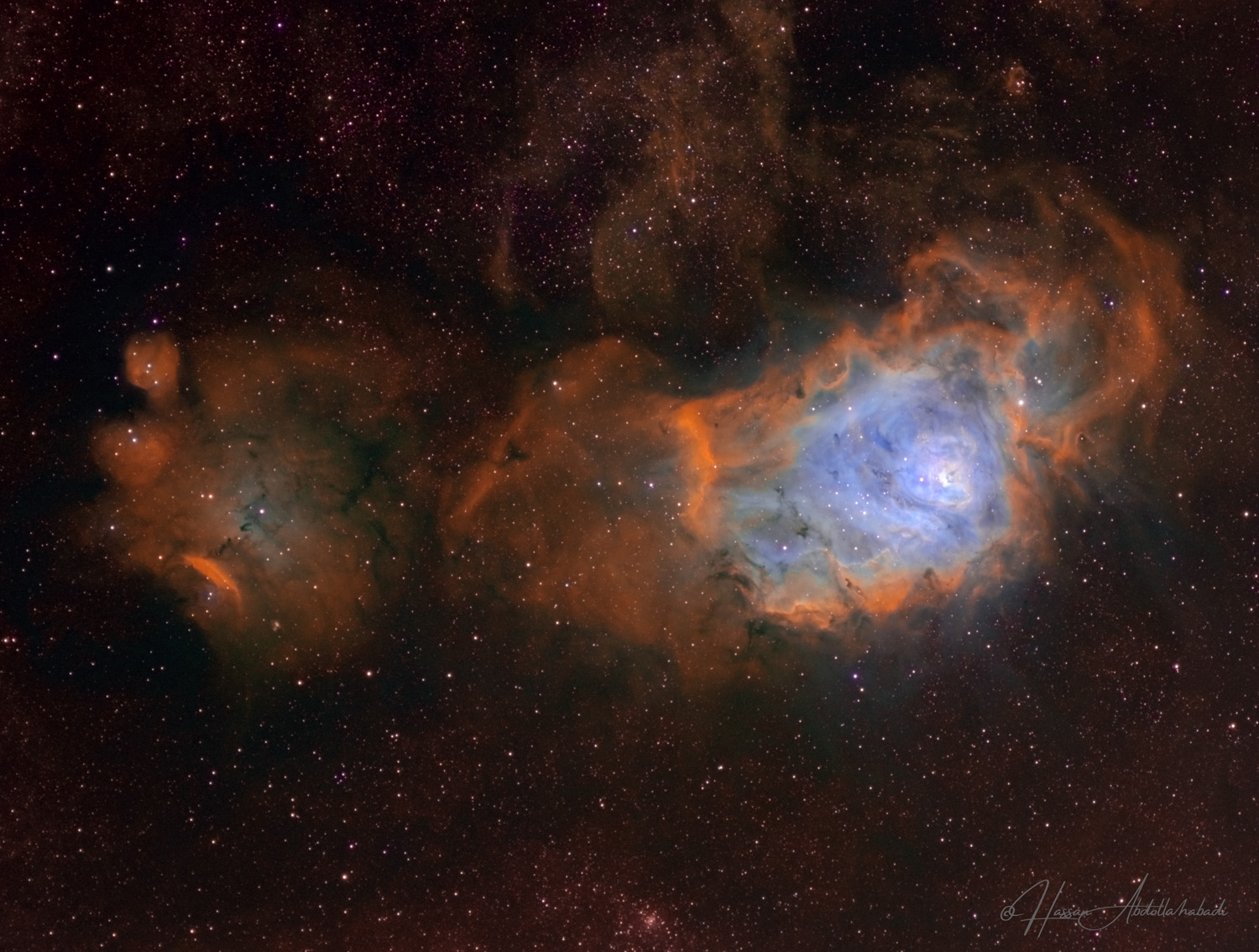
However, the summer sky is abundant with remarkable deep-space objects, many of which are accessible to novice astronomers. Among these is the globular star cluster M13 (Hercules Cluster)—noted for being one of the most readily identifiable and observable; it disintegrates into individual stars even with relatively modest equipment. Nearby is another cluster — M92 — which is also notably luminous. Around midnight, one can transition to a veritable “treasure trove”: in proximity to the Milky Way and within its core, there exists an array of clusters deserving of attention. These include M5, M12, M10, M14, M107, M9, as well as the open clusters M11, M26, M23, M25, M21. Moreover, the most distinguished objects, especially appealing to astrophotographers, comprise the Small Sagittarius Star Cloud, the Trifid Nebula (M20), the Eagle Nebula (M16), the Omega Nebula (M17), and the Lagoon Nebula (M8).
June 17–18: “Mini Planet Parade”
Over the subsequent two days, monitor the western sky. The evening firmament will be decorated with four “beads”: Mercury, Jupiter, Venus, and the Moon. Among these, Mercury will, of course, be the most challenging to observe. It will be situated at the lowest point above the horizon and will present the faintest appearance.
Certainly, their apparent proximity is merely an illusion. For instance, Mercury will be situated 118.5 million kilometers away from us, while Jupiter, which continues to recede from Earth, will already be 918 million kilometers distant.
On June 17, the Moon will align with Venus, followed by an occultation occurring a few hours later. Regrettably, observation will be impossible, as the occultation path does not traverse Ukraine, and Venus and the Moon will have already dipped below the horizon prior to the event.
Regarding the visual spectacle, June 17 is expected to offer a more remarkable experience than June 18. However, it is advisable to consider weather conditions when planning your observations. Optimal viewing conditions are likely to be achieved on a clear evening with the western horizon unobstructed.
June 21: Summer Solstice
Most often, when individuals discuss the summer solstice, they refer to it as “the day of the summer solstice,” but in actuality, it is not a singular day but a precise moment. Astronomers can determine this moment with considerable accuracy. It varies slightly each year because a year does not comprise an exact number of days. In 2026, the summer solstice will occur on June 21 at 11:25 a.m.
During the summer solstice, the Earth’s axis is inclined to its maximum extent towards the Sun at the North Pole. On this date, the duration of daylight in our hemisphere is at its peak, while the hours of darkness are at their minimum annually. For instance, in Kyiv, the disparity is nearly exactly twofold. As it progresses along the ecliptic, the Sun attains its most northerly position, resulting in its highest elevation and most effective warming. The summer solstice signifies the commencement of astronomical summer in the Northern Hemisphere, which persists until the autumnal equinox.
In the Southern Hemisphere, the opposite is true: on this same day, it receives the least amount of sunlight. The solstice here marks the beginning of astronomical winter, and for Antarctica, the middle of the polar night.
Although the nights surrounding the solstice are brief, one can still appreciate them by venturing out of town with friends or family and a telescope. A tour of the summer Milky Way will render your experience truly memorable.

