

A team of scientists has identified areas on Jupiter’s largest moon, Io, that appear to be evidence of cryovolcanic activity. It is quite possible that the JUICE spacecraft will discover something interesting there when it approaches the planet.
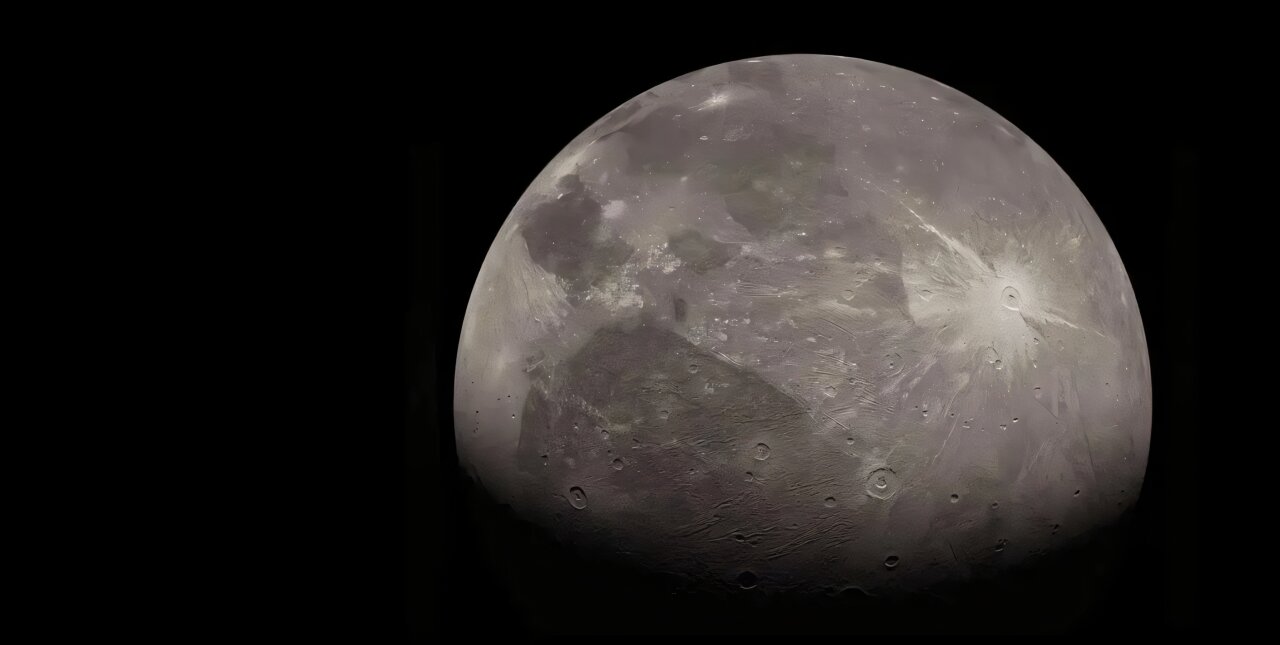
Cryovolcanism on Ganymede
Ganymede, Jupiter’s largest moon, is also the largest moon in the Solar System, even larger than the planet Mercury. Furthermore, it is the only celestial body other than Earth (and the gas giants) that has its own magnetic field. And just as if that wasn’t enough to make this icy body fascinating, scientists also believe that beneath its surface lies a vast ocean containing more water than all of Earth’s oceans combined.
Like volcanoes on Earth, cryovolcanoes are the result of material being forced up from the interior of a celestial body to the surface. But in the case of “ocean worlds” such as Ganymede—so named because of the presence of internal oceans—this material consists of water and volatile substances that are forced up through the surface ice. In addition, this activity is caused by geological activity deep underground, which results from tidal forces generated by the interaction of the moons with the gas giants they orbit.
Possible traces of biosignatures
These regions are key targets for future observations by missions such as JUICE and NASA’s Europa Clipper spacecraft. By studying water from deep underground, scientists hope to find evidence of organic processes occurring beneath the surface, which could indicate the presence of life (or “biosignatures”).
Ever since the Voyager probes flew through the Jupiter system, scientists have speculated that some of its largest moons—Europa, Ganymede, and Callisto—have oceans capable of supporting life. In an HSC press release, Dr. Solomonidou noted: “Ganymede is one of the most fascinating worlds in the solar system. Understanding possible cryovolcanic activity can help us better understand how ocean worlds evolve and whether they may host conditions suitable for life.”
To identify promising cryovolcanoes, the team used reprocessed data from the Near-Infrared Mapping Spectrometer (NIMS) on NASA’s Galileo mission, which studied the Jovian system from 1995 to 2003. This data allowed scientists to investigate unusual depressions and surface features that may be linked to cryovolcanism. Among the top candidates for study were four patterns—depressions that were likely cryovolcanic vents depositing material onto the surface.
Spectrometers reveal the mysteries of cryovolcanism
The study also emphasizes that observations using the MAJIS camera-spectrometer and the JANUS instrument will help determine whether these features are the result of cryovolcanic activity. If this turns out to be true, these areas may contain traces of organic molecules and other biosignatures originating from deep within the planet that have been preserved in the surface ice.
In addition to Ganymede, the JUICE spacecraft will explore Callisto and Europa and characterize them using a sophisticated suite of scientific instruments. It is expected that these studies, combined with data from the Europa Clipper spacecraft, will help shed light on similar systems throughout the galaxy.
According to phys.org

