

The European Space Agency has published a new image of the interstellar comet 3I/ATLAS. It was obtained by the JUICE spacecraft heading towards Jupiter.
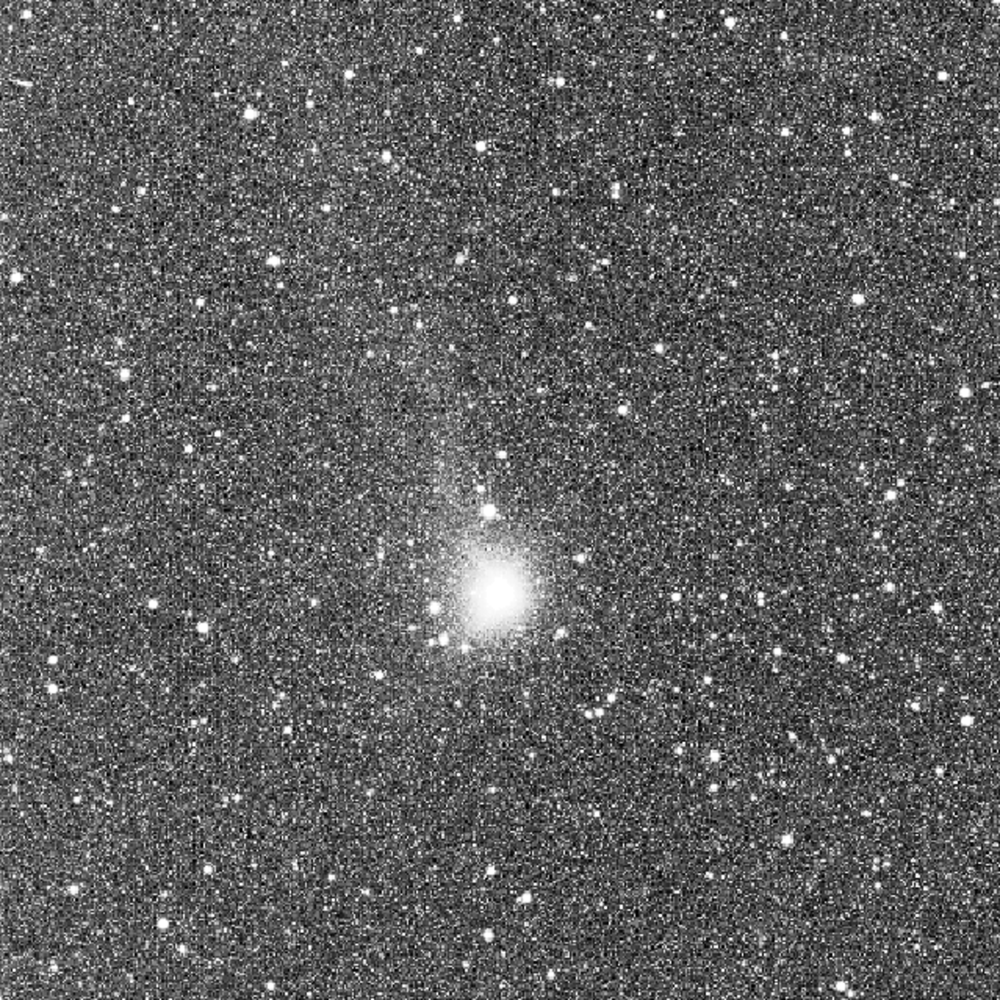
The observations were made in November 2025. Although JUICE was farther from the comet than the Martian spacecraft were in early October, at that point it had just passed the perihelion of its orbit and was in a more active state. Scientists expected to see clearer signs of this activity in the data obtained by JUICE’s five scientific instruments. This included images from the high-resolution JANUS optical camera, spectrometric data from the MAJIS and UVS spectrographs, composition data from the SWI instrument, and particle data from the PEP instrument.
In addition, JUICE photographed the comet using its onboard navigation camera (NavCam). It was not designed as a high-resolution scientific camera, but to assist the spacecraft in navigating the Jupiter system and its icy moons.
Due to technical characteristics and the mission profile, JUICE will only send the data it has collected to Earth in February 2026. However, the scientific team did not want to wait so long and decided to get a “teaser”: a quarter of one NavCam image to see what awaits them.
The results surprised the researchers. Although NavCam is not designed to photograph objects in deep space, it managed to capture a clear image of the comet. What’s more, the photo even shows signs of its activity.
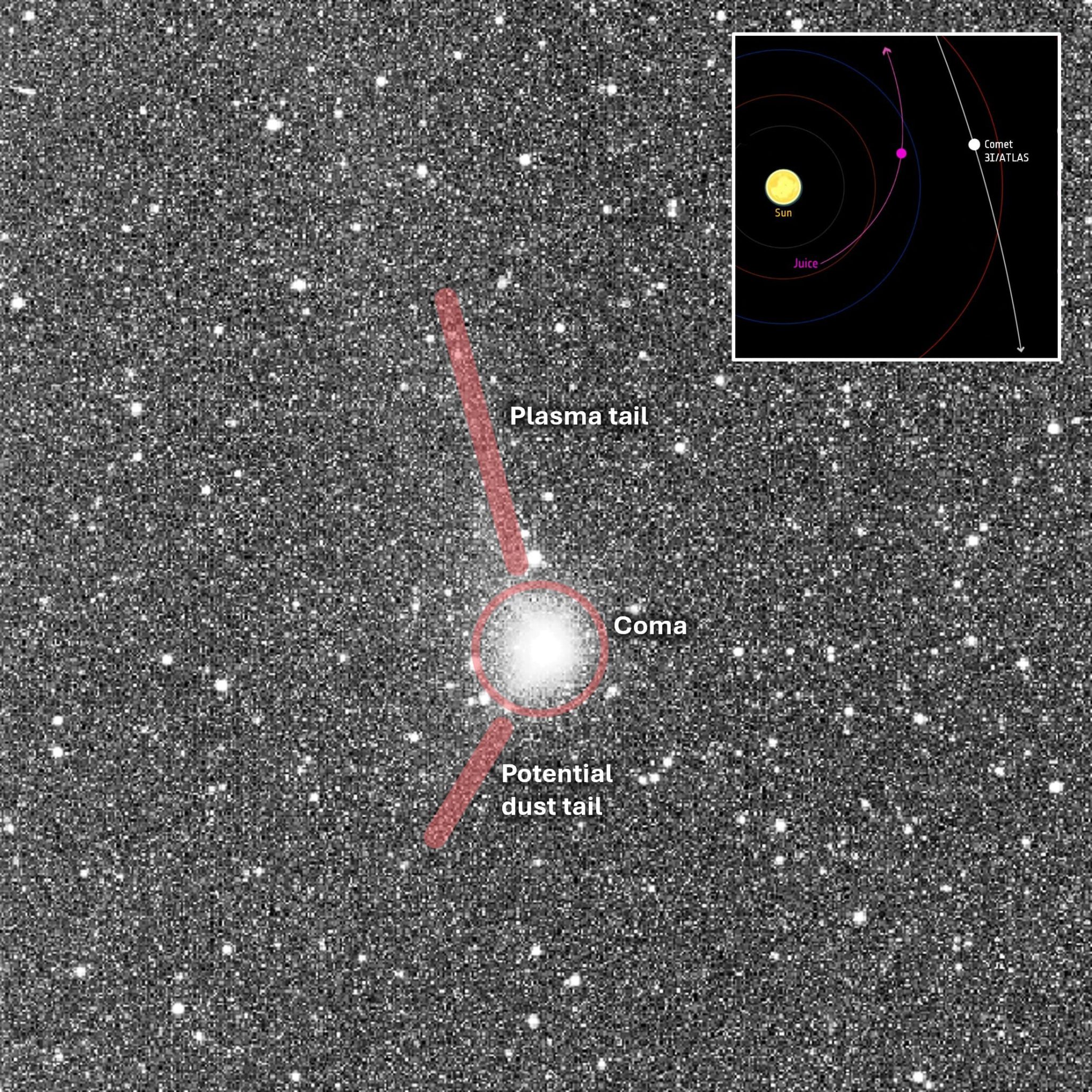
The image clearly shows not only the coma (the glowing cloud of gas surrounding the comet’s nucleus) but also hints of two tails. The comet’s “plasma tail,” consisting of electrically charged gas, stretches toward the top of the frame. We can also see a fainter “dust tail,” consisting of tiny solid particles, extending in the lower left part of the frame.
The image was taken on November 2, 2025, during JUICE’s first observation session of 3I/ATLAS. This was two days before the spacecraft’s closest approach to the comet, which occurred on November 4 at a distance of about 66 million km from the interstellar traveler.
Earlier, we reported on how NASA’s recently launched mission observed a comet discovered by a Ukrainian astronomer.
According to ESA

