

The interstellar comet 3I/ATLAS has passed the perihelion of its orbit, reaching its closest point to the Sun. It will now begin to leave the Solar System.
3I/ATLAS’ journey through the Solar System
Comet 3I/ATLAS was discovered in early July. It became the third confirmed object of interstellar origin found in our Solar System. The comet arrived in the Solar System from the constellation Sagittarius, where the center of our galaxy is located. It is believed to have formed in one of the star systems in the thick disk of the Milky Way. This means that it is several billion years older than Earth.

On October 3, the comet approached Mars at a distance of 30 million km. It was photographed by the European TGO probe and the Perseverance rover.
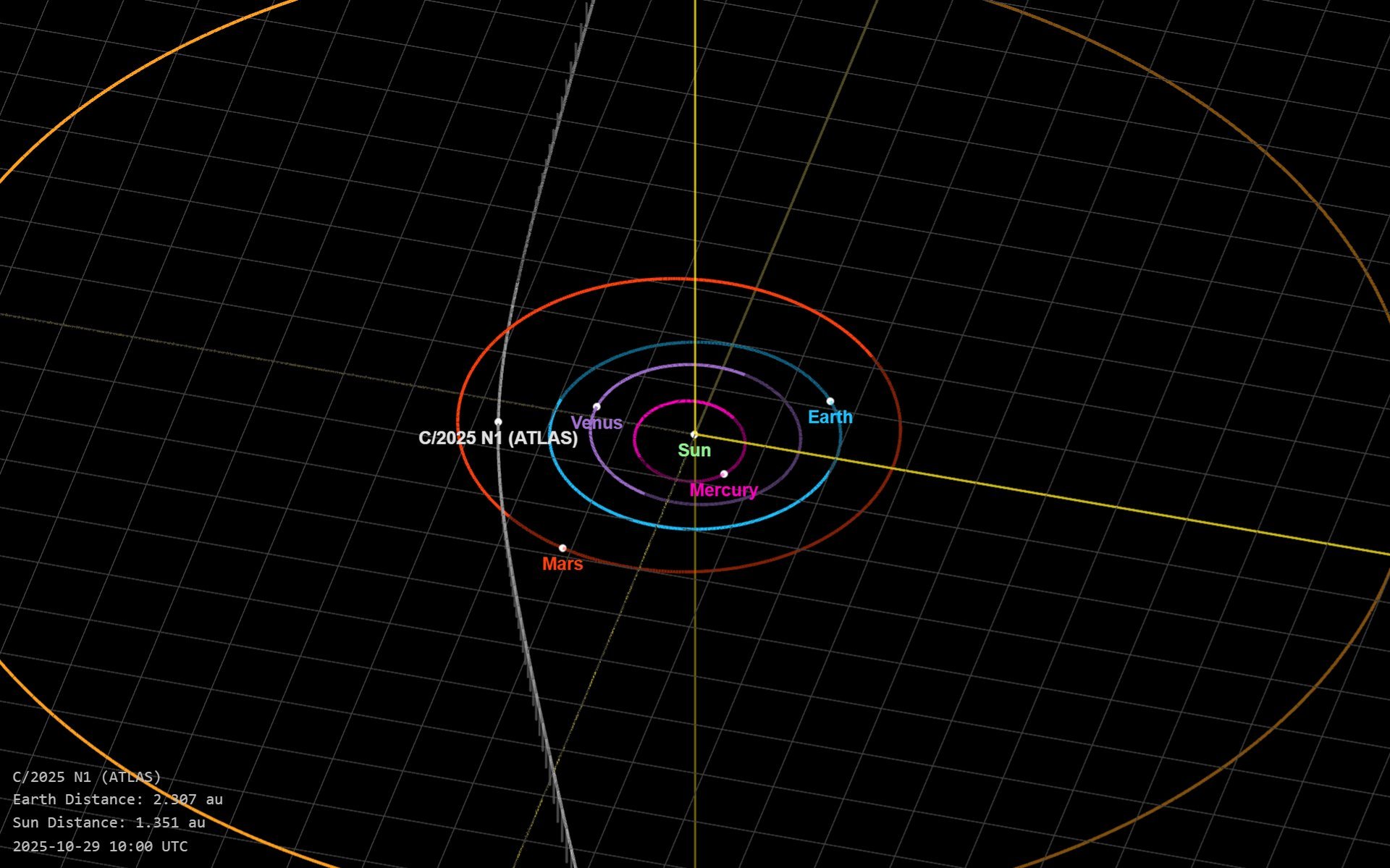
3I/ATLAS passed the perihelion of its orbit on October 29, moving 203 million km from the Sun. This is 35% more than the distance between the Sun and Earth. At this range, solar radiation is unlikely to have enough of an effect on it to cause the nucleus to break up. So it is almost certain that 3I/ATLAS will survive the close approach and continue its journey.
Not an alien spaceship
The visit of 3I/ATLAS has been accompanied by numerous speculations and, at times, outright fabrications regarding its nature. Social media is rife with AI-generated “images” of the comet, depicting it as an alien spaceship. It also claims that certain “maneuvers” performed by the comet and traces of nickel in its core are evidence that it is actually made of metal and is of artificial origin.
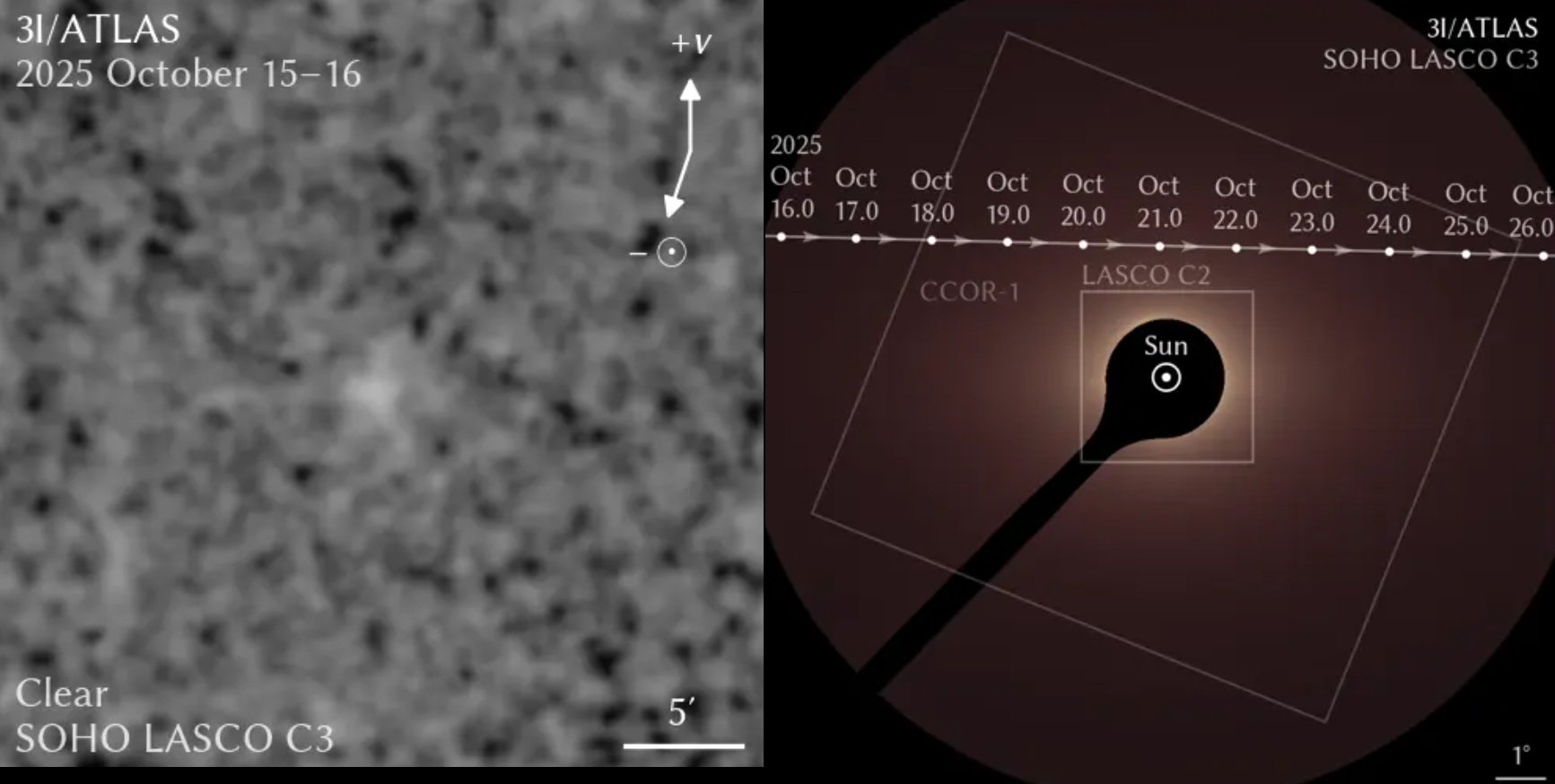
Unfortunately, all this is nothing more than wishful thinking, and in many cases, deliberate fabrications by individuals and online resources aimed at attracting attention and generating traffic. 3I/ATLAS exhibits behavior typical of comets in the Solar System. Despite the fact that the comet has approached the Sun, it has not disappeared completely — it can still be observed by spacecraft equipped with coronagraphs. 3I/ATLAS did not perform any inexplicable maneuvers, and nickel is commonly found in comets in the Solar System.
Future of 3I/ATLAS
In the coming days, the European JUICE mission will begin observing the interstellar comet. The American spacecraft Europe Clipper may pass through its ion tail and measure its characteristics.
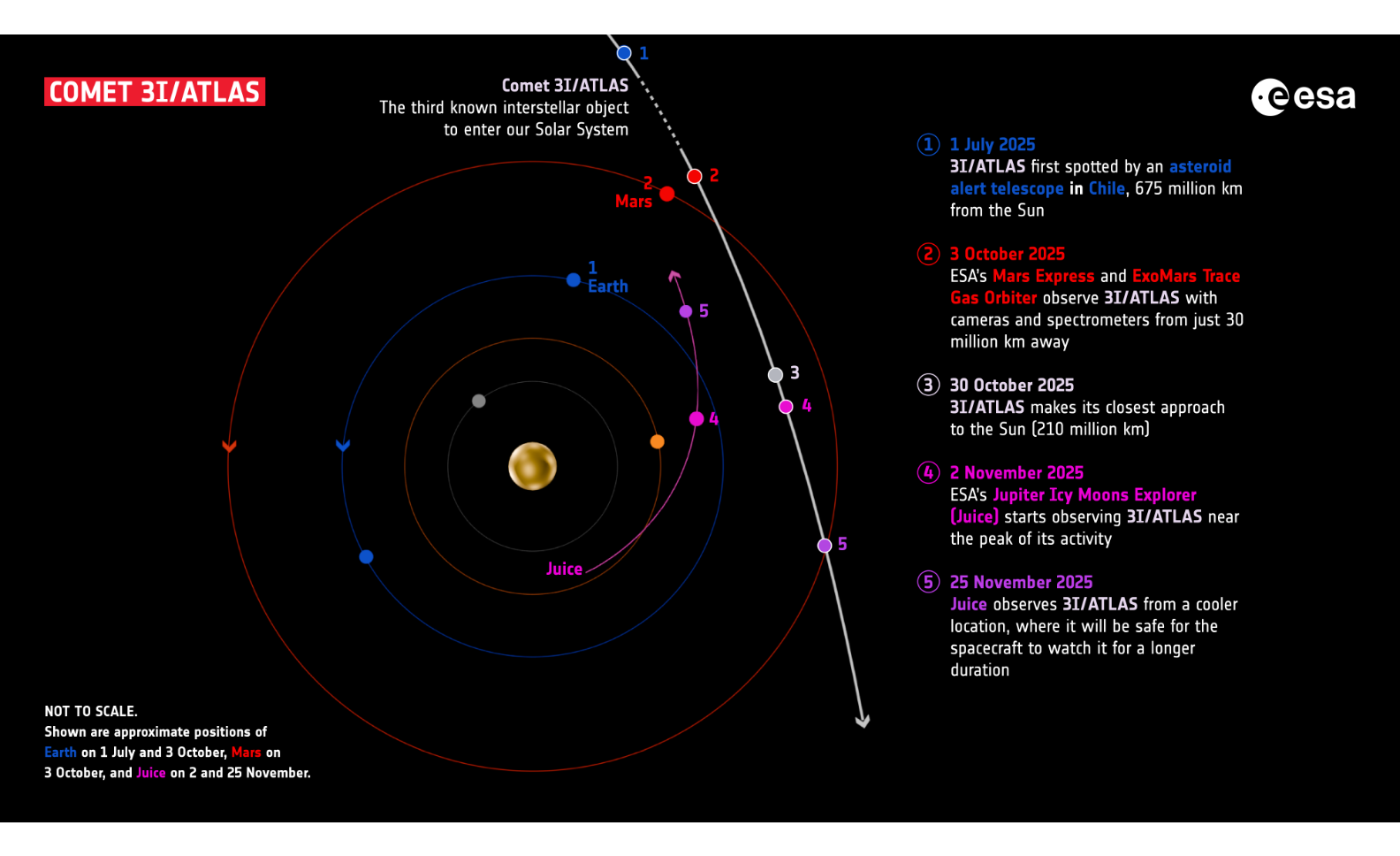
On November 3, the comet will fly past Venus at a distance of 97 million km. By the middle of the month, it will once again be visible to ground-based telescopes. In December, 3I/ATLAS will approach our planet at a minimum distance of 269 million km, which is almost twice the distance between Earth and the Sun.
In March 2026, 3I/ATLAS will fly past Jupiter at a distance of 53 million km. In theory, the Juno spacecraft, which is exploring the gas giant, could participate in its observations — provided that it is still in operation at that point. After that, 3I/ATLAS will head into deep space and never return to the Solar System.

