

The European Space Agency has published images of interstellar comet 3I/ATLAS taken from Mars orbit. They were obtained by the TGO spacecraft.

On October 3, interstellar comet 3I/ATLAS flew past Mars at a distance of 30 million km. Space agencies took advantage of this opportunity by pointing their spacecraft cameras at the guest from another star system. On the part of ESA, the TGO and Mars Express missions in Martian orbit took part in the observations.
Taking photos of the comet was a very difficult task. The TGO and Mars Express cameras are designed to photograph the bright surface of Mars, located just a few hundred or thousand kilometers away. Scientists were uncertain what to expect from observations of an object that was orders of magnitude fainter and located at such a great distance.
TGO managed to accomplish this task. Its photos show a slightly blurred white dot moving near the center of the image. This point is the center of the comet, consisting of its nucleus and the coma surrounding it. TGO was unable to distinguish the nucleus from the coma because 3I/ATLAS was too far away. Taking a photo of a nucleus with a diameter of one kilometer would be equivalent to seeing a cell phone on the Moon from Earth.
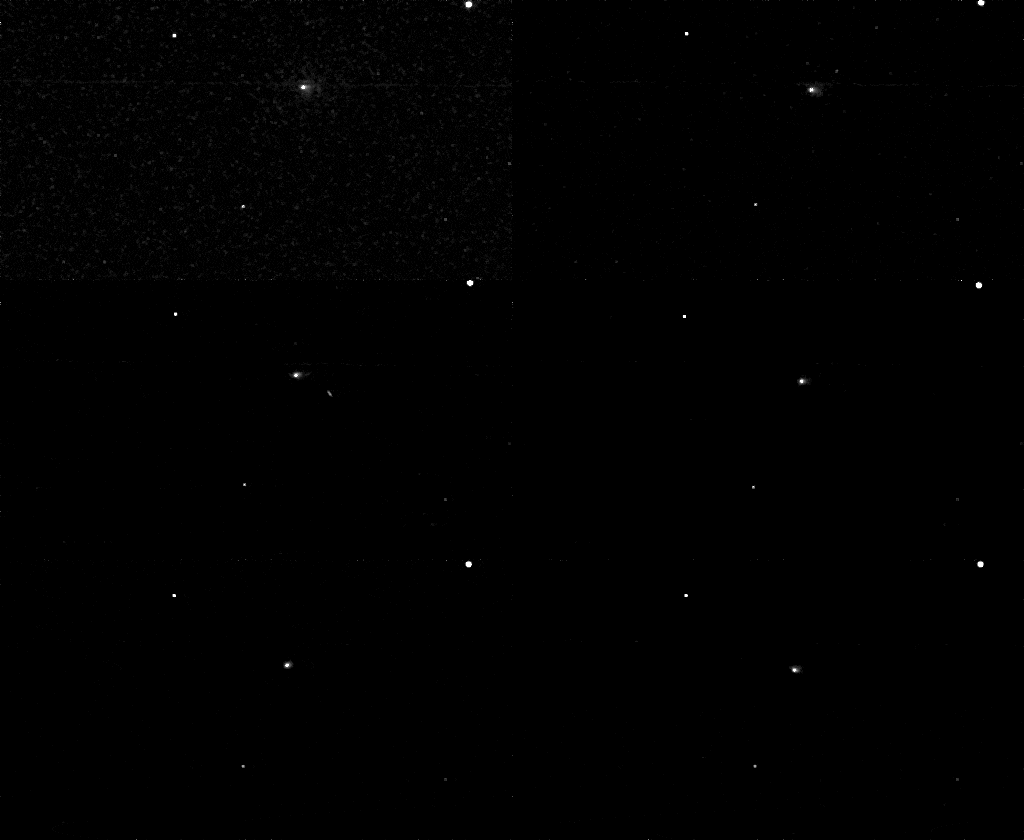
But the coma, which is several thousand kilometers in diameter, is clearly visible. It forms as 3I/ATLAS approaches the Sun. Its radiation heats the core, causing it to release dust and gas. TGO was unable to measure the full size of the coma because the brightness of the dust decreases rapidly with distance from the nucleus. This means that it gets lost in the noise in the image.
Material from the coma is carried away in a long tail that can reach millions of kilometers in length. The tail is much dimmer than the coma, hence TGO was unable to capture it. As for Mars Express, it failed to photograph the comet at all. That is partially because its camera has a maximum exposure time of only 0.5 seconds, while the TGO camera has a maximum exposure time of 5 seconds.
Scientists are going to keep analyzing data from both spacecraft, including combining several images from Mars Express to see if they can spot the comet. They also attempted to measure the spectrum of 3I/ATLAS. However, it is currently unclear whether the coma and tail are bright enough for their spectral characteristics to be determined.
NASA spacecraft also participated in the observations of the comet. However, due to the US government shutdown, we don’t have any official footage yet, only images from the Perseverance rover processed by amateur astronomers, compiled from publicly available “raw” images.
According to ESA

